If you have spent any time near software development in the last decade, you have heard someone recommend Python. Python shows up in job listings for data scientists, backend engineers, automation specialists, and even security researchers.
This is not an accident. The features of the Python programming language line up almost perfectly with what modern software teams actually need: fast development, a huge ecosystem, and code that other people can actually read. If you’re interested in following Python’s evolution, releases, and ecosystem updates, check out our Python Tracker for the latest insights.
This article breaks down the features of Python one by one, explains why each feature of Python matters in practice, and shows where Python is used in the real world. We will also cover what is new in recent Python versions, how Python stacks up against Java, C++, and JavaScript, and where Python is not the right tool for the job.
Python is a high-level, general-purpose programming language created by Guido van Rossum and first released in 1991. Guido van Rossum designed Python around a simple idea: Python code should be easy to write and easy to read, even by someone who did not originally write it. As you explore these features, you can also visit our Python Tracker to stay updated on new Python releases, libraries, frameworks, and industry trends.
What are the Features of Python Programming Language?
Python has a lot of features. The syntax of Python is simple and easy to read. Python also has typing and it manages memory for you. When you run Python code it is interpreted. Python supports object-oriented and multiparadigm programming. You can run Python on different platforms.
Python has a library with a lot of useful things in it. There are also packages made by other people that you can use with Python. All these features of Python make it fast to write code, easy to keep your code working and flexible enough to use for things like web apps, data science, automation and Artificial Intelligence.
Python is really good, for web apps, data science, automation and Artificial Intelligence.
Top 15 Features of Python Programming Language
1. Simple and Readable Syntax
What it means: Python code reads close to plain English. There are no curly braces or semicolons forcing a particular visual structure, indentation itself defines code blocks.
Why it matters: New team members can read existing code faster, and code reviews go quicker because there’s less syntactic noise to parse mentally.
Example:
if age >= 18:
print(“You can vote”)
Real-world use case: Companies onboarding junior developers often pick Python for internal tools specifically because new hires get productive in days rather than weeks.
2. Easy to Learn
What it means: Python is a language to learn. You do not need to know about pointers or manual memory allocation or complicated types to write your Python program. Python has a set of core concepts that you need to understand to get started with Python.
Why it matters: When people learn something it is nice if it is easy to understand. This is called a learning curve. If something has a learning curve you can start doing things with it faster. That is why Python is the thing people learn in many computer science classes. For example Python is what they teach at MIT and Harvard when they introduce students to programming. Python is a language to start with because it is easy to learn and you can start making things with it quickly.
Example: A “Hello, World” program is one line: print(“Hello, World”). Compare that to the multiple lines of boilerplate needed in Java or C.
Real-world use case: Universities and coding bootcamps use Python as the first language for exactly this reason, students spend their time learning to think like programmers instead of fighting syntax.
3. Interpreted Language
What it means: Python code runs line by line through an interpreter rather than being compiled into machine code ahead of time.
Why it matters: You can test a change immediately without a separate compilation step. That shortens the feedback loop during development and makes debugging faster.
Example: Open a Python REPL, type 2 + 2, hit enter, and you get 4 instantly. No project setup required.
Real-world use case: Data analysts use Jupyter Notebooks to run one cell of code at a time, checking outputs as they go, instead of running an entire compiled program to see one result.
4. High-Level Programming Language
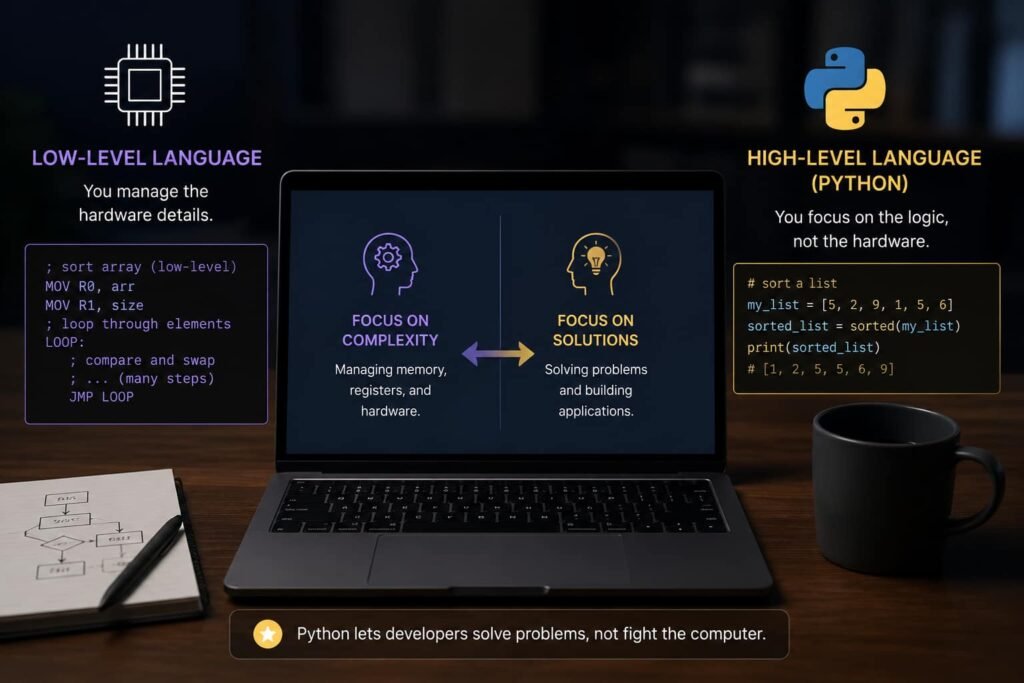
What it means: Python abstracts away hardware-level details like memory addresses and register management. You write logic, not machine instructions.
Why it matters: Developers focus on solving the actual problem instead of managing low-level resources.
Example: Sorting a list takes one call: sorted(my_list). In a lower-level language, you’d write the sorting algorithm yourself or rely on a library with more setup.
Real-world use case: This is a big reason Python dominates in data science, where analysts want to manipulate data, not manage memory.
5. Object-Oriented Programming Support
What it means: Python supports classes, objects, inheritance, and encapsulation, letting you model real-world entities in code.
Why it matters: Object-oriented design helps teams structure large codebases into reusable, testable components.
Example:
class Car:
def __init__(self, brand):
self.brand = brand
def drive(self):
return f”{self.brand} is driving”
Real-world use case: Large frameworks like Django rely heavily on classes for models, views, and forms, which keeps enterprise-scale web applications organized.
6. Dynamic Typing
What it means: You don’t declare a variable’s type up front. Python figures it out at runtime based on the value assigned.
Why it matters: Less boilerplate code and faster prototyping, though it does mean type-related bugs can surface later than in statically typed languages.
Example:
x = 5
x = “now a string”
Real-world use case: Rapid prototyping in research settings, where scientists need to iterate on ideas quickly without rewriting type declarations every time the data shape changes.
7. Cross-Platform Compatibility
What it means: Python code written on Windows generally runs the same way on macOS or Linux, since the interpreter handles the platform-specific parts.
Why it matters: Teams can develop on one operating system and deploy on another without rewriting code.
Example: A script using Python’s built-in os module for file operations will run correctly across all three major operating systems.
Real-world use case: DevOps teams write automation scripts once and run them across mixed server environments without maintaining separate versions.
8. Open-Source Language
What it means: Python’s source code is freely available, and anyone can contribute to its development under an open license managed by the Python Software Foundation.
Why it matters: No licensing fees, plus a global community constantly reviewing, patching, and improving the language.
Example: You can read or propose changes to the language itself through PEPs (Python Enhancement Proposals).
Real-world use case: Startups avoid licensing costs entirely by building their stack on Python and other open-source tools, which matters a lot when budgets are tight.
9. Large Standard Library
What it means: Python ships with built-in modules for tasks like file handling, networking, regular expressions, and data serialization, without needing to install anything extra.
Why it matters: Developers don’t need to reinvent common utilities. The phrase “batteries included” describes this well.
Example: Reading a JSON file takes two lines:
import json
data = json.load(open(“file.json”))
Real-world use case: Backend engineers use the standard library’s http.server module to spin up a quick test server without pulling in any third-party dependency.
10. Extensive Third-Party Package Ecosystem
What it means: Beyond the standard library, the Python Package Index (PyPI) hosts hundreds of thousands of packages covering nearly every domain imaginable.
Why it matters: Instead of building something from scratch, developers can usually find and install an existing, tested package in minutes.
Example: pip install requests gives you a fully featured HTTP client with one command.
Real-world use case: A team building a web scraper can combine Beautiful Soup for parsing and Playwright for browser automation instead of writing an HTML parser themselves.
11. Automatic Memory Management
What it means: Python handles memory allocation and deallocation on its own through reference counting and a garbage collector, so developers don’t manually free memory.
Why it matters: Fewer memory leaks and crashes caused by manual memory mismanagement, which is a common source of bugs in languages like C.
Example: When a variable goes out of scope and nothing else references it, Python’s garbage collector reclaims that memory automatically.
Real-world use case: Long-running services can run for weeks without a developer manually tracking memory allocation, unlike lower-level systems programming.
12. Modular Programming
What it means: Python code can be split across multiple files (modules) and packages, which can be imported wherever needed.
Why it matters: Large applications stay organized and maintainable instead of becoming one massive file.
Example:
# utils.py
def add(a, b):
return a + b
# main.py
from utils import add
Real-world use case: Enterprise codebases separate business logic, data access, and API layers into distinct modules, making it easier for multiple teams to work in parallel.
13. Multi-Paradigm Programming
What it means: Python supports object-oriented, procedural, and functional programming styles, and you can mix them within the same project.
Why it matters: Teams aren’t locked into one way of thinking about a problem. You can write a quick procedural script or a fully object-oriented application depending on what the task needs.
Example: Python supports functional tools like map(), filter(), and lambda expressions alongside full class-based design.
Real-world use case: A data pipeline might use functional-style transformations for processing records while using classes to model the overall pipeline structure.
14. Scalability and Flexibility
What it means: Python works for a five-line automation script and for services handling millions of requests, though the latter usually needs careful architecture.
Why it matters: Teams don’t need to abandon their language of choice as a project grows from a prototype into a production system.
Example: Instagram, at massive scale, still runs a large portion of its backend on Python with Django.
Real-world use case: A startup can prototype in Python and, if performance becomes a bottleneck in a specific hot path, optimize that piece with tools like Cython or by rewriting a module in a faster language, without throwing out the whole codebase.
15. Powerful Community Support
What it means: Python has one of the largest developer communities in the world, active on forums, Reddit’s r/Python, Stack Overflow, and countless local meetups and conferences like PyCon.
Why it matters: When you hit a problem, there’s a very good chance someone has already solved it and written about it.
Example: Searching almost any Python error message on Stack Overflow returns multiple answered threads.
Real-world use case: A developer stuck on a tricky pandas bug can usually find a working solution within minutes, rather than waiting on a smaller or less active community.
Brief History of Python
Guido van Rossum started working on Python during the Christmas holidays in 1989 at the Centrum Wiskunde & Informatica in the Netherlands. He wanted Python to be a language that people could read and write easily. He also wanted Python to be powerful enough for people to use it to create software. Guido van Rossum designed Python as a successor to the ABC programming language.
Python’s first public release was Python 0.9.0. This was released in 1991. Python 0.9.0 had features that are still part of Python today. These features include classes and exception handling and functions and core data types.
Over the years Python kept changing and getting better. In 2000 Python 2.0 was released. This version of Python had some improvements. These improvements included list comprehensions and a garbage collection system. The garbage collection system helped with memory management. Python 2.0 also had Unicode support.
In 2008 Python 3.0 was released. This version of Python was a deal. It got rid of features that were not needed anymore. It also fixed some problems with the language. This made Python more consistent and easier to maintain. The change from Python 2 to Python 3 was not easy. It took developers a time to update their code. Eventually Python 3 became the standard version of Python.
Today Python is a popular programming language. People use Python to create applications for the web and for intelligence and data science and automation and cybersecurity and cloud computing. Python is used in different areas. It is a useful language. People like using Python because it’s easy to read and write. They also like it because it is powerful. Python is a language.
Why Python Is So Popular

Python is a popular programming language. It did not become popular because it is the language. Python became popular because it makes it easy for people to create software. Python is simple and easy to understand. This means that people who are just starting out can write programs in a short amount of time. Experienced programmers can also use Python to build applications without having to deal with things that are not necessary.
For example someone who is just starting out can create a script to automate something in just one afternoon. A person who works with data can quickly create a machine learning model using a Jupyter Notebook. They do not have to worry about setup processes. Python has a lot of built-in tools. There are many other tools available that people can use. This makes it easy for people to create things quickly.
Python is special because it is easy to learn and it is very powerful. This means that Python can be used by anyone. It can be used by students and people who just like to program for fun. It can also be used by companies. Because of this Python is always near the top of lists of programming languages. Many people use Python for different things, including creating software working with data, automating things and creating artificial intelligence. Python is popular. It is used by many people.
Modern Python Features Introduced in Recent Versions
Python hasn’t stood still. Versions 3.10 through 3.13 added several features that make the language more expressive and, in some cases, noticeably faster.
1. Structural Pattern Matching
Introduced in Python 3.10, the match statement lets you write pattern-based branching instead of long if-elif chains.
match command:
case “start”:
run()
case “stop”:
halt()
case _:
print(“Unknown command”)
2. Type Hints
Type hints let you annotate expected types without making Python statically typed. Tools like mypy can then catch type errors before runtime.
def add(a: int, b: int) -> int:
return a + b
This matters for large codebases where dynamic typing alone makes it harder to catch bugs early.
3. Dataclasses
Dataclasses cut down the boilerplate needed to create simple data-holding classes.
from dataclasses import dataclass
@dataclass
class Point:
x: int
y: int
f-Strings
Python has this thing called f-strings. They were introduced in Python 3.6. Now people use them all the time to format strings. F-strings are really good because they are fast and easy to understand.
They are better than the ways of formatting strings.
For example you can do something, like this:
name = “Maya”
print(f”Hello, {name}”)
Async Programming
The async and await keywords let Python handle many I/O-bound operations concurrently without traditional multithreading, which is central to frameworks like FastAPI.
Performance Improvements
Python 3.11 brought meaningful speed gains over 3.10, and the ongoing “Faster CPython” project continues to shrink the performance gap that has historically been one of Python’s weaker points compared to compiled languages.
Advantages of Python Over Other Programming Languages

Python’s biggest advantage isn’t raw execution speed, it’s developer speed. Writing, testing, and maintaining code takes less time than in most compiled languages, largely because of the simple syntax and the sheer size of the existing library ecosystem. You’re rarely starting from zero.
Python is also genuinely multi-purpose. The same language that runs a data science notebook can also run a web server, a command-line tool, or an automation script. Few languages cover that much ground while staying this approachable.
Python vs Java vs C++ vs JavaScript
| Aspect | Python | Java | C++ | JavaScript |
| Typing | Dynamic | Static | Static | Dynamic |
| Execution | Interpreted | Compiled to bytecode (JVM) | Compiled to native code | Interpreted (JIT compiled) |
| Learning curve | Low | Moderate | High | Low to moderate |
| Typical use | Data science, AI, scripting, backend | Enterprise backend, Android | Systems, game engines, performance-critical apps | Web frontend, Node.js backend |
| Raw performance | Slower | Fast | Fastest | Fast for I/O-bound tasks |
| Memory management | Automatic | Automatic (JVM garbage collector) | Manual | Automatic |
None of these languages is universally “better.” Python wins on development speed and library support. C++ wins when you need maximum control over hardware. Java holds strong in large enterprise systems with strict typing needs. JavaScript is unavoidable for anything running in a browser.
Real-World Applications of Python
1. Web Development
Django and Flask are the frameworks that power a lot of things. They power internal tools and they also power large platforms. These large platforms handle millions of users. Django and Flask are really important for making these things work.
2. Machine Learning
Libraries like Scikit-learn and TensorFlow made Python the language that people use to build and train models. People like to use Python for this because of Scikit-learn and TensorFlow. These libraries are really good for building and training models, with Python.
3. Artificial Intelligence
I like working with PyTorch and the Hugging Face Transformers library, both of which are built on Python. These frameworks have become essential tools for modern AI and machine learning development because most researchers publish their code in Python alongside their research papers.
This makes it much easier for developers, students, and organizations to reproduce experiments, learn from cutting-edge research, and build real-world AI applications. If your business is planning an AI transformation, Python’s rich ecosystem of libraries and frameworks provides the foundation for developing, deploying, and scaling AI solutions efficiently.
PyTorch and Hugging Face Transformers are especially valuable for anyone looking to implement natural language processing, computer vision, or generative AI models based on the latest research.I like working with PyTorch and I also like the Hugging Faces Transformers library.
These are built on Python. This is a thing because most people who do research on artificial intelligence publish their Python code when they write a research paper. So the PyTorch and Hugging Faces Transformers library is really helpful, for people who want to learn from these research papers and use the PyTorch and Hugging Faces Transformers library.
4. Automation
Python scripts handle everything from renaming thousands of files to running scheduled data pipelines.
5. Cybersecurity
Security researchers use Python for a lot of things. They use Python for writing scripts. They also use Python for parsing logs.. They use Python for automating tasks when they do penetration testing. This is because Python is a language for security researchers to use. Security researchers like to use Python for these tasks.
6. Cloud Computing
AWS, Google Cloud, and Azure all offer first-class Python SDKs for managing cloud infrastructure programmatically.
7. Data Science
Pandas and NumPy remain the backbone of almost every data analysis workflow in the industry.
8. Game Development
Python isn’t the first choice for AAA game engines, but it’s widely used for game scripting and prototyping, and libraries like Pygame support small and educational game projects.
Popular Python Frameworks and Libraries
- Django: A full-featured web framework with built-in admin panels, ORM, and authentication.
- Flask: A lightweight web framework for smaller applications or APIs.
- FastAPI: A modern async framework built around type hints, popular for high-performance APIs.
- NumPy: The foundation for numerical computing in Python.
- Pandas: The standard tool for working with tabular data.
- TensorFlow: Google’s deep learning framework.
- PyTorch: Meta’s deep learning framework, widely favored in research.
- Scikit-learn: A go-to library for classical machine learning algorithms.
Python is used by some of the world’s biggest companies. Google uses Python for parts of its search infrastructure, automation tools, and internal systems. If you’re looking to promote Python-related courses, software, or development services, our guide to Google Ads explains how to reach the right audience effectively. Netflix relies on Python for backend services, automation, and data analysis. Instagram uses the Django framework, which is built with Python, to power much of its backend infrastructure. Spotify uses Python for backend development, data processing, and recommendation systems. Dropbox was originally built using Python, and Reddit has relied on Python since its early days to support its platform. Even NASA uses Python for scientific computing, data analysis, and mission-related software, demonstrating the language’s versatility across industries ranging from technology to space exploration.
When Python May Not Be the Best Choice
Python isn’t the right fit everywhere, and being upfront about that builds more trust than pretending otherwise.
Raw computational speed is Python’s weakest area. If you’re building a game engine, a high-frequency trading system, or firmware for embedded hardware, a compiled language like C++ or Rust will outperform Python by a wide margin.
Mobile app development is another gap, Python has options here, but Swift, Kotlin, and cross-platform frameworks like Flutter are far more common choices. And in codebases where strict type safety is non-negotiable from day one, a statically typed language reduces a whole category of runtime bugs that Python’s dynamic typing allows through.
Best Practices for Learning Python
When you are learning, start with projects that you can finish. Do not just do tutorials. For example you can make a simple to-do app or a script that renames files. These small Python projects will teach you more than reading about how to do things.
You should use an environment, like venv or Poetry for every project. This is because you will have problems with dependencies if you do not.
Look at peoples code, on GitHub when you know the basics of coding. This will show you things that you did not know about before like patterns and libraries.
When you are writing Python code do not forget to use type hints. Type hints are good because they make your code easy for other people to understand. They also make it easy for you to understand your code when you look at it later.
Common Misconceptions About Python
“Python is only for beginners.” Python is beginner-friendly, but it also runs production systems at Google, Netflix, and Spotify. Being approachable doesn’t mean it’s not capable.
“Python is too slow to use in production.” It’s slower than compiled languages for CPU-bound work, but most real-world applications are I/O-bound (waiting on databases, network calls, user input), where Python’s speed is rarely the bottleneck.
“You can’t build fast APIs in Python.” FastAPI, built specifically around async support and type hints, regularly performs competitively with frameworks in other languages for typical API workloads.
“Python 2 and Python 3 are basically the same.” Python 2 reached end of life in January 2020. Any current work should be in Python 3, and the differences between the two are significant enough that old Python 2 code often needs real changes to run on Python 3.
Frequently Asked Questions
What are the main features of Python?
The main features of this thing include a way of writing code. It also has typing which is really helpful. This thing has memory management which is great. It uses an interpreted execution model. The main features also include object-oriented support. This thing is compatible with lots of platforms. The main features of this thing also include a standard library. This library is backed by an ecosystem of third-party packages. The main features of this thing are really useful.
Why is Python so popular?
Python is a language because it is easy to learn and you can actually use it to make real things. It also has a collection of packages that you can use and a big community of developers who work with Python. This makes Python very useful, for people who want to make things with it.
What makes Python different from Java?
Python uses dynamic typing and simpler syntax, while Java uses static typing and a more verbose, structured syntax. Java also compiles to bytecode that runs on the JVM, while Python is interpreted.
Is Python object-oriented?
Yes. Python is a language that lets you do object-oriented programming. This means you can use classes and things like that. Python also lets you use inheritance, which’s when one thing gets properties from another thing.. It does encapsulation, which is like keeping some things private.. Python is not just for object-oriented programming. You can also use it for functional styles. So Python supports different ways of writing code, including object-oriented programming, with classes.
Is Python interpreted or compiled?
Python is a language that people mainly use in a way. The Python interpreter does a thing: it reads the code and does what it says one line, at a time. Now when we talk about Python, the CPython version does something extra behind the scenes. The CPython interpreter first changes the source code into something called bytecode. Only then does it actually run the Python code. This is what Python does. This is how the CPython interpreter works with Python code.
Conclusion
Python is a language that people have been using for a long time. It is easy to use. Can do a lot of things. Python has a way of writing code that is easy to understand. It also has a lot of built-in tools that make it easy to do tasks. You can use Python on different types of computers. It is good for people who are just starting out and for people who have been using it for a long time.
You can use Python to make websites, automate tasks, look at data, make intelligence models or make cloud applications. Python has the tools you need to get the job done quickly. Python may not be the language but it is easy to use and has a lot of libraries that can help you. There are also a lot of people using Python around the world so you can get help if you need it.
New versions of Python are always coming out with features and ways to make it work better. This means that Python is a language that will be around for a time. If you want to learn a language that’s easy to use and can do a lot of things, Python is a great choice. Python is good for projects and big projects. It is a language to start with if you want to make a lot of different things. Python is a language to learn and use and it will continue to be popular for a long time.