Cloud gaming is one of the hottest scenes in gaming, with its flexibility, cost-effectiveness, multiplayer support, and cross-device play. The only prerequisite: fast and reliable internet.
But what exactly makes an internet connection fast and reliable in 2026? And how do different connection types stack up against each other?
To answer that, I’ve analyzed the performance of the top two internet technologies: fiber and cable internet across speed, latency, and bandwidth to help you make the right choice for cloud gaming.
Minimum Speed, Latency, and Bandwidth Needed for Cloud Gaming
Cloud gaming uses cloud computing to process and render data on remote servers. The output is streamed to your chosen gaming device which could be either your smartphone, tablet, computer, smart TV, or even a gaming console.
Since data has to be downloaded to your device in real time, download speed is the more crucial component compared to upload speed. Both are measured in Mbps (megabits per second) or Gbps (gigabits per second), depending on the type of internet connectivity you’re using.
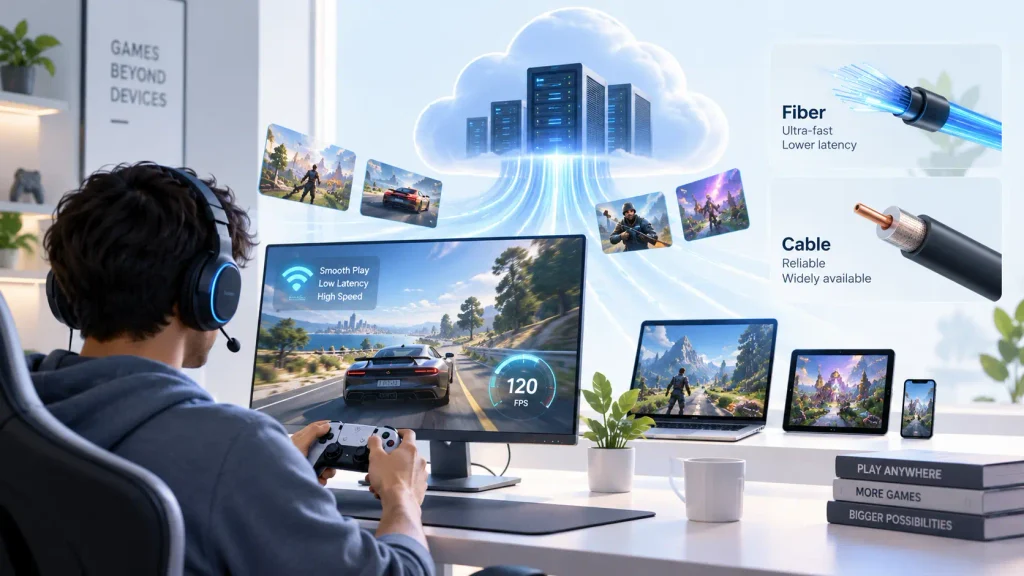
Latency, measured in milliseconds, is the time it takes data to travel from the cloud to your devices; understandably the lower the better. Bandwidth is the maximum amount of data your connection can transmit in a given time, and higher is always better.
The minimum requirements across each of the factors varies based on the resolution you’re aiming for as well as the cloud gaming platform you’re using.
Here’s an overview of the official requirements of the top 3 cloud gaming platforms.
| Cloud Platform | Minimum Download Speed | For 1080p | For 4K | Latency |
| GeForce Now | 15 Mbps | 25 Mbps | 40 to 45 Mbps | Under 40 ms |
| Xbox Cloud Gaming | 10 Mbps | 20 Mbps | 40 Mbps | Under 40 ms |
| Amazon Luna | 10 Mbps | 10 to 15 Mbps | 35 Mbps | Under 40 ms |
The clear snapshot of the minimum speed and latency requirements will help you narrow down the right high-speed internet providers. Depending on where you live, you’ll come across providers offering the connectivity types I shared above.
Let’s explore the performance of each and how it can impact your cloud gaming experience.
Fiber Internet
Fiber internet is hands down the gold standard for cloud gaming since it exceeds all the performance benchmarks required. It offers symmetrical multi-gig speeds, minimal latency, and has a higher bandwidth compared to cable internet networks.
It transmits data as a light signal using glass or plastic cables, both of which improve the speed and reliability of the connection. Since data is nearly travelling at the speed of light, it reaches its intended destination faster. The material of the cables is also not impacted by electrical or weather-based interference, reducing the latency and allowing smooth real-time input and output.
Below is the performance you can expect from a fiber connection under ideal conditions.
- Download and upload speed: 1 to 10 Gbps
- Latency: 1 to 10 ms
These qualities make it the go-to choice for cloud gaming, even with a large number of other devices in your household, from smart technology to streaming devices. However, fiber providers have a limited footprint, mostly being available in urban areas, since the cost of development doesn’t justify the minimal profits from rural and remote regions.
Cable Internet
Cable internet is the next best thing and much more widely available compared to fiber. It uses the existing copper coaxial cable network designed for cable television networks and transmits gaming data as electrical signals.
While cable internet services have a long way to go in matching fiber, providers are actively investing in their networks, allowing the connectivity type to meet new milestones. Here’s the performance you can expect from a cable connection.
- Download Speed: 10 Mbps to 2 Gbps
- Upload Speed: 5 to 50 Mbps
- Latency: 15 to 35 ms
Cable internet can be a viable choice in areas where a fiber network has not been established. It reaches multi-gig speeds and manages to keep the latency within the ideal limit for a smooth cloud gaming experience.
Cable vs Fiber: Which One to Choose for Cloud Gaming in 2026?
The right answer depends on your location, gaming needs, and budget. Fiber is no doubt the gold standard of internet connectivity with symmetrical speeds and ultra-low latency.
That being said, fiber connections are costlier to implement in remote areas. So, if you’re in an urban area and are willing to pay a higher upfront cost, I’d definitely recommend exploring your options.
In areas where a fiber infrastructure is not available, cable internet emerges as a valuable and reliable alternative, with decent speeds and latency for lag-free cloud gaming experiences.
It is also more affordable compared to fiber, which makes it the most suitable option if you’re on a limited budget. Make sure to evaluate all these aspects thoroughly before making a commitment.