Filmmaking has always been a process of transforming ideas into visual stories. A simple concept written on a page goes through several stages before becoming a finished film. Writers develop the story, directors shape the creative vision, cinematographers plan the visuals, production teams manage the shoot, and editors bring everything together during post-production.
For decades, this process depended on large teams working across different departments. While this collaboration created incredible films, it also meant that moving from an idea to a finished video required significant time, resources, and coordination.
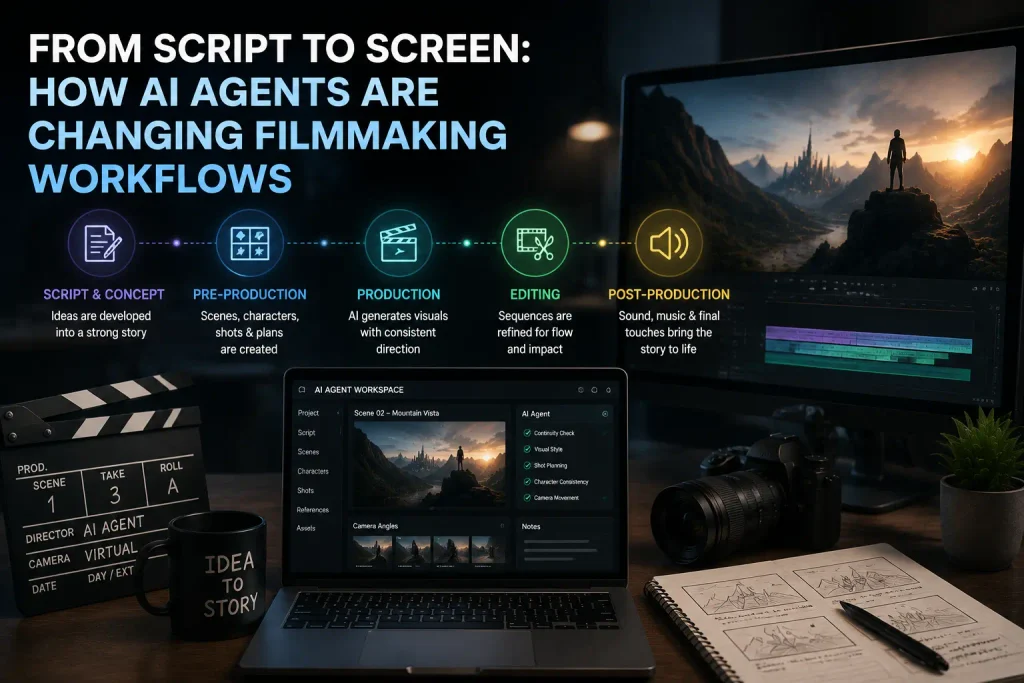
AI is now changing how filmmakers approach this journey. Instead of using separate tools for individual tasks, creators are beginning to work with AI agents that can support connected filmmaking workflows. These systems can understand creative goals, maintain project context, and assist across multiple stages of production.
This shift is creating a new approach to filmmaking where AI acts less like a single-purpose tool and more like a creative production partner.
What Are AI Agents in Filmmaking?
AI agents are systems designed to understand a broader objective and help complete multiple connected tasks. Unlike traditional AI tools that focus on one specific function, such as generating an image or creating a video clip, AI agents can support a complete workflow.
In filmmaking, this means an AI agent can assist with different stages of production, including developing concepts, planning scenes, creating visuals, refining edits, and organizing creative decisions.
The biggest difference is context. A traditional tool may generate a single output based on a prompt, but an AI agent can understand how different parts of a project connect. It can recognize that a character created in one scene needs to remain consistent later, or that a product shown throughout a commercial should maintain the same appearance.
This ability to maintain continuity is one of the reasons AI agents are becoming important for modern filmmaking.
How AI Agents Are Transforming Pre-Production
Pre-production is where many important creative decisions are made. Before filming begins, directors and production teams need to define the story, visual style, characters, locations, and overall direction.
AI agents are helping simplify this stage by allowing creators to explore ideas faster. A filmmaker can start with a basic concept and develop it into a more structured production plan with assistance from AI.
Instead of manually creating every reference, scene idea, and visual concept separately, creators can work through a connected workflow where creative decisions remain linked.
This can help with areas such as:
- Script development
- Scene planning
- Character creation
- Shot visualization
- Visual references
For example, a filmmaker developing a fantasy short film can establish the world, characters, and visual style early. The AI workflow can then help maintain those decisions while expanding the story into different scenes.
Maintaining Consistency Across AI-Generated Scenes
One of the biggest challenges in AI filmmaking is keeping every part of a project consistent.
A character should look the same throughout a film. A product should maintain its design across multiple commercial shots. The lighting, environment, and camera style should feel like they belong to the same creative world.
When scenes are generated separately, inconsistencies can appear. Characters may change appearance, products may lose details, or visual styles may shift unexpectedly.
AI agents help solve this problem by maintaining project context. Instead of treating every scene as an isolated generation, they allow creators to build connected workflows where references and creative decisions carry across the production.
This becomes especially valuable for longer projects such as short films, episodic content, advertising campaigns, and branded storytelling.
How Invideo Agent Represents Agentic Filmmaking
Invideo Agent represents the shift from individual AI tools toward agentic filmmaking workflows. It helps creators move from early ideas and references to complete video projects by supporting different stages of production, including scripting, planning, visual development, generation, editing, and post-production.
Rather than creating disconnected clips, filmmakers can use a more structured approach where creative decisions remain connected throughout the process. This is useful for projects that require multiple scenes, consistent characters, detailed environments, or specific visual styles.
For example, a brand creating a cinematic product campaign can use an AI agent workflow to develop the concept, plan scenes, maintain product appearance, and refine the final video while keeping the overall creative direction aligned.
With invideo Agent Two, larger productions can benefit from more advanced workflow coordination. It helps teams manage complex creative projects by supporting areas such as cinematography, storyboarding, casting decisions, and VFX planning while maintaining consistency across different stages of production.
AI Agents and Virtual Production
Virtual production has already changed filmmaking by combining digital environments, computer-generated elements, and traditional filming techniques. AI agents are expanding these possibilities by helping creators plan and develop digital worlds more efficiently.
A filmmaker can experiment with environments, camera movements, and scene compositions before committing to final production. This allows teams to test creative ideas earlier and make adjustments before spending significant time and resources.
For independent filmmakers, these workflows create new opportunities to explore cinematic storytelling without requiring the same production scale as traditional filmmaking.
AI Agents Are Improving Editing and Post-Production
Editing is another stage where AI agents are changing workflows. Editors often spend significant time organizing footage, reviewing scenes, adjusting pacing, and refining sequences.
AI agents can assist by understanding the broader goal of a project and helping creators make better decisions during post-production. Instead of only handling technical edits, future AI workflows can support storytelling choices such as improving scene flow, maintaining continuity, and identifying stronger moments within a project.
This allows editors and filmmakers to spend more time refining creative decisions rather than managing repetitive tasks.
The Rise of Specialized AI Agents in Filmmaking
Modern filmmaking involves many specialized roles, from cinematographers and editors to sound designers and VFX artists. AI agents are increasingly being developed to support these different areas by assisting with tasks such as cinematography planning, storyboarding, visual effects, audio design, and editing workflows.
These specialized agents can work alongside human creators, helping teams move faster while still keeping creative decisions in human hands. The future of filmmaking is likely to involve filmmakers collaborating with multiple AI assistants, each supporting different parts of the creative process while contributing to a more connected production workflow.
How AI Agents Are Helping Brands Scale Video Production
The impact of AI agents extends beyond films. Brands are also adopting these workflows to create more marketing content across different channels.
A single campaign may require product videos, social advertisements, explainer content, and multiple versions for different audiences. Managing this volume of content while maintaining brand consistency can be challenging.
AI agents help brands create more video assets while keeping the same messaging, visual identity, and creative direction across campaigns.
This allows marketing teams to experiment with more ideas without increasing production complexity.
Human Creativity Remains the Foundation of Filmmaking
Although AI agents can support many parts of production, storytelling decisions still depend on human creativity.
Filmmakers decide the emotional direction of a story, how characters should develop, and what visual choices best communicate the message. AI can help execute and refine these ideas, but the creative vision remains with the filmmaker.
The strongest AI-assisted productions combine human imagination with AI-powered efficiency.
The Future of Agentic Filmmaking
AI agents are moving filmmaking toward a more connected production model. Instead of using separate tools for every stage, creators can work with systems that understand the entire journey from concept to final output.
Future filmmaking workflows will likely connect script development, visual planning, production, editing, and post-production more closely than ever before.
This does not mean replacing filmmakers. Instead, AI agents will help creators overcome production limitations and focus more on storytelling, experimentation, and creative expression.
Final Thoughts
AI agents are changing filmmaking by making the journey from script to screen more connected and efficient. They help creators manage complex projects, maintain consistency, and explore new creative possibilities.
As agentic filmmaking continues to evolve, the relationship between filmmakers and AI will become more collaborative. Human creativity will remain at the center, while AI agents help turn ambitious ideas into complete cinematic experiences faster and with greater control.