Last Updated: June 2026 | Reading Time: ~25 minutes
Executive Summary: The Three Years That Changed Quantum Computing
Something remarkable has happened in quantum computing between 2024 and 2026. For years, the technology lived mostly in research labs, generating headlines but little real-world impact. That changed — fast.
In December 2024, Google unveiled a chip that solved a problem in five minutes that would take a classical supercomputer longer than the age of the universe. In February 2025, Microsoft announced the world’s first processor built on an entirely new class of quantum particles.
Across 2025 and into 2026, the industry raised billions in fresh investment, governments launched national quantum strategies, and the first real-world applications began moving beyond research labs.
We are living through quantum computing’s most consequential period yet.
This article covers every major milestone, explains what each breakthrough means in plain language, and gives you a clear picture of where quantum computing is headed next.
Key Breakthroughs at a Glance
- December 2024– Google’s Willow chip becomes the first quantum processor to achieve “below-threshold” error correction, meaning more qubits actually produce fewer errors.
- February 2025– Microsoft unveils Majorana 1, the world’s first processor powered by topological qubits, with a design theoretically scalable to one million qubits on a single chip.
- 2025– Quantum error correction research surges, with 120 peer-reviewed papers published in the first ten months alone, up from just 36 in all of 2024.
- 2025– The industry raises nearly $4 billion in investment in just the first three quarters, triple the total for all of 2024.
- August 2024– NIST finalizes its first post-quantum cryptography standards, triggering a global transition to quantum-resistant encryption.
- 2026– Quantum networking sees its first multi-node demonstrations over existing fiber optic infrastructure in real cities.
Why 2024–2026 May Be Remembered as Quantum Computing’s Turning Point
Every technology has a moment when the hype ends and the real work begins. For quantum computing, that moment came in 2024.
Before this period, most quantum computers were too error-prone to be useful. Scientists could demonstrate impressive results in controlled experiments, but the machines fell apart when pushed toward practical problems. Error rates climbed as more qubits were added, creating a wall that seemed impossible to break through.
Then Google broke through it.
The Willow chip showed that adding more qubits could actually reduce errors – the opposite of what everyone had experienced before. That single result changed the technical direction of the entire industry. Suddenly, the path toward fault-tolerant quantum computers looked not just theoretical, but achievable.
Everything that followed in 2025 and 2026 built on that foundation.
The Biggest Winners of the Quantum Race So Far
| Company | Key Achievement (2024–2026) |
|---|---|
| First below-threshold error correction with Willow chip | |
| Microsoft | First topological qubit processor (Majorana 1) |
| IBM | Flamingo 1,386-qubit multi-chip system; roadmap to 4,158 qubits |
| Quantinuum | Record quantum volume with 98-qubit trapped-ion system |
| QuEra / Atom Computing | Fault-tolerant operations demonstrated on neutral atom platforms |
| AWS | Ocelot chip using cat qubits to suppress noise |
What Is Quantum Computing and Why Does It Matter?
Before diving into the breakthroughs, it helps to understand what quantum computers actually are, and why scientists have been trying to build them for decades.
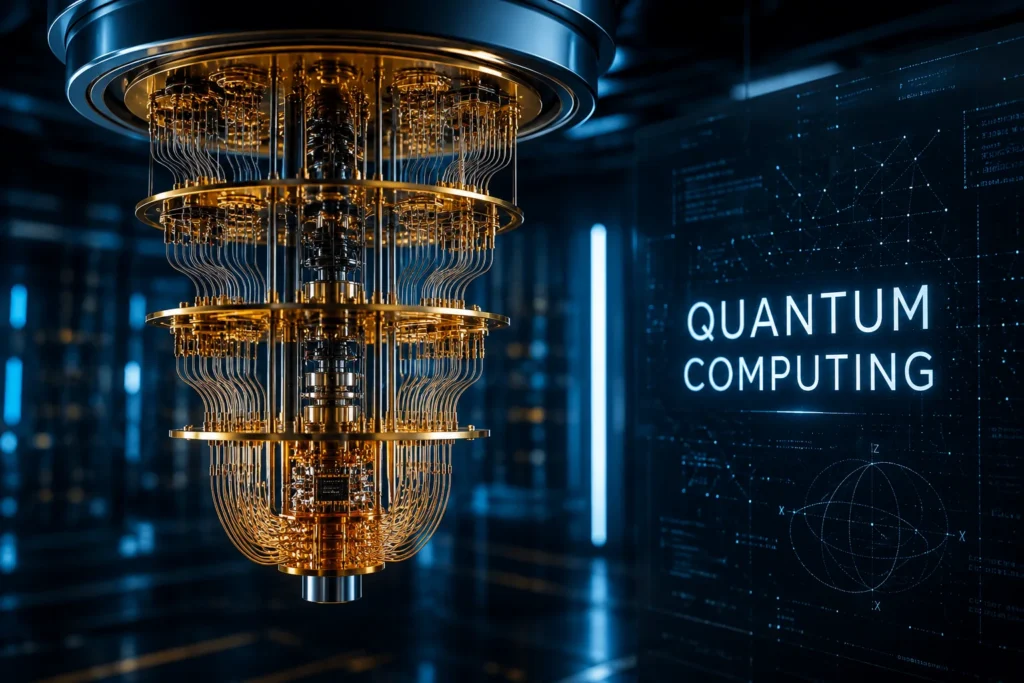
How Quantum Computers Differ from Classical Computers
Your laptop, phone, and even the fastest supercomputers in the world are built on the same basic idea: information is stored as bits, which are either 0 or 1. Every calculation, every image, every email — it all comes down to long strings of those two values.
Quantum computers work differently. Instead of bits, they use qubits (quantum bits), which can exist as 0, 1, or both at the same time. This allows quantum computers to explore many possible solutions to a problem simultaneously rather than checking them one at a time.
Think of it like a maze. A classical computer tries each path until it finds the exit. A quantum computer can, in a sense, explore many paths at once.
Understanding Qubits, Superposition, and Entanglement
Three concepts sit at the heart of quantum computing:
Superposition is the ability of a qubit to exist in multiple states simultaneously until it is measured. It’s what allows quantum computers to process many values at once.
Entanglement is a connection between qubits where the state of one instantly influences the other, no matter how far apart they are. Entangled qubits can coordinate their behavior in ways that classical bits cannot, enabling quantum computers to solve certain problems far more efficiently.
Interference is how quantum computers guide calculations toward correct answers and away from wrong ones by making correct probability paths reinforce each other while incorrect ones cancel out.
Together, these three properties give quantum computers their unique power, but they also make qubits extremely fragile. Any interaction with the environment, whether it’s heat, vibration, or electromagnetic interference, can cause a qubit to lose its quantum state in a process called decoherence.
Why Certain Problems Require Quantum Computing
Quantum computers are not faster versions of classical computers for all tasks. They are better suited to a specific class of problems where the number of possible combinations grows so rapidly that classical computers would take billions of years to find a solution.
These include:
- Simulating molecules for drug discovery (classical computers cannot model quantum-level interactions between atoms accurately)
- Breaking and building encryption (quantum algorithms like Shor’s algorithm can factor large numbers exponentially faster)
- Optimization problems with millions of variables (logistics, financial modeling, supply chains)
- Machine learning tasks where quantum parallelism offers speed advantages
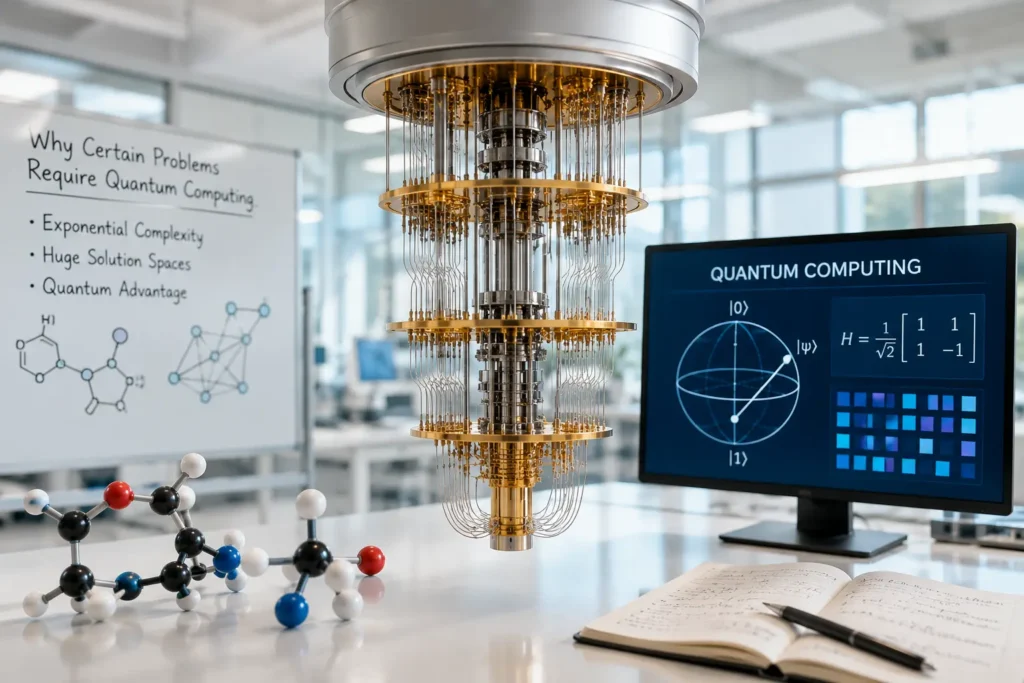
For everyday tasks like browsing the web or editing documents, classical computers remain far superior.
The Difference Between Quantum Supremacy, Quantum Advantage, and Fault Tolerance
These three terms are often confused, but they mean very different things:
Quantum supremacy (now often called quantum computational advantage) means a quantum computer has performed a specific calculation faster than any classical computer, even if that calculation has no practical use. Google achieved this in 2019 with its Sycamore processor, and again with Willow in 2024 at a dramatically higher level.
Quantum advantage means a quantum computer outperforms classical computers on a problem that actually matters to the real world. This is the goal the industry is racing toward.
Fault tolerance means the quantum computer can correct its own errors in real time and maintain accuracy across complex, long calculations. No quantum computer has fully achieved this yet, but the breakthroughs of 2024–2026 have made it look genuinely achievable within this decade.
The Great Quantum Reality Check (2024–2025)
Why the Industry Entered a Post-Hype Phase
Quantum computing attracted enormous investment and media attention throughout the late 2010s and early 2020s. Promises were bold: quantum computers would crack drug discovery, revolutionize finance, and break the internet’s encryption within years.
Those timelines turned out to be optimistic.
By 2023, enterprise customers who had invested in early quantum programs were asking hard questions. What problems had actually been solved? What value had been delivered? The honest answer, in most cases, was: not much yet.
This was not a sign that quantum computing was failing. It was a sign that the industry had overcommunicated what near-term quantum computers could do. The underlying science remained valid. The roadmap just needed recalibrating.
The Gap Between Experimental Success and Commercial Value
The quantum computers that existed through 2023 were what researchers call NISQ devices, Noisy Intermediate-Scale Quantum systems. They had dozens to hundreds of qubits, but those qubits were noisy (error-prone) and could only maintain coherence for very short periods.
This meant NISQ computers could demonstrate impressive benchmark results in controlled experiments but struggled to run the long, complex algorithms needed for practical applications.
The gap between “this is scientifically impressive” and “this solves a real business problem” turned out to be much wider than expected.
How Enterprise Expectations Changed
Companies that had rushed to build quantum teams began right-sizing their investments. The goal shifted from “deploy quantum solutions now” to “build quantum readiness for when the hardware is ready.” Internal quantum programs moved from attempting near-term applications toward learning, experimentation, and developing quantum expertise.
This was actually healthy. Organizations that understood the technology more deeply would be better positioned to use it when the hardware matured.
The Rise of Quantum Readiness Assessments
A new consulting category emerged: quantum readiness assessment. Rather than building applications, organizations began auditing which of their problems might eventually benefit from quantum computing, identifying the data and algorithms they would need to have ready, and preparing their encryption infrastructure for the post-quantum era.
This shift was practical, not pessimistic.
Why the Reality Check Ultimately Strengthened the Industry
The recalibration that happened in 2024 and 2025 was good for quantum computing’s long-term health. It pushed the industry toward measurable milestones instead of vague promises. It forced hardware teams to focus on the problems that actually mattered, particularly error correction. And it attracted more serious, long-term investors who understood the technology’s genuine timeline.
When Google announced Willow in December 2024, the industry was ready to receive it honestly. The breakthrough was real, the evidence was published in Nature, and the community understood exactly what it meant.
Quantum Computing Timeline: The Breakthroughs That Shaped 2024–2026
2024 Milestones
| Date | Breakthrough | Who |
|---|---|---|
| August 2024 | NIST finalizes first three post-quantum cryptography standards (FIPS 203, 204, 205) | NIST |
| October 2024 | Real-time, low-latency quantum error correction demonstrated | Rigetti + Riverlane |
| 2024 | IBM launches Flamingo, a 1,386-qubit multi-chip quantum processor | IBM |
| December 2024 | Willow chip achieves below-threshold error correction; solves benchmark problem in minutes that would take classical supercomputers 10 septillion years | |
| December 2024 | First quantum teleportation over busy internet cables demonstrated | Multiple research groups |
| 2024 | Global quantum startup funding exceeds $2 billion, up 50% year-over-year | Industry-wide |
2025 Milestones
| Date | Breakthrough | Who |
|---|---|---|
| February 2025 | Majorana 1 unveiled — world’s first topological qubit processor, scalable design to 1 million qubits | Microsoft |
| February 2025 | AWS debuts Ocelot chip using cat qubits for noise suppression | AWS |
| February 2025 | First distributed quantum computing instance demonstrated using photonic network | Research consortium |
| April 2025 | Fujitsu and RIKEN announce 256-qubit superconducting quantum computer | Fujitsu / RIKEN |
| 2025 | Quantinuum launches 98-qubit trapped-ion system with record-breaking fidelity (99.9993% SPAM accuracy) | Quantinuum |
| 2025 | Quantum error correction papers surge to 120 published in first 10 months, up from 36 in all of 2024 | Global research community |
| 2025 | Industry raises nearly $4 billion in first three quarters, triple all of 2024 | Industry-wide |
| 2025 | Encoded lattices demonstrate exponential error suppression across increasing qubit group sizes | Multiple teams |
2026 Milestones
| Date | Breakthrough | Who |
|---|---|---|
| January 2026 | Quantum networking tested across three nodes using existing fiber optic cables in New York | Research consortium |
| January 2026 | New research warns of quantum computer security vulnerabilities (Penn State) | Penn State |
| February 2026 | White House begins drafting executive order to reshape U.S. quantum policy | U.S. Government |
| Early 2026 | IBM on track to deliver 7,500 quantum gates by end of year | IBM |
| 2026 | Post-quantum cryptography rollout at enterprise scale begins following NIST mandate | Industry-wide |
| 2026 | China’s Zuchongzhi 3.2 achieves key quantum error correction milestone | China |
| May 2026 | Quantum networking breakthrough demonstrated using entanglement swapping across fiber links | Kyoto University + others |
Google’s Willow Chip and the Historic Breakthrough of 2024
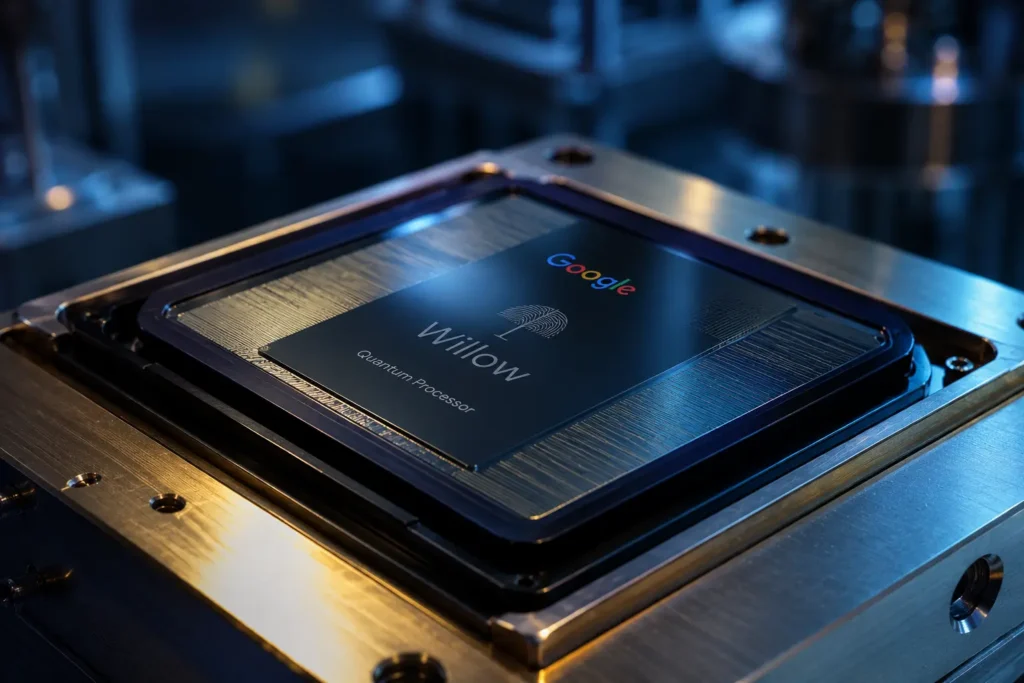
Of all the developments in this three-year period, one stands out as the moment that changed everything. On December 9, 2024, Google published results in Nature that the quantum computing community had been waiting decades to see.
What Is Willow?
Willow is Google’s 105-qubit quantum chip, the successor to its Sycamore family of processors. It was designed with one goal above all others: to demonstrate that quantum error correction could actually work at scale.
In a benchmark test using random circuit sampling, a standard measure of whether a quantum computer is doing something that classical computers cannot, Willow performed a calculation in under five minutes. The same calculation would take the fastest classical supercomputer approximately 10 septillion years. For context, the universe is only about 14 billion years old. The gap between quantum and classical was not just large; it was almost incomprehensible.
But the benchmark result, impressive as it was, was not the most important news.
The Problem of Error Accumulation
Every quantum computer built before Willow suffered from the same fundamental problem: the more qubits you added, the more errors accumulated. Qubits are fragile. They interact with their environment in ways that corrupt their quantum states. As systems grew larger, errors multiplied faster than any error-correction system could keep up with.
This created a brutal engineering wall. You needed more qubits to run complex algorithms. But more qubits meant more errors. More errors meant less accuracy. Less accuracy meant the results were useless.
For years, the entire quantum computing industry was stuck on the wrong side of this wall.
Understanding Below-Threshold Error Correction
Willow broke through it.
In experiments with qubit arrays scaled from 3×3 to 5×5 to 7×7 grids, Google’s team observed something that had never been seen before in a superconducting quantum system: every time they increased the size of the logical qubit array, the error rate dropped by half. More qubits, fewer errors. The relationship was exponential.
Julian Kelly, director of quantum hardware at Google, described error correction as “the end game for quantum computers.” For a system to be truly useful, it must be able to correct its own mistakes in real time, the same way a computer processor can detect and fix data corruption without you noticing. Willow demonstrated that this was possible in practice, not just in theory.
This is what researchers mean when they say Willow achieved the “below-threshold” regime. The system crossed a critical boundary where error correction overhead decreases rather than increases as you scale. Below this threshold, larger systems become more reliable. Above it, they become less reliable. Every quantum computer before Willow was above it.
Why Willow Changed the Industry Narrative
Before Willow, fault-tolerant quantum computing was a theoretical destination that nobody knew how to reach in practice. Error correction schemes existed on paper, but no one had demonstrated that they could work in a real superconducting system.
Willow proved they could.
As Google’s Hartmut Neven put it: “The whole community breathed a sigh of relief because it shows that quantum error correction indeed can work in practice.”
The industry shifted almost immediately. Error correction, which had been treated as a distant problem, became the central focus of every major quantum hardware program. The race was no longer about qubit counts. It was about reaching fault tolerance.
How Willow Laid the Foundation for Future Fault-Tolerant Systems
Willow is not a fault-tolerant quantum computer. It is a proof-of-concept that the key ingredient for fault tolerance, below-threshold error correction, is achievable in hardware that can be manufactured and scaled.
Google’s roadmap calls for its “milestone six” machine, a large-scale fault-tolerant quantum computer, to arrive around the end of this decade. Neven noted in December 2024 that the company is tracking closely to the roadmap it published in 2020. Willow represents the building block that makes that roadmap credible.
The Beginning of the Fault-Tolerant Foundation Era
What the NISQ Era Looked Like
From roughly 2017 to 2024, quantum computing was in what researchers called the NISQ era, Noisy Intermediate-Scale Quantum. These machines had tens to a few hundred qubits, but they were noisy (error-prone) and could only run shallow circuits before errors made results unreliable.
NISQ computers were real, they were operational, and researchers learned enormously from them. But they were not powerful enough to run the algorithms, like Shor’s factoring algorithm or complex molecular simulations, that would deliver genuine commercial value.
The NISQ era was necessary. It taught researchers how qubits behave, how errors propagate, and what kinds of error correction might work. But it was always understood as a stepping stone, not the destination.
Why Quantum Error Correction Became the Industry’s Main Focus
As the limits of NISQ computing became clear, the entire field converged on a single conclusion: fault tolerance was the only path to useful quantum computing. Everything else was preliminary.
Error correction requires redundancy. Rather than relying on individual physical qubits, you encode a single logical qubit across many physical qubits, so that errors in individual physical qubits can be detected and corrected without disrupting the logical qubit’s state.
The catch: before Willow, every attempt to do this in hardware showed that more physical qubits meant more total errors, not fewer. The overhead was unsustainable.
The Scientific Advances That Made Fault Tolerance Realistic
Several advances converged to make below-threshold error correction possible:
Better qubit materials reduced the baseline error rate per operation. Faster classical co-processors made it possible to detect and correct errors quickly enough to matter. Improved chip fabrication produced more consistent qubits with fewer manufacturing defects. And theoretical advances in error correction codes provided more efficient ways to encode logical qubits.
No single breakthrough was sufficient. The combination of all of them, maturing simultaneously around 2024, is what pushed the field across the threshold.
The Emergence of Logical Qubits
A logical qubit is a quantum bit that is protected by error correction. Rather than the fragile physical qubits that interact with their environment and degrade quickly, a logical qubit is a collective state of many physical qubits, maintained by continuous error detection and correction.
Logical qubits are what fault-tolerant quantum computers will actually use to run algorithms. Creating them reliably was one of the central goals of quantum computing research throughout the 2020s.
By 2025, multiple groups had demonstrated logical qubits that actually outperformed the individual physical qubits they were built from, confirming that error correction was genuinely improving the system rather than just adding overhead.
What Researchers Mean by the “Fault-Tolerant Foundation Era”
The term describes the period we are entering now: one where the fundamental building blocks of fault tolerance have been demonstrated in hardware, and the work shifts toward assembling those building blocks into larger, more capable systems.
We are not yet in the fault-tolerant era, that arrives when quantum computers can run complex, long algorithms with sufficient accuracy to deliver real-world value. We are in the foundation era: the stage where every major research and engineering decision is oriented toward building that future machine.
The Biggest Quantum Computing Breakthroughs of 2025
Microsoft’s Majorana 1 and Topological Quantum Computing
On February 19, 2025, Microsoft announced something the quantum computing world had been skeptical would ever materialize: a working processor built on topological qubits.
What Are Majorana Particles?
Majorana particles are named after Ettore Majorana, an Italian physicist who theorized in 1937 that certain particles could be their own antiparticles. For decades, Majorana fermions existed only in theory.
Microsoft’s research teams discovered that by combining indium arsenide (a semiconductor) and aluminum (a superconductor), and cooling the device to near absolute zero while applying magnetic fields, they could create topological superconducting nanowires. At the ends of these nanowires appear Majorana Zero Modes (MZMs), quantum states with unique properties that make them far more stable than conventional qubits.
The key point: information encoded in Majorana Zero Modes is stored non-locally, distributed across the wire rather than concentrated in one spot. This makes it dramatically harder for environmental disturbances to corrupt.
Why Topological Qubits Could Be More Stable
Conventional qubits store information in a specific physical property, the spin of an electron, the energy level of an ion, the oscillation of a superconducting circuit. Any disturbance to that physical property corrupts the qubit.
Topological qubits store information in the collective, geometric properties of a quantum system rather than any single physical location. To corrupt a topological qubit, you would need to fundamentally change the topology of the system, a much harder task for environmental noise to accomplish accidentally.
Microsoft claims that this intrinsic hardware-level protection could dramatically reduce the amount of error correction overhead needed, allowing more qubits to be packed onto a chip without the error overhead that plagues conventional designs. The Majorana 1 chip is designed to scale to one million qubits on a single chip.
Opportunities and Remaining Questions
The scientific community received Microsoft’s announcement with a mixture of excitement and healthy skepticism. The claims are extraordinary, and verifying Majorana Zero Modes experimentally is genuinely difficult, scientists at a major U.S. physics conference debated the measurements publicly in the weeks after the announcement.
What is clear: Microsoft has demonstrated a proof-of-concept eight-qubit topological processor. What remains to be proven: that the topological protection works as claimed, that the qubits can be reliably manufactured at scale, and that universal quantum gate operations can be performed on topological qubits with sufficient fidelity.
The next few years will determine whether Majorana 1 is a historic turning point or an ambitious but ultimately limited approach.
Quantinuum’s Record Quantum Volume Achievement
While Google and Microsoft made the biggest headlines, Quantinuum, the quantum computing company formed from the merger of Honeywell Quantum Solutions and Cambridge Quantum, continued to push the boundaries of trapped-ion technology.
Quantinuum launched a 98-qubit trapped-ion system with a reported SPAM (State Preparation and Measurement) accuracy of 99.9993%, among the highest gate fidelity figures ever recorded in any quantum computing technology. Quantum Volume, the benchmark Quantinuum uses to measure overall system quality (combining qubit count, connectivity, and gate fidelity), reached record levels.
Trapped-ion systems sacrifice raw qubit counts for dramatically higher gate fidelity. This approach may reach practical quantum advantage sooner for specific high-value applications in chemistry and cryptography.
Advances in Logical Qubit Scaling
Across 2025, multiple research groups demonstrated logical qubits that reliably outperformed the physical qubits they were built from. This “beyond breakeven” threshold, where error correction helps more than it hurts, was crossed repeatedly by different teams using different approaches, confirming that the results were robust and reproducible.
The number of peer-reviewed papers on quantum error correction published in just the first ten months of 2025 (120 papers) dwarfed the entire output of 2024 (36 papers), reflecting how rapidly the field was accelerating.
Improvements in Quantum Hardware Reliability
Superconducting systems showed steady gains throughout 2025, driven by better materials, refined chip packaging, and higher-fidelity multi-qubit gates. IBM continued executing on its ambitious roadmap, with the Flamingo processor delivering 1,386 qubits via a multi-chip configuration, and the Kookaburra system, targeting 4,158 qubits across three linked chips, moving toward completion.
AWS entered the hardware space in February 2025 with its Ocelot chip, built around “cat qubits” designed to suppress certain types of noise at the hardware level before error correction is even needed. This approach, reducing errors before they happen rather than correcting them after, could reduce the overhead required for fault-tolerant operation.
Breakthroughs in Neutral Atom and Photonic Quantum Systems
Neutral atom quantum computers, which trap individual atoms using lasers and use their quantum states to store information, demonstrated fault-tolerant operations at practical scales in 2025. Companies like QuEra and Atom Computing showed that neutral atom systems could perform logical qubit operations with error rates low enough to be useful.
Photonic quantum computing, which encodes information in particles of light, made progress on its biggest challenge: creating reliable sources of single photons on demand. Advances in quantum dot technology and optical cavity design brought photonic systems closer to the error rates needed for fault-tolerant operation.
The Biggest Quantum Computing Breakthroughs of 2026
Progress Toward Verified Quantum Advantage
By 2026, the conversation in quantum computing shifted from “can we correct errors?” to “can we demonstrate genuine advantage on a useful problem?” IBM projected that the first verified cases of quantum advantage, where a quantum computer solves a practical problem better than any classical approach, would be confirmed and validated by the broader community around this period.
JPMorganChase reported achieving a milestone with a quantum streaming algorithm that delivers theoretical exponential space advantage in real-time processing of large datasets, an early signal that financial applications may be among the first to reach practical quantum advantage.
IBM set an ambitious target of delivering 7,500 quantum gate operations reliably by the end of 2026, a benchmark that would bring error-corrected quantum computation meaningfully closer.
New Records in Quantum Error Reduction
Encoded lattices demonstrated exponential error suppression across increasing qubit group sizes, consistent with the theoretical predictions that below-threshold error correction makes possible. China’s Zuchongzhi 3.2 processor achieved key quantum error correction milestones, confirming that the global research community was converging on similar results independently.
Novel fault-tolerant quantum protocols published in January 2026 demonstrated ways to reduce the resource cost of error correction, potentially cutting the number of physical qubits needed to support each logical qubit. This is critical for making fault-tolerant quantum computers of manageable size.
Quantum Networking and Distributed Quantum Computing Advances
One of the most significant developments of 2026 was the move from single-node quantum computers to multi-node quantum networks.
In February 2025, scientists demonstrated the first instance of distributed quantum computing using a photonic network. By 2026, researchers tested a three-node quantum network across existing fiber optic cables in New York, using entanglement swapping to connect quantum links into a small but functional network.
This matters enormously. Individual quantum processors face hard physical limits on the number of qubits they can contain in a single cryogenic system. Connecting multiple processors via quantum networks, essentially creating a quantum internet, would allow systems to scale far beyond those limits. A 2025 development extended quantum coherence in rare-earth crystals to tens of milliseconds, boosting quantum links by a factor of 200 in range.
Real-World Quantum Applications Moving Beyond Research Labs
The most significant trend of 2026 is not any single technical breakthrough, but the quiet movement of quantum computing applications from academic papers into corporate pilots.
Drug discovery programs began using quantum simulation for molecular modeling. Financial institutions started testing quantum algorithms for portfolio optimization and risk modeling. Logistics companies explored quantum approaches to routing problems. None of these were production deployments at scale, but they were real problems, run on real hardware, producing results that informed real decisions.
The era of quantum computing being purely a research curiosity was ending.
The Most Significant Scientific Papers and Demonstrations of 2026
- Stanford researchers created miniature optical cavities that efficiently collect light from individual atoms, enabling potential large-scale photonic quantum computers.
- Penn State researchers published warnings about novel security vulnerabilities in quantum computers themselves — a reminder that quantum hardware raises new security questions beyond just cryptography.
- Kyoto University demonstrated quantum entanglement identification of the elusive W state, solving a decades-old problem in quantum information theory.
- New fault-tolerant quantum protocols reduced the resource overhead for error correction, potentially accelerating the timeline to practical fault-tolerant machines.
The Race Toward Verified Quantum Advantage
Why Quantum Supremacy Was Not Enough
Google’s claim of quantum supremacy in 2019, and the even more dramatic demonstration with Willow in 2024, proved that quantum computers could outperform classical ones on specific benchmarks. But those benchmarks were carefully chosen to favor quantum computers. They had no practical applications.
The world doesn’t need a faster way to run random circuit sampling. It needs a faster way to discover new drugs, model climate systems, and optimize financial portfolios.
Quantum supremacy showed the potential of quantum computers. Quantum advantage will show their value.
What Makes Quantum Advantage “Verified”
The word “verified” is doing significant work here. A quantum advantage claim must be:
- Demonstrated on a practically relevant problem, not a synthetic benchmark designed specifically to favor quantum hardware.
- Validated by independent researchers who can confirm the quantum result is both accurate and faster than the best classical approaches.
- Reproducible, not a one-time experimental result but a stable capability of the quantum system.
- Clearly better on meaningful metrics, speed, accuracy, cost, or some combination that matters in a real application context.
These are demanding criteria. Meeting all four simultaneously has not yet been definitively achieved as of mid-2026, though several groups are close.
Benchmarks Researchers Use to Measure Success
Quantum Volume measures the overall quality of a quantum computing system, combining qubit count, error rate, connectivity, and the depth of circuits the system can reliably execute. Higher is better.
Circuit Layer Operations Per Second (CLOPS) measures how quickly a system can execute quantum circuits in practice, accounting for all the setup and measurement time involved.
Algorithmic Qubit count measures how many effective qubits a system has for running useful algorithms, after accounting for the overhead of error correction.
Application benchmarks the most meaningful but hardest to define, measure performance on specific real-world problems like molecular simulation or optimization tasks.
Industries Most Likely to Reach Quantum Advantage First
Based on current research trajectories, the sectors most likely to see quantum advantage first are:
- Drug discovery and chemistry molecular simulation is a natural fit for quantum computers, and even modest improvements could accelerate pharmaceutical development significantly.
- Finance portfolio optimization, derivatives pricing, and Monte Carlo simulations involve the kinds of large combinatorial problems where quantum speedups are theoretically large.
- Cryptography and cybersecurity both in attacking current encryption (a concern) and in building quantum-safe systems (an opportunity).
- Materials science designing new battery materials, superconductors, and catalysts requires quantum-level simulation of atomic interactions.
The Roadmap Toward Commercially Valuable Quantum Computing
Most experts place the arrival of genuinely commercially valuable quantum computing, machines that can solve important practical problems better than any classical approach, somewhere between 2028 and 2033. The exact date depends heavily on how quickly error rates fall, how well logical qubit scaling proceeds, and whether any of the new architectural approaches (topological, photonic, neutral atom) prove more scalable than expected.
Commercial viability for most enterprises is widely projected for the early 2030s, though 2026 represents what many researchers describe as the beginning of quantum industrialization.
Which Companies Are Leading the Quantum Race?
Google remains the most credible quantum computing company on pure hardware benchmarks. The Willow chip’s below-threshold error correction result, published in Nature in December 2024, is the most significant experimental quantum computing result of the decade so far. Google’s roadmap targets a fault-tolerant “milestone six” machine by the end of the 2020s, and the company reports it is tracking closely to that roadmap.
Google’s approach uses superconducting transmon qubits operating at near absolute zero. Its advantage is deep hardware expertise and a clear, milestone-based roadmap.
IBM
IBM has the most mature quantum ecosystem of any company. Its Qiskit software platform has the largest developer community in quantum computing, and its cloud-based quantum systems have more users than any competitor. IBM’s hardware roadmap has generally delivered on its targets, with the Flamingo multi-chip 1,386-qubit system launching in 2024 and the larger Kookaburra system targeted for 2025.
IBM’s approach emphasizes making quantum computers accessible to developers and enterprises today, even before full fault tolerance is achieved. This positions IBM well for the transition from research to early commercial use.
Microsoft
Microsoft is pursuing the highest-risk, highest-potential-reward strategy in quantum computing. Its bet on topological qubits took nearly two decades of research before producing the Majorana 1 chip in 2025. If the approach works as claimed, Microsoft could leapfrog competitors by achieving a hardware architecture that is fundamentally more scalable and error-resistant.
The uncertainty is real. Outside scientists have questioned the experimental evidence for Majorana Zero Modes. But Microsoft’s track record in fundamental research and its deep engineering capabilities make it a serious long-term contender.
Quantinuum
Quantinuum operates the highest-fidelity quantum computers currently available. Its trapped-ion approach sacrifices qubit counts for dramatically lower error rates, and its systems have achieved quantum volume records multiple times. For applications that need high accuracy on moderate-size problems — certain chemistry simulations, cryptography, and financial modeling — Quantinuum’s systems may reach practical advantage before their higher-qubit-count competitors.
IonQ
Like Quantinuum, IonQ builds trapped-ion quantum computers. The company went public via SPAC in 2021 and has continued developing its hardware through 2025 and 2026. IonQ offers cloud access to its systems through AWS, Azure, and Google Cloud, giving it broad market reach.
PsiQuantum
PsiQuantum is pursuing photonic quantum computing at a scale that no other photonic company has attempted. With over $1.3 billion in funding and a focus on manufacturing quantum chips using existing semiconductor fabrication facilities, PsiQuantum is betting that photonic quantum computers can be manufactured in massive quantities using the same infrastructure that produces classical chips. A public offering was anticipated for 2026.
Rigetti Computing
Rigetti is one of the smaller publicly traded quantum computing companies. In October 2024, in collaboration with Riverlane, Rigetti achieved a breakthrough in real-time, low-latency quantum error correction — demonstrating that error correction fast enough to be practical was achievable on its hardware.
D-Wave Systems
D-Wave occupies a unique niche in quantum computing. Rather than building universal gate-based quantum computers, D-Wave builds quantum annealers, specialized machines optimized for solving specific optimization problems.
D-Wave’s systems have been commercially available for over a decade, making it the company with the longest history of real-world quantum deployments. Its approach is not suited to all quantum applications, but for problems that fit its architecture, logistics, scheduling, materials research, it can deliver results today.
Comparing Today’s Leading Quantum Computing Technologies
Different approaches to building quantum computers have very different tradeoffs. Here is a clear comparison:
| Technology | Key Companies | Qubits (2025–2026) | Gate Fidelity | Operating Temperature | Key Advantage | Key Challenge |
|---|---|---|---|---|---|---|
| Superconducting | Google, IBM, Rigetti, AWS | Hundreds to thousands | 99–99.9% | ~15 millikelvin | Fast gate operations, manufacturability | Decoherence, cryogenic requirements |
| Trapped-Ion | IonQ, Quantinuum | Tens to ~100 | 99.9–99.9993% | Room temperature (trap) | Highest gate fidelity | Slow gate speed, limited qubit count |
| Photonic | PsiQuantum, Xanadu | Variable | High (in development) | Room temperature | No cryogenics, manufacturable at scale | Reliable single-photon sources |
| Neutral Atom | QuEra, Atom Computing | Hundreds | 99–99.9% | Laser cooling (~microkelvin) | Flexible connectivity, scalable | Complex laser control systems |
| Topological | Microsoft | 8 (Majorana 1, 2025) | Theoretical advantage | ~15 millikelvin | Intrinsic error protection | Unproven at scale, scientific debate |
Which Approach Is Most Likely to Scale?
No single approach has decisively won the race. Each has real advantages:
Superconducting qubits benefit from decades of materials science and the ability to fabricate chips using adapted semiconductor manufacturing processes. They have the most advanced error correction results (Willow). The challenge is the extreme cryogenic cooling required and decoherence times measured in microseconds.
Trapped-ion systems offer the best gate fidelity today and operate at room temperature in the ion trap itself, though the electronics and lasers require sophisticated infrastructure. Their slow gate speeds limit how quickly they can run circuits.
Photonic systems could potentially be manufactured at semiconductor scale and operated at room temperature, making them the most scalable in principle. The challenge is the difficulty of generating reliable single photons and performing quantum gates on light.
Neutral atom systems have demonstrated impressive flexibility, particularly in reconfiguring qubit connectivity on the fly — a significant advantage for certain algorithms. Their scaling trajectory in 2025–2026 has been impressive.
Topological qubits, if they work as Microsoft claims, could offer a fundamentally more efficient path to fault tolerance. The scientific jury is still deliberating.
Most experts expect the eventual fault-tolerant quantum computer to combine elements from multiple approaches, rather than a single technology winning outright.
How Quantum Computing Is Already Solving Real Problems
Even before full fault tolerance is achieved, quantum computers are beginning to contribute to real problems.
Drug Discovery and Molecular Simulation
The human body is governed by quantum mechanics at the molecular level. Proteins fold, enzymes catalyze reactions, and drugs bind to receptors through quantum-level interactions that classical computers can only approximate.
Quantum computers can simulate these interactions directly. Early results from pharmaceutical companies exploring quantum molecular simulation suggest that even near-term quantum computers can outperform classical methods for specific molecular systems. The payoff, when quantum simulation of complex molecules becomes routine, could be dramatically accelerated drug discovery — potentially cutting the time from molecule identification to clinical trial by years.
Materials Science and Battery Research
Better batteries require better materials — and designing better materials requires understanding how atoms interact at the quantum level. Researchers are using quantum computers to simulate candidate battery chemistries, superconducting materials, and catalysts that could accelerate the clean energy transition.
Classical computers can simulate small molecules reasonably well, but as molecules grow more complex, the computational cost explodes exponentially. Quantum computers scale more naturally with molecular complexity.
Financial Risk Modeling
Financial systems involve massive optimization problems with millions of interacting variables. Quantum algorithms for Monte Carlo simulation, portfolio optimization, and derivatives pricing have been studied extensively, and several financial institutions are running early pilots.
JPMorganChase’s achievement of exponential space advantage in a quantum streaming algorithm for real-time data processing, reported in 2026, is an early signal that financial quantum advantage may arrive sooner than other sectors.
Supply Chain and Logistics Optimization
Routing, scheduling, and inventory optimization problems are classic cases where the number of possible solutions grows exponentially with problem size. Quantum optimization algorithms — including quantum approximate optimization and quantum annealing — are natural fits.
D-Wave’s systems have been used by real companies for logistics optimization for years, providing an early proof of concept that quantum approaches can deliver value in this space even before universal fault-tolerant quantum computers exist.
Artificial Intelligence and Machine Learning
The relationship between quantum computing and AI is more nuanced than headlines suggest. Quantum computers are not simply “better AI processors.” But there are specific tasks — training certain types of models, sampling from probability distributions, and solving specific optimization problems — where quantum speedups are theoretically significant.
Quantum machine learning remains an active and somewhat contested research area, with genuine open questions about where quantum advantage will materialize. The intersection of quantum computing and AI is likely to be one of the most important research frontiers of the late 2020s.
Climate and Energy Research
Climate modeling, carbon capture chemistry, and clean energy materials design all benefit from the quantum simulation capabilities that are maturing now. Simulating complex atmospheric chemistry, designing more efficient solar cells, and understanding high-temperature superconductors are all problems where quantum computers could eventually provide meaningful accelerations.
Quantum Computing and the Future of Cybersecurity
This is the section that should concern every organization that holds sensitive data — which is to say, every organization.
Why Current Encryption Is Vulnerable
The encryption that protects your banking, your email, your government records, and the internet’s core infrastructure is based on mathematical problems that are extremely hard for classical computers to solve. The most widely used algorithms — RSA and elliptic curve cryptography (ECC) — rely on the difficulty of factoring large numbers or solving discrete logarithm problems.
A sufficiently powerful quantum computer running Shor’s algorithm could break these in hours or days. The threat is not theoretical. It is a matter of when, not if, assuming quantum hardware continues to advance.
The Rise of Post-Quantum Cryptography
Post-quantum cryptography (PQC) refers to encryption algorithms that are resistant to attacks from both classical and quantum computers. These are not quantum encryption systems — they are classical algorithms based on mathematical problems that quantum computers are not believed to solve efficiently.
On August 13, 2024, NIST finalized its first three post-quantum cryptography standards:
- FIPS 203 (ML-KEM): Based on CRYSTALS-Kyber, for general encryption and key exchange
- FIPS 204 (ML-DSA): Based on CRYSTALS-Dilithium, for digital signatures
- FIPS 205 (SLH-DSA): Based on SPHINCS+, an alternative signature scheme
These standards give organizations a clear technical foundation for migration. The challenge now is implementation.
Government and Enterprise Preparation Efforts
The U.S. government has been moving faster than most private sector organizations. OMB Memo M-23-02 directed federal agencies to inventory their cryptographic dependencies and develop post-quantum migration plans. CISA has published migration guides specifically for identity and access management. Defense contractors and critical infrastructure operators with federal contracts face a hard compliance deadline of January 2027.
NIST has signaled that by 2030, organizations should have migrated away from RSA and ECC, and that after 2035, quantum-vulnerable algorithms will be formally prohibited for U.S. government use.
Many enterprises are lagging on this transition — a significant risk given that sensitive data captured today could be decrypted by a quantum computer in the future.
How Soon Could Quantum Threats Become Real?
The term “Q-Day” refers to the moment a quantum computer powerful enough to break current encryption becomes operational. Estimates from serious experts range from 2029 to the mid-2030s, depending on assumptions about hardware progress.
The most insidious threat is “harvest now, decrypt later”: nation-state adversaries may already be collecting encrypted data today, planning to decrypt it once quantum computers become capable. Sensitive data encrypted in 2026 using current standards could be exposed within a decade.
This is why post-quantum migration is urgent now, even though Q-Day has not arrived.
The Global Quantum Race
Quantum computing has become a matter of national strategic priority. Governments around the world are investing billions, recognizing that leadership in quantum technology could translate into advantages in defense, finance, scientific research, and cybersecurity.
United States
The U.S. leads in private sector quantum investment and hosts the most advanced quantum computing companies, Google, IBM, Microsoft, IonQ, Quantinuum, and others. The National Quantum Initiative Act, passed in 2018, established a coordinated federal approach.
In February 2026, the White House began drafting a new executive order to reshape U.S. quantum policy, reflecting the growing strategic importance of the technology. Federal quantum funding runs into the billions annually, spread across NSF, DOE, DARPA, and NIST programs.
China
China has made quantum technology a national priority and is advancing rapidly. The Zuchongzhi series of superconducting quantum computers has achieved multiple benchmark records.
China has also invested heavily in quantum communication infrastructure, including a 2,000-kilometer quantum key distribution network linking Beijing and Shanghai.
In December 2025, Zuchongzhi 3.2 achieved key quantum error correction milestones. China’s scale of investment and the pace of its academic output make it the most significant competitor to U.S. quantum leadership.
European Union
The EU’s Quantum Flagship program committed €1 billion over 10 years to quantum research and development. The European Quantum Communication Infrastructure (EuroQCI) aims to establish quantum-secure communication networks across EU member states.
European research institutions contribute significantly to quantum algorithms and error correction theory, even if European hardware companies lag behind U.S. and Chinese counterparts. The European Commission published a comprehensive Quantum Europe Strategy in July 2025.
Japan
Japan combines strong academic research in quantum physics with significant industrial investment from companies like Fujitsu, Toshiba, and NTT. Fujitsu and RIKEN announced a 256-qubit superconducting quantum computer in April 2025, with plans for a 1,000-qubit machine by 2026. Japan’s quantum program emphasizes both hardware development and the application of quantum computing to industrial challenges.
Canada
Canada has been a serious force in quantum computing since the field’s earliest commercial days, anchored by the “Quantum Valley” cluster in Waterloo, Ontario, home to the Perimeter Institute for Theoretical Physics, founded by BlackBerry co-founder Mike Lazaridis, and the Institute for Quantum Computing at the University of Waterloo, co-founded by Raymond Laflamme and Michele Mosca.
D-Wave, based in British Columbia, holds the distinction of operating the world’s first commercial quantum computer since 2011, while Toronto-based Xanadu has emerged as a leading photonic quantum computing company, going public in March 2026.
Canada launched its National Quantum Strategy in 2023 with $360 million in federal funding, followed by an additional C$334.3 million in its 2025 budget, reflecting the country’s determination to remain a global quantum leader.
Which Region Is Advancing the Fastest?
By most measures, the United States leads in hardware breakthroughs and private investment. China is advancing most rapidly in quantum communication infrastructure and academic output. Europe leads in quantum policy framework-setting and foundational research. Japan and Canada maintain important niches in specific technology areas.
The gap between the U.S. and China is the geopolitical focal point of the quantum race, and is likely to intensify through the end of the decade.
What Challenges Still Stand in the Way?
Scaling From Hundreds to Millions of Qubits
Even the most optimistic estimates of when fault-tolerant quantum computers will be ready assume systems with millions of physical qubits — orders of magnitude more than today’s most advanced machines. Getting from the hundreds or low thousands of qubits available now to the millions needed for fault-tolerant universal quantum computing is a massive engineering challenge with no clear single solution.
Reducing Error Rates Further
Willow demonstrated below-threshold error correction, but the overhead required is still enormous. Today’s error correction schemes require roughly 1,000 physical qubits to support each logical qubit used in computation. Better error correction codes and lower physical error rates could reduce this ratio — but achieving both simultaneously at scale remains extremely difficult.
Infrastructure and Energy Requirements
Most superconducting quantum computers operate at temperatures near absolute zero, roughly 0.015 Kelvin — colder than the vacuum of outer space. Maintaining those temperatures requires sophisticated cryogenic systems that consume significant amounts of energy and require highly specialized engineering. As quantum computers scale, the infrastructure requirements scale with them.
Software and Developer Ecosystems
Building a quantum computer is one challenge. Writing software for it is another. Quantum programming is fundamentally different from classical programming, and the pool of developers who can write quantum algorithms is tiny. Building the tools, frameworks, and educational resources to expand that pool is essential for commercial quantum computing to deliver on its promise.
IBM’s Qiskit, Google’s Cirq, and Microsoft’s Q# are the leading quantum programming frameworks, but all require significant expertise to use effectively. Making quantum computing accessible to non-specialists remains a significant challenge.
Cost and Commercial Accessibility
Today’s quantum computers are expensive to build and operate. Access is primarily through cloud services, which makes quantum computing theoretically accessible to anyone with an internet connection — but the cost per quantum computation remains high relative to the value delivered for most problems.
As hardware scales and becomes more capable, the cost per useful computation should fall. But the timeline for quantum computing to be economically competitive with classical approaches for specific problems remains uncertain.
Predictions for Quantum Computing Beyond 2026
Expected Milestones Between 2027 and 2030
- First definitive demonstrations of verified quantum advantage on practically relevant problems in chemistry or finance.
- IBM’s 4,158-qubit Kookaburra system in production, with successors targeting tens of thousands of qubits.
- Microsoft’s first fault-tolerant prototype based on topological qubits (if the Majorana approach validates at scale).
- Widespread enterprise migration to post-quantum cryptography, driven by NIST deadlines and national security requirements.
- Quantum networking extending to multi-city scale, with early demonstrations of what researchers call the “quantum internet.”
When Fault-Tolerant Quantum Computers Could Arrive
The most credible estimates from hardware companies and researchers place the arrival of full fault-tolerant quantum computers capable of running commercially valuable algorithms somewhere between 2029 and 2033. Google’s roadmap targets a large-scale fault-tolerant machine by the end of the decade. IBM has laid out a clear path to fault-tolerant quantum computing with well-defined intermediate milestones.
These timelines are targets, not guarantees. The history of quantum computing is full of schedules that proved optimistic. But the breakthroughs of 2024–2026 have given the field more reason for confidence than at any previous point.
Industries Most Likely to Benefit First
The sectors likely to see commercially meaningful quantum impact first, roughly in order of probability:
- Pharmaceutical and biotech — molecular simulation for drug discovery
- Financial services — portfolio optimization, derivatives pricing, Monte Carlo simulation
- Defense and national security — cryptography, sensing, optimization
- Chemical and energy — catalyst design, battery materials, carbon capture
- Logistics and manufacturing — scheduling, routing, supply chain optimization
What Experts Expect Over the Next Decade
The scientific consensus, reflected in roadmaps from Google, IBM, Microsoft, and leading academic groups, points toward a decade of rapid but uneven progress. The hardware will scale, error rates will fall, and the first genuine quantum advantages on practical problems will be demonstrated.
But the transition from “demonstrated quantum advantage” to “routine commercial use” will take additional time. Training quantum-literate developers, building quantum-ready software infrastructure, and developing applications specific to quantum hardware are all long-term projects.
By the mid-2030s, quantum computing is likely to be a standard component of the high-performance computing toolkit, not a replacement for classical computing, but a complementary capability that unlocks solutions to problems currently beyond reach.
The next decade will be the most consequential in the history of quantum computing. The foundations are being laid right now.
Frequently Asked Questions
What was the biggest quantum computing breakthrough in 2024?
Google’s Willow chip, announced in December 2024, was the most significant quantum computing breakthrough of the year. Willow achieved below-threshold quantum error correction — meaning that as more qubits were added, error rates actually decreased exponentially rather than growing. It also completed a benchmark calculation in under five minutes that would take classical supercomputers approximately 10 septillion years. The result was published in Nature and marked a turning point for the entire field.
Why is Google’s Willow chip considered important?
Willow is important because it solved the central problem that had blocked practical quantum computing for decades: error accumulation. Before Willow, every quantum computer showed that more qubits meant more total errors. Willow demonstrated the opposite — that it is possible to build quantum systems that become more reliable as they scale. This confirmed, in practice rather than just in theory, that fault-tolerant quantum computing is achievable. Without below-threshold error correction, large-scale quantum computers that could solve real-world problems were impossible in principle.
What is the fault-tolerant foundation era?
The fault-tolerant foundation era is the period we are currently entering, where the key technical building blocks needed for fault-tolerant quantum computing have been demonstrated and the industry is working to assemble them into complete systems. It follows the NISQ (Noisy Intermediate-Scale Quantum) era, characterized by noisy hardware that was too error-prone for most practical applications. The fault-tolerant foundation era is not yet the fault-tolerant era itself — that arrives when complete fault-tolerant quantum computers run complex commercial algorithms accurately.
What is Microsoft’s Majorana 1?
Majorana 1, announced in February 2025, is the world’s first quantum processor built on topological qubits — a fundamentally different approach to building quantum bits. Rather than storing quantum information in the properties of individual particles (as conventional qubits do), topological qubits encode information in the collective, geometric properties of a quantum system. Microsoft claims this makes them intrinsically more resistant to environmental disturbances. The current Majorana 1 chip contains eight qubits, but is designed with a path to one million qubits on a single chip. The scientific community has raised legitimate questions about the experimental evidence, and the approach’s viability at scale remains to be demonstrated.
What is quantum volume and why does it matter?
Quantum volume is a benchmark developed by IBM to measure the overall quality of a quantum computing system. Unlike simple qubit count, quantum volume accounts for gate fidelity, qubit connectivity, error rates, and the maximum circuit depth a system can reliably execute. A higher quantum volume means a more capable, reliable system for running real algorithms. It provides a more meaningful measure of practical capability than raw qubit numbers alone, which can be misleading if the qubits are too noisy to be useful.
What is verified quantum advantage?
Verified quantum advantage means a quantum computer has demonstrably outperformed any classical computer on a practically relevant problem — not just a synthetic benchmark — and that the result has been independently confirmed by outside researchers. Achieving verified quantum advantage requires demonstrating better performance on a problem that actually matters (not one designed specifically to favor quantum hardware), having the result reproduced or validated by others, and showing that the advantage holds on meaningful metrics like speed, accuracy, or cost. As of 2026, no definitive verified quantum advantage on a commercially relevant problem has been universally accepted, though several groups are close.
Which company currently leads quantum computing?
No single company leads across all dimensions. Google leads in hardware benchmark results, having demonstrated the most significant error correction milestone with Willow. IBM leads in ecosystem maturity, developer tools, and commercial accessibility. Microsoft is pursuing the most ambitious long-term approach through topological qubits. Quantinuum leads in gate fidelity on its trapped-ion systems. The answer depends on what metric matters most: raw performance benchmarks, practical accessibility, software ecosystem, or long-term architectural potential.
Can quantum computers break modern encryption?
Not yet, and not soon — but eventually, yes. A quantum computer running Shor’s algorithm with sufficient qubits and low enough error rates could break the RSA and elliptic curve cryptography that protects most internet communications. Current quantum computers are nowhere near capable of this. The most credible estimates place the arrival of a “cryptographically relevant” quantum computer — one capable of breaking today’s encryption — somewhere between 2029 and the mid-2030s. However, the threat known as “harvest now, decrypt later” — where adversaries collect encrypted data today planning to decrypt it when quantum computers become capable — means organizations should begin migrating to post-quantum cryptography now.
How close are we to practical quantum computers?
The honest answer in 2026 is: closer than ever, but still years away for most applications. The breakthroughs of 2024–2026 have made fault-tolerant quantum computing look genuinely achievable within this decade rather than merely theoretically possible. The first commercially meaningful quantum advantage on specific problems in chemistry or finance may arrive by 2028–2030. Widespread commercial deployment across multiple industries is more likely in the early-to-mid 2030s. The current period is best described as one of intense foundation-building rather than imminent deployment.
Will quantum computers replace classical computers?
No. Quantum computers are not general-purpose replacements for classical computers. They are specialized tools that excel at specific types of problems — those involving exponentially large solution spaces, quantum-level simulations, or certain mathematical structures. For everyday computing tasks — running software, browsing the internet, creating documents, playing games — classical computers will remain the right tool indefinitely. The future of computing is hybrid: classical computers handling the vast majority of tasks, with quantum processors called upon for the specific problems where quantum approaches offer genuine advantages.
This article reflects information available through June 2026. The quantum computing field moves rapidly; specific milestones, qubit counts, and company capabilities may have been updated since publication.