Most link building fails for one simple reason: teams pick pages based on the wrong numbers. A high domain authority score feels reassuring, but it tells you almost nothing about whether the specific page hosting your link will ever send you traffic or ranking value.
SERP insight link insertion fixes that by flipping the research process, you start with the search results, not the domain metrics.
This guide breaks down what SERP insight link insertion actually is, how to run a campaign step by step, and how it stacks up against niche edits, guest posting, and digital PR.
You’ll also get a vetting checklist, a tools list, and answers to the questions link builders ask most often.
What Is SERP Insight Link Insertion?
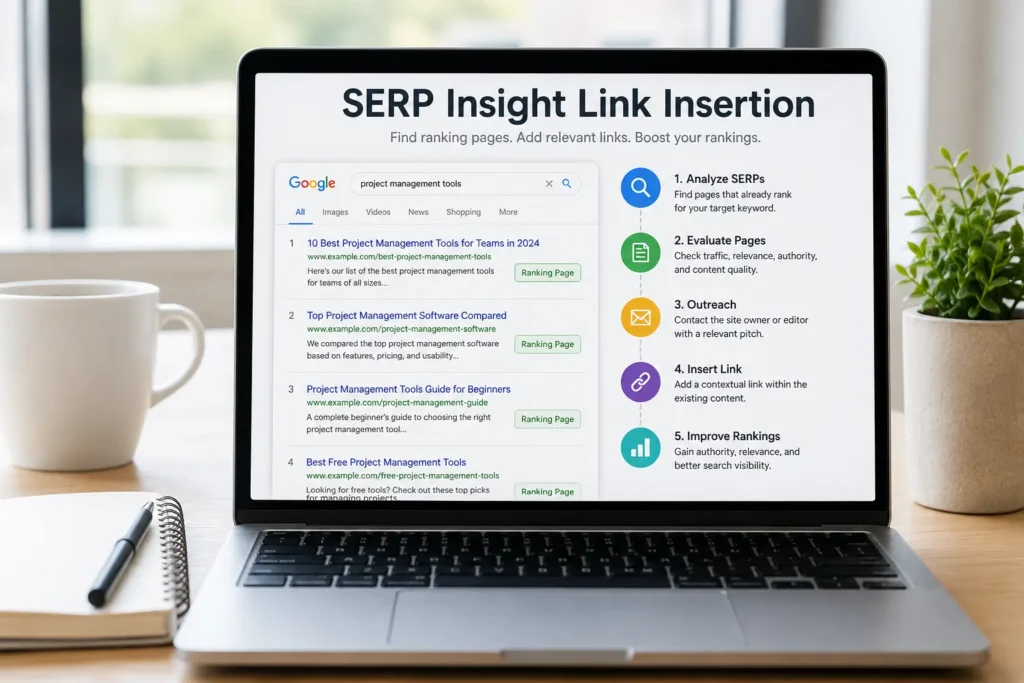
SERP insight link insertion is the practice of placing a contextual backlink into an already-published, already-ranking page, where the target page is chosen by analyzing live Google search results for relevant keywords rather than by domain authority alone.
Instead of asking “does this site have a high DA?” you ask “does this specific page rank, get traffic, and match my topic?”
Why the Term Became Popular
Link builders have quietly known for years that domain-level metrics are a weak proxy for link value. A domain can carry a strong overall score while its individual pages sit buried on page five of Google, with zero organic visitors.
As tools like Ahrefs and Semrush made page-level SERP data easier to pull at scale, more practitioners started filtering prospects by ranking position and traffic before ever sending an outreach email. The phrase “SERP insight” caught on as a shorthand for that filtering step.
Is It a New Strategy or a New Name?
It’s mostly the second one. The underlying tactic, paying or negotiating to insert a link into existing content, has existed for over a decade under names like niche edits, link insertions, or curated links. What’s new is the discipline around page selection. SERP insight link insertion isn’t a different delivery mechanism; it’s a more rigorous filter layered on top of the same core tactic.
How SERP Insight Link Insertion Works
The workflow has seven steps, and skipping any of them is usually where campaigns go wrong.
Step 1: Research Target Keywords
Start with the keywords your link should be contextually tied to, ideally the same keywords the linking page should already rank for. If you sell project management software, your list might include “team task tracking,” “sprint planning tools,” or “remote work collaboration.”
Build this list from your own content gaps and existing rankings, not just generic head terms. The closer the keyword sits to a page you’re actively trying to strengthen, the more useful the eventual link becomes.
It helps to group keywords into small clusters rather than treating each one in isolation. A cluster around “sprint planning” might include the head term plus variants like “agile sprint planning template” or “sprint planning checklist.”
Clustering this way means one round of SERP research can surface prospects for several related link opportunities at once, which saves real time later in the process.
Step 2: Analyze Google’s Search Results
Run each keyword through Google and study the actual results, not just a keyword research tool’s estimate. Look at which content formats dominate (listicles, comparison posts, how-to guides), how many ads appear, and whether the intent is informational or commercial.
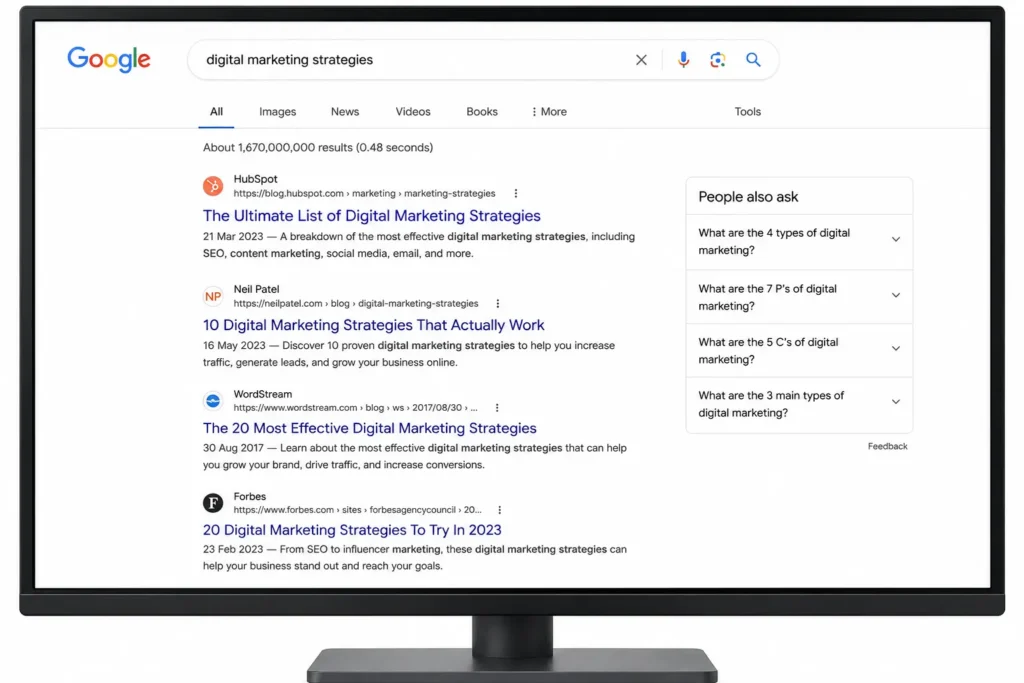
This step also tells you what kind of page is likely to accept a link insertion, resource roundups and comparison guides tend to be more open to it than single-topic tutorials.
Pay attention to how crowded the results are with big-brand domains. If the top ten are dominated by major publishers who rarely accept outreach, positions eleven through twenty are usually a more realistic hunting ground, and they still carry real search visibility.
Step 3: Identify Ranking Pages
Pull the URLs ranking in positions 3 through 20 for your target keywords. Top-three results are usually unwilling to add outbound links or too expensive to negotiate with; positions further down still get meaningful traffic and are often more open to outreach.
Export these into a working spreadsheet or prospect tracker so you can layer in the metrics from Step 4 without losing track of where each URL came from.
Step 4: Evaluate Page Quality
Check the individual page, not the domain, for organic traffic, backlink count, content freshness, and topical fit. A page can sit on a strong domain and still be a poor host for your link if it’s thin, outdated, or off-topic.
This is also the point to check for red flags: excessive ad density, a pattern of obviously paid links elsewhere on the page, or content that reads as machine-generated filler.
Set a minimum bar before you move a prospect forward, for example, a floor on estimated monthly organic traffic and a cap on how old the content can be without an update.
Having explicit thresholds keeps the vetting process consistent instead of relying on gut feel for each page.
Step 5: Reach Out to Publishers
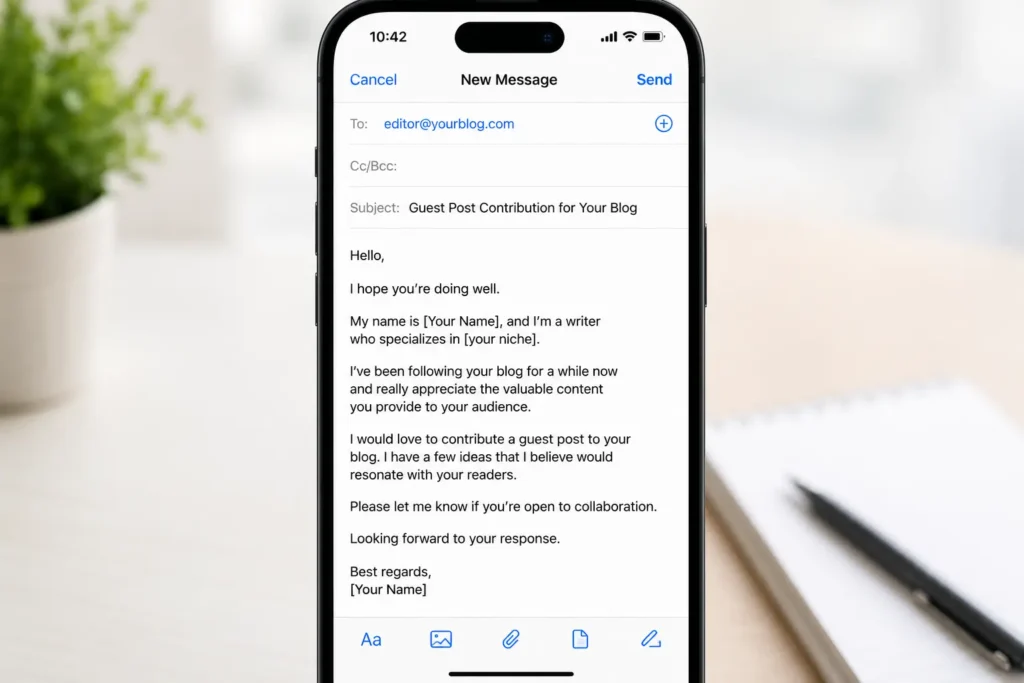
Contact the site owner or editor with a specific, relevant ask. Reference the exact page, explain why your link adds value to their existing content, and avoid generic mass templates, publishers can spot them instantly.
A short note that mentions a specific detail from their article, and proposes a specific sentence or section where the link would fit, tends to get far better response rates than a broad “would you consider linking to us” pitch.
Be upfront if compensation is part of the conversation. Publishers who regularly accept paid placements will usually tell you their process and pricing directly, which also gives you a chance to confirm they’ll apply the correct link attribute.
Step 6: Insert Contextual Links
Once approved, the link needs to sit naturally inside a relevant sentence or paragraph, not bolted onto the end of the post or crammed into an unrelated section.
Where possible, suggest the exact sentence or a short addition rather than leaving the wording entirely to the publisher, this keeps the anchor text and surrounding context aligned with what you actually need without asking for edits you don’t control.
Step 7: Monitor Performance
Track whether the link stays live, whether the host page keeps ranking, and whether your own rankings and referral traffic move.
Link insertions can be removed or buried under a content refresh, so ongoing monitoring matters. A simple quarterly check, revisiting each placement URL and confirming the link, its attribute, and its surrounding context are unchanged, catches most problems before they affect your reporting.
Why SERP Insight Matters More Than Domain Authority
Domain authority is a single, blended score for an entire website. It says nothing about the page your link will actually live on.
- Page authority vs. domain authority: A domain can have a high overall authority score while a specific page has almost no backlinks or search visibility of its own. Link equity doesn’t distribute evenly across every page on a site.
- Ranking pages vs. homepage metrics: Many SEO tools default to showing homepage or domain-wide traffic estimates. The page hosting your link might contribute a tiny fraction of that traffic.
- Traffic relevance: A page with high traffic for unrelated topics doesn’t help you. You want traffic from people searching for things connected to your product or content.
- Topical relevance: Google’s ranking systems and internal link-quality signals reward links from content that’s genuinely on-topic. A backlink from a page discussing a related subject typically carries more contextual weight than one from an unrelated high-authority page.
How to Find the Best Link Insertion Opportunities
Once you’ve identified candidate pages from SERP research, filter them further using these factors.
Keyword Relevance
The page should already rank for keywords close to your target topic, ideally within the same content cluster.
Organic Traffic
Check estimated monthly organic visits at the page level, not the domain level. A page pulling in a few hundred relevant visitors a month is often more valuable than a page on a bigger domain that gets none.
Ranking Keywords
Look at how many keywords the page ranks for and where. A page ranking for dozens of related long-tail terms signals strong topical authority within its niche.
Content Freshness
Recently updated pages tend to hold rankings better and signal to Google that the content — and by extension, the links inside it, is still actively maintained.
Internal Linking
Pages that receive internal links from other parts of the site tend to carry more authority within that site’s own architecture, which can help your inserted link too.
Link Profile
Review the page’s and domain’s existing backlink profile. A history of spammy, irrelevant, or low-quality links is a warning sign, even if the traffic numbers look fine.
Editorial Quality
Well-written, well-structured content signals a publisher who maintains standards, and that generally means your link will sit in a credible context rather than a thin, filler-heavy page.
Benefits of SERP Insight Link Insertions
- Faster indexing, links placed on already-indexed, actively crawled pages tend to get discovered by Google quickly, compared to waiting for a brand-new guest post to be crawled.
- Better topical relevance, because pages are pre-filtered by keyword ranking, the surrounding content is more likely to match your subject matter.
- Stronger contextual signals, a link embedded in a relevant sentence, on a relevant page, sends clearer signals than a link dropped into an author bio or resource list.
- Improved authority flow, links from pages that already rank and draw traffic tend to pass more meaningful link equity than links from stagnant or deindexed pages.
- Lower content creation costs, you’re not writing a full guest article; you’re negotiating placement into content that already exists.
Risks and Common Mistakes
Even with careful page selection, this tactic carries real risk if the execution is sloppy. Here are the mistakes that come up most often.
- Paid links without disclosure, compensating a publisher for a link that passes full ranking value, without the appropriate
rel="sponsored"attribute, violates Google’s link spam policies. This is the single most common compliance mistake, often made unintentionally when a vendor doesn’t apply the attribute correctly. - Spam networks, some vendors operate networks of interlinked, low-value sites built specifically to sell insertions. These are easy for search engines to detect as a pattern, and a link from one of these networks can do more harm than good to your site’s trust profile.
- Poor anchor text, over-optimized, exact-match anchors inserted repeatedly across many domains can look manipulative rather than natural. A handful of exact-match anchors is fine; dozens acquired in a short window is a pattern search engines are built to notice.
- Low-quality publishers, sites with thin content, excessive ads, or a history of penalties can drag down the perceived trustworthiness of the link, even if the traffic numbers look acceptable on paper.
- Irrelevant placements, a link that technically ranks well but has nothing to do with your topic undermines the contextual relevance the whole tactic depends on. A finance blog linking to a project management tool inside an unrelated paragraph rarely helps either party.
- Over-optimization, acquiring too many links with the same anchor text or from the same content niche in a short window can trigger unnatural pattern detection. Spacing out acquisition and varying anchor text naturally reduces this risk considerably.
SERP Insight Link Insertion vs. Traditional Niche Edits
| Factor | SERP Insight Link Insertion | Traditional Niche Edits |
|---|---|---|
| Page selection method | Filtered by live SERP data – rankings, traffic, keyword relevance | Often filtered by domain authority or bulk outreach lists |
| Research effort | Higher – requires SERP analysis per keyword | Lower – relies on broad prospecting tools |
| Relevance accuracy | Generally higher | Variable, sometimes loosely matched |
| Risk of low-value placements | Lower, due to page-level vetting | Higher, since domain metrics can mask weak pages |
| Scalability | Slower per link, but more consistent quality | Faster to scale, but quality control suffers |
SERP Insight Link Insertion vs. Guest Posting
| Factor | SERP Insight Link Insertion | Guest Posting |
|---|---|---|
| Content creation | None – link added to existing content | Full article required |
| Time to publish | Fast, once approved | Slower – drafting, editing, approval cycles |
| Page authority at launch | Immediate, since the page already ranks | Starts at zero and has to build authority over time |
| Editorial control | Limited – publisher controls surrounding content | Higher – you write the surrounding context |
| Best used when | You have strong existing content that fits into other pages | You have the bandwidth to create original articles |
SERP Insight Link Insertion vs. Digital PR
| Factor | SERP Insight Link Insertion | Digital PR |
|---|---|---|
| Link acquisition driver | Direct outreach and negotiated placement | Newsworthy content, data, or campaigns that earn coverage |
| Cost structure | Often a flat fee per placement | Often higher upfront investment in research/creative, but links can be free |
| Volume of links per campaign | Typically one link per placement | Can generate many links from a single successful campaign |
| Link quality signal | Contextual, but sometimes compensated | Usually earned editorially, seen as a stronger trust signal |
| Predictability | High — you know what you’re getting before you pay | Low — coverage isn’t guaranteed |
Choosing the Right Pages
Metrics That Actually Matter
| Metric | Why It Matters |
|---|---|
| URL Rating | Measures the specific page’s link authority, not the whole domain |
| Organic Traffic | Confirms the page actually attracts real search visitors |
| Ranking Keywords | Shows topical depth and consistency for related terms |
| Topical Relevance | Confirms the page’s subject genuinely overlaps with yours |
| Crawl Frequency | Indicates how often Google revisits the page, affecting how fast a new link gets noticed |
| Referring Domains | Shows how many unique sites already trust this page enough to link to it |
| Internal Links | Reflects how much authority the site itself funnels to this page |
| Page Freshness | Signals active maintenance, which correlates with ranking stability |
Anchor Text Best Practices
- Branded anchors – using your company or product name keeps the link looking natural and is generally the safest anchor type to use frequently.
- Partial match – phrases that include part of your target keyword alongside other words, offering some relevance signal without looking forced.
- Generic – anchors like “this guide” or “learn more,” useful for variety and for links embedded in less formal contexts.
- Exact match – the precise target keyword as anchor text; effective in small doses but risky if it dominates your link profile.
- Natural distribution – the goal is a mix that mirrors how real writers link to things, which means branded and generic anchors should outnumber exact-match anchors by a wide margin.
Google’s View on Link Insertions
Google has been explicit that buying and selling links is a normal part of how the web economy works — for advertising and sponsorship – and it isn’t against the rules on its own. Such links only cross into policy violation territory when they lack the correct rel=”nofollow” or rel=”sponsored” attribute and attempt to pass ranking credit as if they were a genuine editorial endorsement.
- Spam Policies – Google’s link spam policies treat any paid or exchanged link that passes ranking credit without proper disclosure as a violation, regardless of how naturally it’s written into the page.
- Sponsored links – the
rel="sponsored"attribute is the correct tag for compensated placements, telling Google not to pass ranking value through that link. - Editorial links – a link earned because an editor genuinely found your content valuable, with no payment involved, carries the most trust and doesn’t require special tagging.
- Link schemes – large networks of interconnected sites built primarily to exchange or sell links are specifically called out as manipulative and can trigger manual penalties.
- Risk mitigation – the safest approach is transparency: disclose paid placements properly, prioritize genuinely relevant pages, and avoid vendors who guarantee links across dozens of sites for a flat monthly fee.
Real Example: Building a SERP Insight Link Insertion Campaign
Here’s how this played out for a fictional but realistic B2B SaaS company selling project management software.
Target Keyword
The team targeted “sprint planning tools,” a mid-volume, commercially relevant keyword tied to a core product feature.
SERP Analysis
They pulled the top 20 ranking pages for that keyword and several close variants, noting which were blog posts, which were vendor comparison pages, and which were forum threads.
Prospect Selection
After filtering for organic traffic above a set threshold, topical relevance, and reasonable content freshness, the list narrowed from 20 pages to six realistic candidates.
Outreach
Each publisher received a short, specific email referencing the exact article and a clear reason the link would help their readers, not a templated pitch.
Link Placement
Three of the six publishers agreed. The links were placed inside relevant paragraphs discussing sprint planning workflows, using a mix of branded and partial-match anchor text.
Monitoring Results
Over the following weeks, the team tracked keyword position changes, referral traffic from each placement, and whether the links remained live during any content updates on the host sites. One link was removed during a site redesign two months later, a reminder that ongoing monitoring is part of the process, not an afterthought.
Tools for SERP Insight Link Building
| Tool | Primary Use |
|---|---|
| Ahrefs | SERP analysis, page-level traffic and backlink data |
| Semrush | Keyword research and competitor ranking analysis |
| Google Search Console | Tracking your own site’s indexing and ranking data |
| Google Analytics 4 | Measuring referral traffic from placed links |
| BuzzStream | Outreach campaign management and relationship tracking |
| Pitchbox | Scaled outreach and prospect list management |
| Respona | Combined prospecting and email outreach workflows |
| Hunter.io | Finding verified contact emails for publishers |
| Majestic | Trust flow and citation flow backlink metrics |
| Screaming Frog | Crawling target sites to check technical link placement details |
Measuring Success
- Ranking improvements – track whether your target keywords move up in position after links go live.
- Organic traffic – watch for lift in organic sessions tied to the pages you were building authority for.
- Referral traffic – measure direct clicks coming from the inserted links themselves.
- Indexation – confirm your linked pages get crawled and indexed in a reasonable timeframe.
- Link retention – periodically check that placements are still live and haven’t been removed or nofollowed after the fact.
- ROI – weigh the cost per placement against the combined value of ranking gains, referral traffic, and retained link equity over time.
Vendor Evaluation Checklist
If you’re outsourcing link insertion campaigns, vet vendors carefully before signing on.
Questions to ask:
- How do you select pages, by domain metrics, page-level SERP data, or both?
- Can you show examples of live, relevant placements from past campaigns?
- Do you disclose paid links with the correct
relattributes? - What’s your link retention or replacement policy if a link gets removed?
Red flags:
- Guaranteed rankings or guaranteed number of links within an unrealistic timeframe.
- Refusal to share sample placements or client references.
- Pricing based purely on domain authority tiers with no page-level vetting.
Pricing expectations:
- Costs vary widely by niche and page authority, and can range from roughly $100 to well over $1,000 per placement on higher-traffic pages.
Quality indicators:
- Transparent reporting, relevant sample placements, and a willingness to walk away from low-quality opportunities rather than force a sale.
Frequently Asked Questions
What is a link insertion in SEO? A link insertion is a backlink added into an already-published page on another website, rather than a link built through a brand-new article or guest post.
Is SERP insight link insertion against Google’s guidelines? Not inherently. It’s compliant as long as compensated links use the correct rel="sponsored" or rel="nofollow" attribute and the tactic doesn’t rely on spammy, irrelevant, or scaled link networks.
How much does a link insertion typically cost? Prices vary by page traffic, niche, and authority, generally ranging from around $100 to well over $1,000 per placement.
How is link insertion different from guest posting? Guest posting requires writing an entire new article for another site, while link insertion adds your link into content that already exists and already ranks.
Does link insertion still work in 2026? Yes, when done with proper page-level vetting and disclosure. Links placed on genuinely relevant, actively maintained, ranking pages continue to carry meaningful value.
How do I know if a page is worth pursuing? Check page-level organic traffic, ranking keywords, topical relevance, and content freshness — not just the domain’s overall authority score.
Final Thoughts
SERP insight link insertion isn’t a trick or a loophole, it’s a more disciplined way of doing something link builders have always tried to do: get a link in front of the right readers, on a page Google already trusts. The tactic lives or dies on the quality of your page-level research.
Skip that step, and you’re back to guessing based on domain metrics that don’t reflect what’s actually happening on the page hosting your link.
Treat every placement as a long-term investment rather than a one-time transaction. Vet publishers carefully, disclose paid links properly, and keep monitoring what happens to your links after they go live.
Do that consistently, and SERP insight link insertion earns its place as one of the more efficient, defensible tactics in a modern link building playbook.