Most companies don’t struggle to find developers anymore. They struggle to choose the right delivery structure.
On paper, full outsourcing sounds efficient: hand the project to a vendor, agree on deadlines, wait for releases. Sometimes that works perfectly well. Basecamp outsourced parts of its development early on. Slack relied heavily on external support before building larger internal engineering operations. Startups do this every day because speed matters more than process maturity.
But once a product becomes central to the business, the equation changes. Product decisions happen faster. Priorities shift weekly. Engineering discussions move closer to operations, sales, support, and leadership. At that point, full outsourcing can start creating friction instead of reducing it.
That’s usually where IT staff augmentation services enter the conversation.
Instead of transferring ownership of delivery to a vendor, companies bring external engineers directly into their existing workflows. The developers still work remotely in many cases, but operationally, they function as part of the internal team. They join sprint planning, work inside the same Jira boards, participate in architecture discussions, and ship code through the company’s CI/CD pipeline.
The distinction sounds subtle. In practice, it changes almost everything.
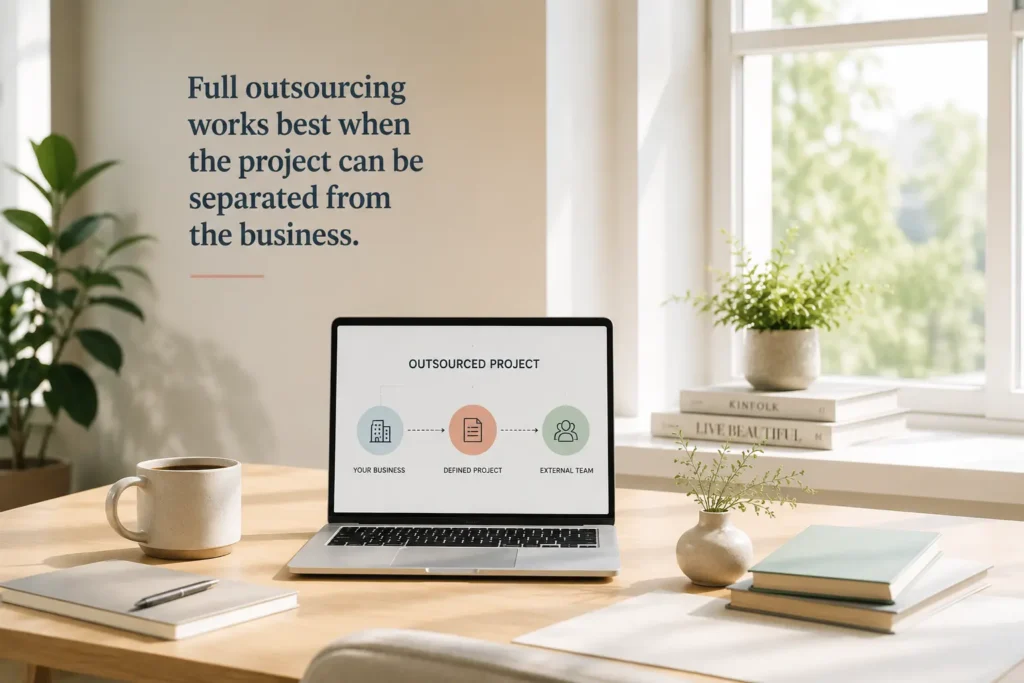
Full outsourcing works best when the project can be separated from the business
There’s nothing inherently wrong with software development outsourcing. For clearly defined projects, it can be the most practical option.
If a company needs a standalone internal portal, a temporary migration project, or an MVP with limited scope, outsourcing often reduces management overhead. The vendor handles staffing, delivery coordination, QA, and technical supervision. The client focuses on requirements and approvals.
The model breaks down when the product itself becomes a moving target.
That happens constantly in SaaS. Product managers revise priorities after customer interviews. Sales teams push for enterprise features mid-quarter. Compliance requirements change. Infrastructure costs suddenly spike after growth. Engineering roadmaps shift because the business shifts.
In those environments, communication latency becomes expensive.
Every additional layer between stakeholders and engineers slows decisions down. A request moves from product leadership to an account manager, then to a delivery lead, then to developers. Clarifications loop back through the same chain. Small misunderstandings compound over months.
Companies usually notice this too late, after velocity drops.
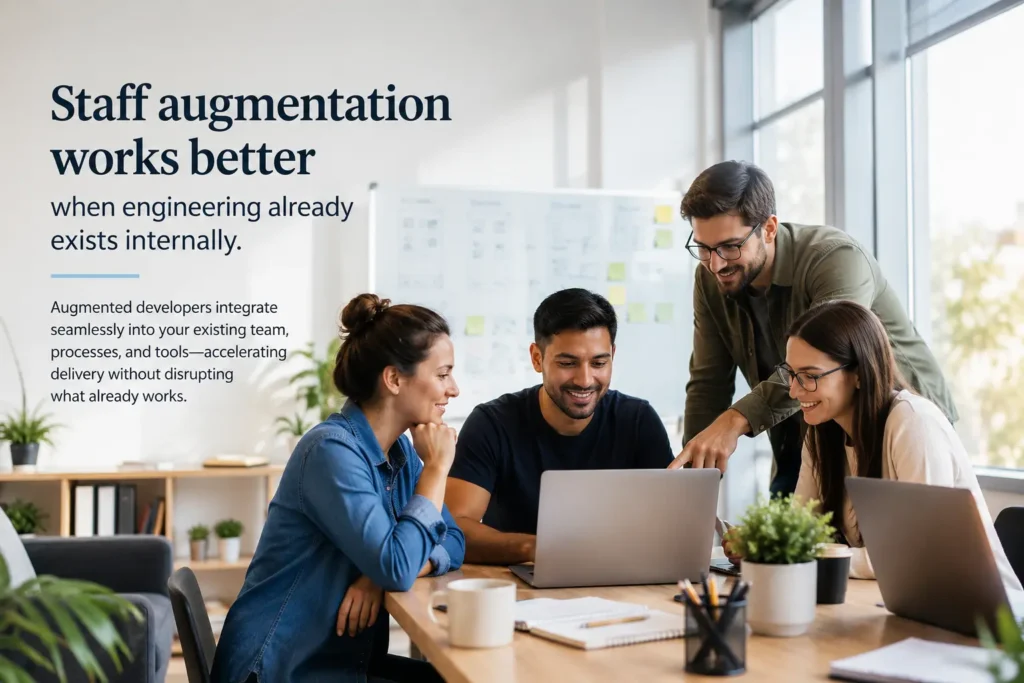
Staff augmentation works better when engineering already exists internally
A mature engineering organization rarely needs someone else to “run development.” It needs additional capacity or specialized expertise.
That’s the core advantage of working with a staff augmentation company instead of fully outsourcing delivery.
The external engineers plug into systems the business already has in place. Existing architecture standards stay intact. Internal release processes don’t change. Product leadership remains close to development decisions.
This structure is common in companies that already operate with strong technical leadership. Think of Shopify expanding its platform teams during peak growth periods, or fintech companies temporarily adding senior backend engineers while scaling payment infrastructure.
The external developers are there to accelerate delivery, not replace internal ownership.
That distinction matters because ownership is where long-term software quality usually succeeds or fails.
The hidden cost of outsourcing is context loss
Most outsourcing problems are not technical problems.
They’re context problems.
An external team can write perfectly functional code and still miss critical business logic because they’re operating at a distance from the organization itself. Over time, knowledge gets fragmented across documents, tickets, Slack threads, and vendor-side teams.
Eventually, the client becomes dependent on the vendor simply because the vendor knows the system better.
This happens more often than companies admit publicly.
A Gartner report estimated that poor knowledge transfer and communication gaps remain among the leading causes of software delivery delays in distributed projects. The issue becomes especially visible during platform scaling or handover periods.
Staff augmentation reduces that risk because product and technical knowledge stay embedded inside the company.
The augmented engineers contribute to delivery, but internal stakeholders still drive architectural decisions, priorities, and roadmap direction. If contractors leave, the operational knowledge doesn’t disappear with them.
Hiring internally sounds ideal until you measure the timeline
Building a strong engineering team internally takes time, often much more than leadership expects.
In the US market, senior developers in specialized areas like cloud security, distributed systems, or AI infrastructure can remain open requisitions for months. Some companies lose entire quarters trying to fill critical roles.
Meanwhile, product deadlines don’t pause.
This is where augmentation becomes operationally useful, not just financially convenient.
An experienced engineer from a dedicated development team can often join delivery within weeks instead of months. For businesses under pressure to release features, stabilize infrastructure, or recover delayed timelines, that difference matters immediately.
The tradeoff is straightforward, though: augmented engineers still require internal management.
Companies sometimes underestimate this part. Staff augmentation is not a hands-off model. If product direction is unclear internally, adding more developers rarely fixes the problem. It usually amplifies it.
Control becomes more important as systems become more complex
Early-stage products can survive fragmented processes. Large platforms usually cannot.
Once infrastructure grows across multiple services, cloud environments, third-party integrations, analytics systems, and compliance layers, engineering coordination becomes far more sensitive. Teams need shared standards around deployments, observability, security reviews, and incident response.
That’s difficult to maintain when external vendors operate semi-independently.
A company running Kubernetes workloads on AWS, for example, may already have strict internal policies around Terraform modules, monitoring through Datadog, or release approvals inside GitHub Actions. Rebuilding those processes around a separate vendor workflow often creates unnecessary operational overhead.
With augmentation, external engineers adapt to the existing environment instead of introducing parallel delivery systems.
That consistency becomes especially valuable in regulated industries like fintech, healthcare, or logistics platforms handling real-time operations.
Some companies choose augmentation because they’ve already been burned by outsourcing
This pattern comes up constantly in long-term software projects.
A company outsources development early because it seems faster. Two years later, the vendor relationship becomes difficult to unwind. Documentation is incomplete. Internal teams lack deep familiarity with the architecture. Releases slow down because every change depends on the external partner.
At that point, leadership usually wants more direct ownership over engineering.
Not necessarily because the vendor failed.
Because the business matured.
An in-house team supported by selective external specialists often becomes a more sustainable structure once the software itself turns into a core business asset rather than a side initiative.
There’s no universally “better” engagement model
Some articles frame augmentation versus outsourcing like a winner-takes-all debate. Real companies rarely operate that way.
Many use both models simultaneously.
A business might outsource an MVP, then later transition toward augmentation once the product stabilizes. Another company may keep core platform engineering internal while outsourcing secondary systems to external vendors.
The right engagement model depends less on budget and more on operational maturity.
If a company lacks technical leadership, full outsourcing can provide structure and execution discipline. If engineering leadership already exists internally, augmentation usually preserves flexibility and control more effectively.
The important part is recognizing the tradeoff clearly.
Outsourcing reduces direct management responsibility, but creates more distance between the business and engineering execution.
Staff augmentation keeps engineering closer to the company itself, but requires stronger internal ownership to work well.