Most guest posts get published and then quietly disappear. They sit on page four of Google, pull in a trickle of referral traffic, and pass a backlink that barely moves the needle. The writer did the work, the editor approved it, and still nothing happened.
The difference between a guest post that ranks and one that doesn’t usually isn’t writing quality. It’s research. A SERP insight guest post is built from what’s already working in Google, not from a topic idea and a keyword tool.
This guide covers exactly how to build one, step by step, with the research process, the framework, and the mistakes that quietly kill most campaigns.
What Is a SERP Insight Guest Post?
Definition
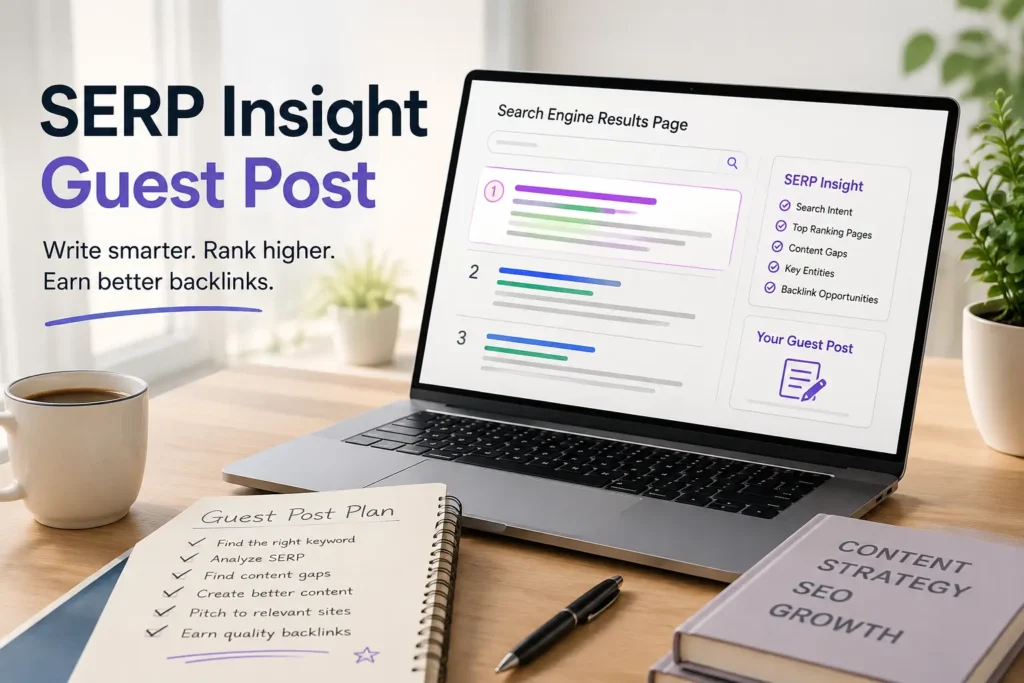
A SERP insight guest post is a piece of guest content built by studying the current top-ranking pages for a target keyword before writing a single sentence. Instead of guessing what a topic should cover, the writer reverse engineers the search results page (SERP) to find the intent, structure, entities, and gaps that Google is already rewarding, then writes a stronger version of that content for a relevant third-party site.
How It Works
The process starts with a keyword, not a pitch. A writer studies the top 10 ranking pages, maps the shared subtopics, and identifies what none of them cover well. That gap becomes the angle for the guest post. The article is then placed on a site with topical relevance to the keyword, so the backlink carries context as well as authority.
This is different from writing a generic article and hoping it ranks somewhere. The keyword comes first, the SERP research comes second, and the writing comes last.
Why It Matters in Modern SEO
Google’s ranking systems increasingly reward content that demonstrates real depth on a topic, not just keyword coverage. A generic 800-word guest post rarely competes with pages built around actual search intent. Search Engine Journal and other industry publications have repeatedly pointed to search intent alignment as one of the strongest on-page ranking factors, and that logic applies just as much to guest content as it does to owned content.
There’s a second reason this matters: link relevance. Google’s own documentation on link spam treats unnatural, irrelevant links as a quality signal problem. A guest post that’s genuinely useful and topically matched to the linking site looks like a natural citation. A thin, generic one looks like exactly what it is.
Traditional Guest Posting vs SERP Insight Guest Posting
Key Differences
Traditional guest posting starts with a list of websites and works backward to a topic. The writer pitches an idea, gets approval, and writes something reasonable but rarely exceptional. SERP insight guest posting starts with a keyword, researches the SERP, and only then looks for a publishing site that fits the topic and audience.
The traditional approach optimizes for placement. The SERP insight approach optimizes for the placement earning results.
Comparison Table
| Factor | Traditional Guest Posting | SERP Insight Guest Posting |
|---|---|---|
| Starting point | List of websites | Target keyword |
| Research step | Minimal or none | Full SERP and intent analysis |
| Content depth | Often generic | Matched to what’s already ranking |
| Site selection | Based on DA/DR alone | Based on topical relevance and audience fit |
| Anchor text | Often exact-match, risky | Natural, varied, intent-matched |
| Typical outcome | Link exists, little ranking impact | Link contributes to rankings and referral traffic |
| Time investment | Lower upfront | Higher upfront, better long-term ROI |
Which Strategy Produces Better Results?
For link volume, traditional guest posting is faster. For rankings, referral traffic, and long-term authority, SERP insight guest posting performs better because the content is built to compete, not just to exist.
Most experienced link builders run a hybrid: high-priority pages get the full SERP insight treatment, while lower-priority outreach can follow a lighter process.
Why Traditional Guest Posts Often Fail

Writing Without SERP Research
A guest post written from a keyword and a hunch usually misses what searchers are actually looking for. The writer might cover the topic accurately and still lose to competitors who mapped the intent first.
Poor Search Intent Matching
A keyword can look informational but actually pull mostly commercial or comparison results. Writing an educational article for a keyword that Google treats as a buying decision produces a mismatch that no amount of good writing fixes.
Weak Editorial Value
Publishers reject guest posts that don’t add anything their audience can’t already find. A rehash of common advice, without a new angle or fresh data, reads as filler even when it’s well written.
Over-Optimized Anchors
Guest posts stuffed with exact-match anchor text (“best project management software”) trigger the exact pattern Google’s link spam systems are built to catch. It’s one of the fastest ways to draw negative attention to an otherwise fine article.
Low-Relevance Placements
A backlink from an unrelated site, even a high-authority one, carries less weight than one from a site that actually covers the topic. Publishing a cybersecurity guest post on a lifestyle blog rarely helps rankings and can look manipulative.
Benefits of SERP Insight Guest Posting
- Better rankings – content built around real ranking patterns competes more effectively than content built on assumption
- Higher editorial acceptance – editors approve pitches that clearly understand their audience and fill a real content gap
- More relevant backlinks – publishing on topically aligned sites strengthens the link’s contextual signal
- Stronger topical authority – a cluster of relevant, well-researched guest posts reinforces subject-matter depth across the web
- Long-term organic traffic – content matched to intent tends to hold rankings longer than generic articles
- Better referral traffic – a post that genuinely helps the publisher’s audience gets read, shared, and clicked, not just skimmed past
The SERP Insight Guest Posting Framework

Step 1: Choose the Right Keyword
Pick a keyword with real search volume, a business connection, and a SERP that guest content can realistically compete in. Avoid keywords dominated entirely by brand giants or product pages, since a guest post has little chance of outranking them.
Step 2: Analyze Search Intent
Look at the result types Google returns: are they listicles, comparisons, how-to guides, or product pages? The dominant format tells you what Google believes searchers want, and that format should guide your outline.
Step 3: Study the Top 10 Results
Open every page ranking on page one. Note structure, depth, and the specific questions each one answers. This step alone reveals most of what a competitive article needs to cover.
Step 4: Identify Common Themes
Look for subtopics that appear across most or all of the top 10. These recurring themes are close to non-negotiable; skip them and the article will look thin by comparison.
Step 5: Find Content Gaps
Look for angles, data points, or subtopics that none of the top-ranking pages cover well. This is where a guest post can actually outperform the competition instead of just matching it.
Step 6: Extract Important Entities
Note the people, tools, brands, and concepts that repeatedly show up across the SERP. Google’s systems associate these entities with the topic, and including them signals topical relevance.
Step 7: Create a Better Outline
Combine the common themes, the content gaps, and the entity list into an outline that’s more complete than anything currently ranking. This outline becomes the pitch and the writing brief.
Step 8: Match the Publisher’s Audience
Adjust tone, examples, and depth to fit the site where the post will run. A B2B SaaS blog and a small business marketing blog need different framing even for the same core topic.
Step 9: Write the Guest Post
Write to the outline, keep paragraphs short, and answer questions directly before expanding on them. This is where the research pays off, since the writer is no longer guessing what to include.
Step 10: Place Links Naturally
Insert links where they genuinely help the reader, using anchor text that reads naturally in the sentence. A link dropped into an unrelated paragraph is a signal, and not a good one.
Step 11: Optimize for AI Overviews
Structure key sections so they can be lifted cleanly into an AI-generated summary: direct definitions, numbered steps, and clear comparison tables all help here.
Step 12: Publish and Measure Results
Track rankings, referral traffic, and link equity over the following weeks. This step is often skipped, but it’s what tells you whether the framework is actually working for a given site or niche.
How to Reverse Engineer a SERP Before Writing
Search Intent Mapping
Categorize the target keyword as informational, commercial, navigational, or transactional based on what’s actually ranking, not what the keyword sounds like on paper.
Heading Analysis
Pull the H2s and H3s from the top-ranking pages into a single document. Patterns emerge quickly, showing which subtopics are treated as essential.
Entity Extraction
List the brands, tools, people, and concepts mentioned across the top results. Tools like Ahrefs’ Content Gap feature or manual review can surface these efficiently.
Topic Clustering
Group related subtopics together to see the article’s natural structure before you start writing. This step usually reveals two or three logical sections that weren’t obvious from the keyword alone.
Competitor Weakness Analysis
Look for what’s outdated, shallow, or missing across the ranking pages: stale statistics, unanswered questions, missing examples. These weaknesses are the clearest opportunities for a guest post to add real value.
Information Gain Opportunities
Identify what you can add that doesn’t exist anywhere in the current SERP: original data, a case study, a framework, or a perspective from direct experience. This is often the single biggest factor separating a post that ranks from one that doesn’t.
How to Choose the Best Guest Posting Websites
Relevance
The site’s core content should overlap with your topic. A marketing agency blog is a strong fit for an SEO guest post; a general news site usually isn’t, regardless of its traffic numbers.
Organic Traffic
Check whether the site earns real organic search traffic, not just social referrals. A tool like Ahrefs or Semrush can confirm this quickly and flag sites with traffic that looks inflated or purchased.
Editorial Standards
Sites with a visible editing process, author bios, and consistent publishing quality tend to carry more trust with both readers and search engines than sites that publish anything for a fee.
Indexation
Check whether the site’s recent posts are actually indexed in Google. A backlink on a page that isn’t indexed passes little to no value.
Link Profile
Review the site’s own backlink profile for spammy or unnatural patterns. A site with a manipulated link profile poses risk to anything linked from it.
Audience Fit
Consider who actually reads the site. A guest post can rank and still fail to deliver referral traffic if the audience has no real interest in the topic.
Writing a Guest Post That Editors Want to Publish
Topic Selection
Pitch a topic the site hasn’t already covered well, based on a quick search of their existing content. Editors reject duplicate ideas quickly.
Pitch Structure
A strong pitch states the proposed headline, a two- or three-sentence outline, and why the topic fits the site’s existing audience. Editors are more likely to respond to a pitch that shows research than one that reads like a template.
Content Depth
Match or exceed the depth of the site’s best-performing existing articles. A shallow post next to well-researched ones stands out immediately, and not in a good way.
EEAT Signals
Include specific examples, named tools, and realistic scenarios rather than vague generalizations. This also happens to be what Google’s quality rater guidelines describe when discussing experience and expertise in content.
Original Research
A small original data point, survey, or analysis gives editors a reason to accept the pitch over a dozen similar ones in their inbox. It also tends to be the part of the article other sites cite later.
Expert Quotes
A short quote from a practitioner, even an internal one, adds a credibility signal that pure research can’t replicate on its own.
Visual Assets
Original charts, screenshots, or diagrams increase both editorial acceptance and reader engagement. Stock images rarely help; a genuinely useful chart often does.
Anchor Text Best Practices
Branded Anchors
Anchors like “HubSpot” or “the Ahrefs blog” look natural because that’s how people actually reference brands in conversation. Use these as the majority of your anchor mix.
Partial Match Anchors
Phrases like “a guide to keyword research” work well because they include relevant terms without exactly matching the target keyword. These should make up a healthy share of your anchor profile, but not all of it.
Generic Anchors
Anchors like “read more here” or “this article” read naturally in context and are useful in moderation, particularly for secondary links.
Naked URLs
Pasting the raw URL as the anchor is uncommon in guest posts but occasionally appropriate, especially in resource lists or citations.
Internal Link Strategy
| Anchor Type | Example | When to Use |
|---|---|---|
| Branded | “According to Semrush” | Citing a known source or tool |
| Partial match | “a step-by-step keyword research process” | Most contextual links |
| Exact match | “keyword research tool” | Sparingly, only when it reads naturally |
| Generic | “this guide” or “learn more” | Secondary or supporting links |
| Naked URL | https://example.com/guide | Resource lists, rare in body copy |
Optimizing Guest Posts for AI Search
AI Overviews
Google’s AI Overviews tend to pull from content that answers a question directly, near the top of a section, before expanding into detail. Structuring guest posts this way increases the odds of being cited.
Entity Optimization
Mentioning the right related brands, tools, and concepts helps search systems understand what the content is actually about, beyond the literal keyword.
Semantic SEO
Covering a topic’s full range of related subtopics, not just the primary keyword, signals depth to both traditional ranking systems and AI summarization tools.
Answer-First Content
Open each major section with a direct, concise answer before elaborating. This mirrors how featured snippets and AI Overviews extract content, and it also just makes the article easier to read.
Structured Formatting
Numbered steps, bullet lists, and comparison tables are easier for both readers and AI systems to parse than dense paragraphs. Use them anywhere a process or comparison is being explained.
Measuring Guest Post Success
Rankings
Track whether the guest post itself ranks for its target keyword, and monitor whether your linked page’s rankings shift in the weeks after publication.
Organic Traffic
Check the guest post’s own search traffic where the publisher allows access to analytics, or estimate it through tools like Ahrefs’ traffic estimates.
Referral Traffic
Look at direct clicks from the guest post to your site in your analytics platform. This is often the most immediate, measurable return.
Link Equity
Confirm the link is live, dofollow (where relevant to your strategy), and hasn’t been removed or altered after publication. Periodic audits catch this before it becomes a bigger problem.
Conversions
Track whether referral traffic from the guest post converts into leads, signups, or sales, not just clicks. A high-traffic post with zero conversions may need a different call to action.
Assisted Revenue
In multi-touch attribution models, guest post traffic often shows up as an assisting channel rather than a last-click conversion. Reviewing assisted conversion data gives a fuller picture of its actual contribution.
Common SERP Insight Guest Posting Mistakes
- Ignoring search intent — writing a great article for the wrong content format
- Choosing the wrong sites — prioritizing domain authority over topical relevance and audience fit
- Weak research — skimming two or three competitors instead of studying the full top 10
- Poor link placement — inserting links where they interrupt the reader instead of helping them
- Keyword stuffing — repeating the target keyword unnaturally instead of using semantic variations
- Thin content — matching competitor word count without matching competitor depth
Case Study: From Generic Guest Post to SERP-Driven Guest Post
Initial Strategy
A mid-sized project management software company ran a standard guest posting campaign: a list of marketing blogs, a generic 900-word article on “tips for remote team productivity,” and a single branded backlink. Six placements went live over two months.
SERP Analysis
After minimal rankings movement, the team ran a SERP insight analysis on their actual target keyword: “best project management tools for remote teams.” The top 10 results were dominated by detailed comparison articles with pricing tables, screenshots, and specific use-case breakdowns, not general productivity advice.
Content Improvements
The team rewrote their guest post approach around this finding: a 2,200-word comparison-style article with an original survey of 50 remote teams, a pricing comparison table, and screenshots of actual workflows. They pitched it to three sites with genuine software and productivity audiences instead of general business blogs.
Results and Lessons Learned
The new post ranked on page one for a related long-tail keyword within ten weeks and drove roughly four times the referral traffic of the original campaign’s average post. The clearest lesson: the keyword and the SERP should shape the content, not the other way around.
| Metric | Generic Guest Post | SERP Insight Guest Post |
|---|---|---|
| Word count | 900 | 2,200 |
| Ranking achieved | None in top 50 | Page 1, long-tail keyword |
| Referral traffic (monthly avg) | 40 clicks | 160 clicks |
| Editorial acceptance rate | 3 of 8 pitches | 3 of 4 pitches |
| Original data included | No | Yes (50-team survey) |
Expert Tips for Scaling SERP Insight Guest Posting
Building Repeatable Processes
Turn the SERP research steps into a standard checklist or template so every writer on a team follows the same process, regardless of who’s handling a given keyword.
Using AI Responsibly
AI tools can speed up SERP research, summarize competitor content, and draft outlines, but the original data, expert perspective, and final editing should stay human. Publishers and readers can usually tell the difference.
Maintaining Editorial Quality
As volume increases, it’s tempting to cut corners on research. Set a minimum research bar per article regardless of how many posts are in the pipeline that month.
Tracking Long-Term Performance
Rankings and traffic from guest posts often build over three to six months, not three to six weeks. Review performance on that timeline instead of judging a campaign too early.
Frequently Asked Questions
What is a SERP insight guest post? It’s a guest post built by researching the current top-ranking pages for a target keyword before writing, so the content matches proven search intent and structure instead of guesswork.
How is SERP insight guest posting different from regular guest posting? Regular guest posting usually starts with a website list and a general topic idea. SERP insight guest posting starts with keyword and SERP research, then finds a site that fits the resulting content.
Do I need expensive SEO tools to do SERP research? No. Manual review of the top 10 results covers most of what’s needed. Paid tools like Ahrefs or Semrush speed up entity extraction and competitor gap analysis but aren’t required to start.
How many competitor pages should I analyze before writing? Review at least the top 10 organic results. Fewer than that risks missing common themes; more rarely adds new information.
What anchor text ratio is considered safe? Most experienced link builders keep branded and partial-match anchors as the majority, with exact-match anchors used sparingly and naturally within a sentence, not forced.
How long should a guest post be? Length should match what’s actually ranking for the target keyword, not a fixed number. A comparison-heavy keyword might need 2,000+ words, while a simple how-to might only need 800.
Can SERP insight guest posting help with AI Overviews visibility? Yes. Content structured with direct answers, numbered steps, and clear comparison tables is easier for AI summarization systems to extract and cite.
How do I find content gaps in a SERP? Compare the subtopics, data, and questions covered across the top 10 results, then note what’s missing, outdated, or answered poorly across all of them.
What makes a guest posting site worth pursuing? Topical relevance and a real, engaged audience matter more than domain authority alone. A lower-authority site in your exact niche often outperforms a high-authority, unrelated one.
How do I know if a guest post is actually working? Track rankings for the linked page, referral traffic from the guest post, and whether that traffic converts, not just whether the link exists.
Should I write the guest post myself or hire a writer? Either works, provided the SERP research happens first. A skilled writer without research context will still produce a generic article.
How often should I update or check on published guest posts? A quarterly audit is reasonable for most campaigns, checking that links are still live, still dofollow if intended, and that the linked page’s rankings are trending in the right direction.
What’s the biggest mistake in guest post link placement? Placing a link where it interrupts the reader’s flow instead of supporting a point they were already reading about. Editors and readers both notice this.
Can I use the same guest post content on multiple sites? No. Duplicate guest content across multiple publishers weakens the value of both placements and risks editorial rejection once discovered.
How does search intent affect guest post format? It determines whether the article should be a how-to guide, comparison, listicle, or definition-first explainer. Matching the dominant format in the SERP is one of the fastest ways to improve ranking odds.
Final Thoughts
A SERP insight guest post isn’t a new tactic so much as a different starting point. Instead of writing content and hoping it fits what Google wants, the research happens first, and the writing fills in what’s already been proven to work.
That shift, from topic-first to SERP-first, is what separates a guest post that quietly disappears from one that ranks, earns referral traffic, and holds its position over time. The framework in this guide takes more upfront effort than a generic pitch-and-publish approach, but for anyone building a link building strategy meant to actually move rankings, it’s the difference between a link that exists and a link that works.