If you searched for SFM Compile, you probably landed on a confusing pile of results. One is a website. One is a Reddit community. Others are articles that treat it as a software tool. That is because the phrase points to more than one thing.
This guide sorts it out. You will learn what the term means, what we can and cannot say about SFMCompile.club, how real model compilation works in Source Filmmaker, and how to check an unfamiliar site before you trust it.
Quick answer: SFM Compile is a search term with two common meanings. It can be the name of a website and online community (SFMCompile.club and similar names), and it is also shorthand for compiling custom models for Source Filmmaker, Valve’s animation software. Context tells you which one a person means.
A note on sourcing. Many pages about this keyword repeat each other, and some describe things that don’t exist. I’ve kept to claims I could back up and I’ve said where something is unconfirmed.
What Is SFM Compile?
The phrase has no single official owner. Three groups use it differently, and that is where the confusion starts.
1. The three ways people use the term
Some people use it as a name: a website, a social profile, or a community called SFM Compile or SFM Compile Club.
Others use it as a process: turning a 3D model into a file Source Filmmaker can load. Animators call this “compiling” a model.
A third group uses it loosely, as a catch-all for anything related to SFM content. That is the least precise use, and it is why search results look so mixed.
2. What does SFM stand for?
SFM stands for Source Filmmaker. It is animation software made by Valve that runs on the Source engine, the same technology behind games like Half-Life 2 and Team Fortress 2. People use it to build animated scenes and short films, and it is free on Steam.
3. Where Source Filmmaker came from
Valve first built the tool for its own use, mainly to produce Team Fortress 2 videos. It later released the software to the public as a free download, and it has stayed free on Steam since.
Because it runs on the Source engine, SFM can pose and light any character or prop the engine can display. That includes models from Valve’s own games and models made by fans.
4. Why custom models need compiling
Most people who ask about compiling have the same problem. They found a character, vehicle, or prop that isn’t in the default library, and they want it in their scene.
That model usually starts life in Blender, Maya, or another 3D program. SFM can’t open those files directly. It only reads Source engine formats, so the model has to be converted first. That conversion is the “compile” step the rest of this guide explains.
5. Where people get custom assets
There are three common routes. You can make the model yourself, download one from a community library, or convert an existing model by decompiling it and recompiling it with changes.
The third route is where most beginners get stuck. A downloaded model may arrive half-finished, with source files but no QC file, or with the wrong folder layout. Check the license or the creator’s notes before you edit or share anyone else’s work.
What Is SFMCompile.club?
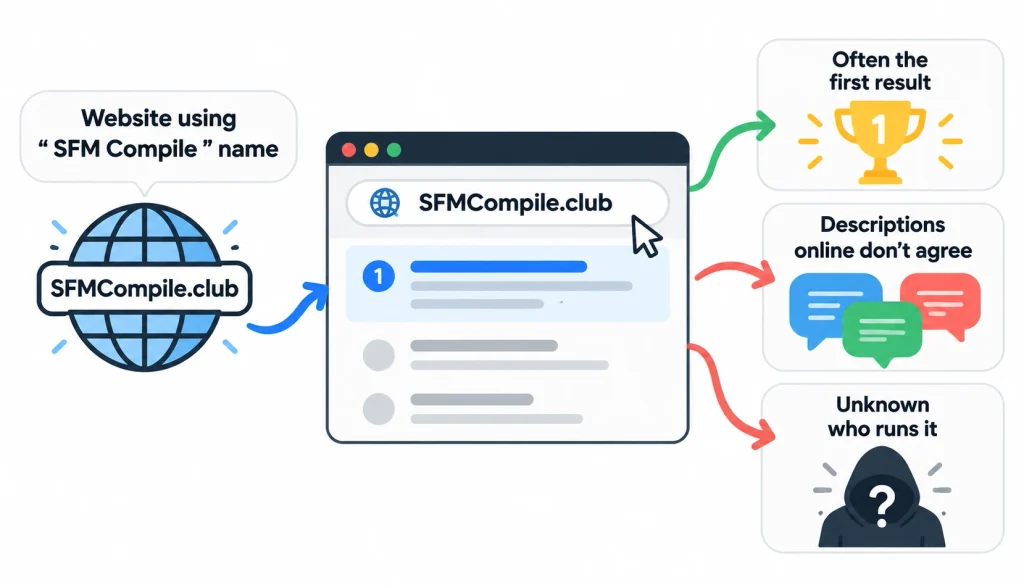
SFMCompile.club is a website that uses the SFM Compile name in its domain. Because it matches the search exactly, it is often the first result.
Here is the honest part. Descriptions of it online don’t agree with each other, and I could not confirm who runs it.
1. What different sources say about it
Several SEO-style articles describe an educational community that helps animators with tutorials, troubleshooting, and collaboration. Those pages read like marketing copy, and many are near-copies of one another. I wouldn’t treat them as proof of anything.
For a broader perspective on creating useful, original online resources, explore why content-based link building matters.
The Reddit community called sfmcompileclub tells a different story. Its own description, as shown in search listings, presents it as a place for adult animated content made in SFM or Blender. If you are under 18, or browsing at work, that matters.
Those two descriptions don’t match. They may be unrelated projects that share a name, or one may be misdescribed. I can’t tell which from public information alone.
2. What to verify before you rely on it
Open the site yourself and look for a stated purpose, an operator or contact address, a privacy policy, and terms of service. Don’t assume the website, the Reddit community, and the social accounts all belong to the same people. Names like this get copied all the time.
If you are publishing something about the site, check these points on the live pages first, because they change.
3. Why the same name shows up on so many sites
When I searched the name, I found near-identical “complete guides” on unrelated domains, including ones that clearly have nothing to do with animation. The sentences repeated almost word for word, and several described a point-and-click “SFMCompile” program with no link to a download or to Valve.
When evaluating online content, understanding how contextual links work can also help readers recognize how websites connect related information and resources.
That pattern is common with low-competition keywords. Content farms copy a handful of pages, swap the headline, and publish them under many domains. The result looks like consensus, but it is one source repeated.
A good test: if ten pages make the same claim and none of them cites Valve, a developer wiki, or a named person, you have one unverified claim, not ten confirmations.
4. A note for parents, teachers, and workplace readers
SFM is a general animation tool, and plenty of its output is harmless: short films, game-style comedy, and fan animation. Part of the wider SFM scene also produces adult content, and communities that use “SFM” in their name can fall on either side.
If you are choosing what a younger person should visit, or opening links on a work network, look at a community’s own description and rules before you click through. Treat an adult-oriented description as adult-oriented, whatever its name suggests.
SFM Compile vs. Source Filmmaker Compilation
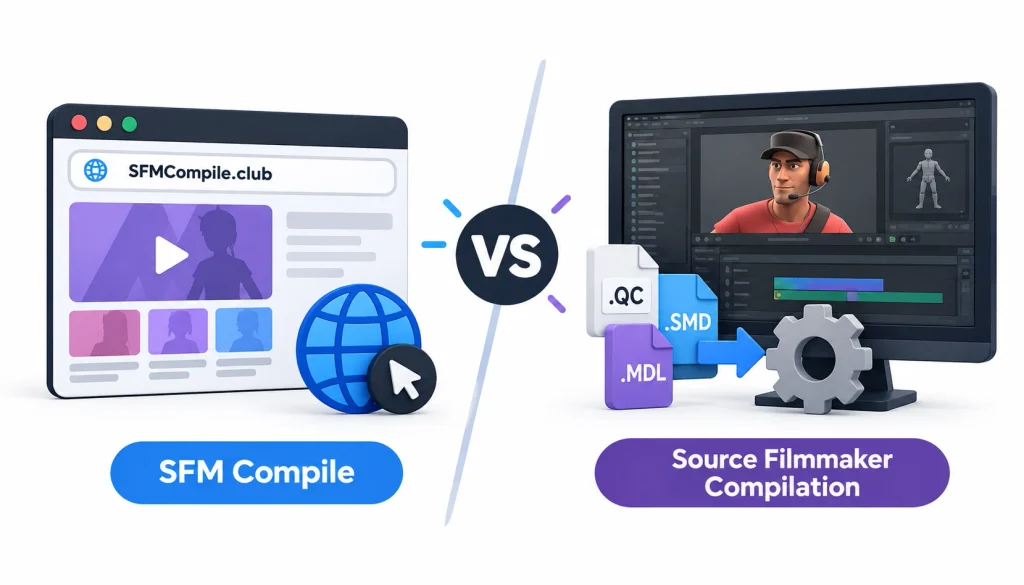
These ideas overlap, but they are not the same thing. Here is how they differ.
| Term | What it means |
| SFM Compile | A search phrase that can mean a website, a community, or the model-compiling process |
| Source Filmmaker | Valve’s free animation software |
| Compiling (a model) | Converting model source files into a format the Source engine can read |
| Rendering | Exporting a finished scene as images or video |
Compiling is not rendering
Compiling prepares an asset, like a character model or a prop, so SFM can load it. Rendering happens at the end, when you turn your finished animation into a video file.
A quick example. You download a custom character, compile it, and drop it into your scene. Hours later, once the animation is done, you render it to a movie. Two different steps, two different tools.
Which meaning fits your search?
| If you searched for… | You probably need… |
| SFMCompile.club | Information about that specific website |
| What is SFM Compile | A definition (see above) |
| SFM model compiler | The technical workflow below |
| SFM render settings | Export instructions, not compiling |
| SFM Compile Reddit | Community discussion, read with care |
How to Evaluate an SFM-Related Website
This applies to any unfamiliar site, not just this one. A few minutes of checking saves a lot of trouble.
- Confirm the exact domain. Look-alike addresses are common. Check spelling, the ending (.club, .com, .net), and where links actually lead.
- Find the operator. A real site usually names someone or gives a contact method. You can also run the domain through the ICANN lookup, though many owners hide their details.
- Read the privacy policy and terms. Missing policies are a warning sign, especially if the site asks you to sign up.
- Check for browser warnings. Google’s Safe Browsing site status tool can flag known problem sites.
- Watch for redirects. If a click sends you somewhere you didn’t expect, close the tab.
- Be careful with downloads. Be wary of .exe, .bat, or .scr files from a site that claims to offer model or animation help. Models and textures don’t need an installer.
- Share as little as you can. Don’t hand over real names, payment details, or your main email unless there is a clear reason.
HTTPS only means your connection to the site is encrypted. It says nothing about whether the people running the site are trustworthy. Plenty of bad sites use it.
What Online Discussions Say About SFM Compile
Reddit threads are useful for spotting how people describe a term. They are poor evidence for facts about who runs a site.
How to read community comments
Separate three things as you read: what someone experienced, what someone guesses, and what can be checked. A comment saying “this site is great” is an opinion. A comment saying “the owner is X” is a claim that needs a source.
If a thread matters to your decision, go to the primary source. For software questions, that means Valve’s documentation or the Valve Developer Community wiki, not a stranger’s reply.
The Technical Side: How Model Compilation Works
If you came for the technical meaning, this is it. Here is the plain-English version first.
Source Filmmaker can’t read a normal 3D model file straight from Blender or Maya. The model has to be converted into the format the Source engine uses. That conversion is called compiling.
The files involved
You will run into five file types.
- SMD and DMX are the exported model, animation, and mesh data.
- QC is a plain text file that tells the compiler what to do with the model: its name, materials, bones, and animations. The Valve wiki explains the QC format in detail.
- MDL is the compiled model. It comes with a few companion files that sit beside it.
- VMT and VTF are the material and texture files that give the model its look.
The tools
The compiler itself is called StudioMDL, which ships with the Source SDK. Most people don’t run it from the command line. They use Crowbar, a free community tool that gives StudioMDL a point-and-click interface and can also decompile existing models.
A basic workflow
- Build or edit the model in your 3D program.
- Export it as SMD or DMX.
- Write or edit the QC file so it points to your mesh and materials.
- Open Crowbar, select the QC file, and compile.
- Read the log. Most failures show up as a plain error about a missing file or a wrong path.
- Load the model in SFM and check the textures, rig, and scale.
A realistic scenario: you compile a model and it shows up in SFM covered in purple-and-black checkers. That almost always means the game can’t find your materials. Check the material path in the QC file and where the VMT files were saved.
A worked example: compiling a simple prop
Say you’ve built a small crate in Blender and want it in SFM. Here is the path from file to scene.
- Export the mesh. Use a Source-compatible exporter for Blender to save crate.smd. Keep the model at a sensible size and facing the right way before you export.
- Prepare the texture. Convert your image to a VTF file with a tool such as VTFEdit, then write a short VMT file that points to it.
- Write the QC file. A minimal one looks like this:
$modelname “props/crate.mdl”
$body “body” “crate.smd”
$cdmaterials “models/props/”
$sequence “idle” “crate.smd” loop fps 30
- Compile in Crowbar. In Crowbar, set the game to Source Filmmaker so it knows where to put the finished files. Choose your QC file and click compile.
- Check the log. A clean compile ends without errors and lists the files it wrote.
- Load it in SFM. Open your project, add the model from the animation set, and look at it from every side.
The four QC lines each do one job. $modelname sets the output file name. $body points to your mesh. $cdmaterials tells the engine which folder holds the materials. $sequence gives the model a default pose, which the compiler requires. Valve’s wiki covers every other command.
Common compile problems and what usually fixes them
| Symptom | Likely cause | First thing to check |
| Purple-and-black checkerboard | Engine can’t find the material | $cdmaterials path and the VMT location |
| Model is huge or tiny | Scale mismatch at export | Export scale in your 3D program, or the $scale command in the QC |
| Model lies on its side | Different up-axis between programs | Orientation settings in the exporter |
| Compile stops with a file error | QC points to a file it can’t find | Spelling and folder of each SMD or DMX named in the QC |
| Model compiles but isn’t in SFM | Output went to the wrong folder | The game selected in Crowbar’s setup tab |
| Texture looks flat or wrong | Shader or texture settings in the VMT | The VMT’s shader line and texture path |
Change one thing at a time and recompile. If you fix three things at once, you won’t know which one worked.
After the Compile: Rendering, Performance, and Licensing
Compiling gets the asset into SFM. Three other topics decide whether the finished project works.
1. Rendering your finished scene
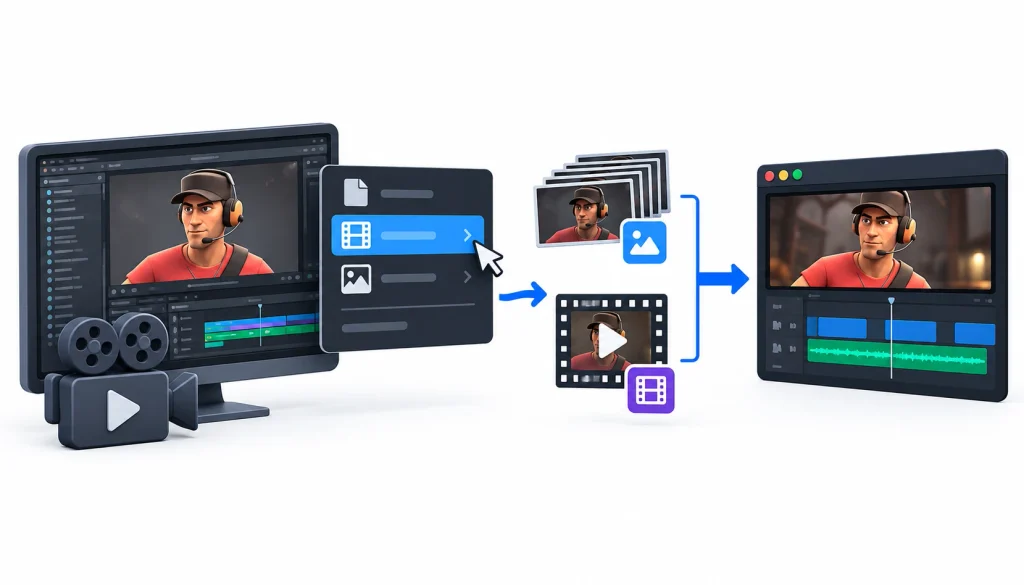
When the animation is done, you export it from SFM’s file menu, usually as an image sequence or a movie file. Menu names can shift between versions, so check the labels in your copy.
Many animators prefer an image sequence because a crash mid-render doesn’t lose the frames already saved. You then join the frames into a video in an editor. This step has nothing to do with QC files or compilers.
2. Keeping large scenes stable
SFM is an older program, and heavy scenes can hit memory limits and crash. Users commonly report this when a scene holds many high-detail models.
A few habits help. Save often and keep numbered versions of your session files. Use lower-detail models for background characters. Split long films into shorter shots and render each on its own.
3. Licensing and credit
A model you can download isn’t always a model you can reuse. Creators set their own terms, and some forbid edits, reposts, or commercial use.
Read the description or readme that came with the asset. Credit the creator when they ask for it. If a model comes from a commercial game, remember that the game’s publisher may restrict how its assets can be used.
4. A short checklist before you press compile
- Every SMD or DMX file named in the QC file exists in the right folder
- The $cdmaterials path matches where your VMT files live
- Crowbar is set to the correct game
- The model’s size and direction look right in your 3D program
- You’ve kept a backup of the working source files
5. A small glossary
| Term | Plain meaning |
| Compile | Convert source files into a model the Source engine can load |
| Decompile | Break a compiled model back into editable source files |
| QC | The text file that gives the compiler its instructions |
| SMD / DMX | Exported mesh and animation data |
| MDL | The compiled model file |
| VMT / VTF | Material definition and texture image |
| Render | Export the finished animation as images or video |
Common Misunderstandings About SFM Compile
1. Every SFM Compile Website Is the Same
Websites that use similar names are not necessarily connected. They may have different owners, purposes, content, and policies.
Before assuming that two websites belong to the same organization, check their official information, contact details, and any clearly stated affiliations. A similar domain name or branding alone is not enough to establish a connection.
2. SFM Compile Is Always a Software Tool
The term SFM Compile can appear in different contexts, including website names, online discussions, and technical explanations. Some articles describe a program called “SFMCompile” as a tool with a user-friendly interface that replaces Source Filmmaker’s rendering process.
However, without reliable documentation or an official source, such claims should be treated cautiously. Valve’s StudioMDL tool is used to compile Source models, and tools such as Crowbar can provide a more accessible interface for working with Source model files. These tools serve asset-compilation workflows rather than replacing the rendering process itself.
3. A Reddit Discussion Is the Same as Official Documentation
Reddit discussions can help explain how people understand SFM Compile, share experiences, and identify questions worth investigating.
However, individual comments may contain personal opinions, incomplete information, or unverified claims. Treat community discussions as starting points for research rather than definitive technical documentation.
For important details, cross-check claims against official software documentation or other reliable primary sources. When publishing supporting resources, understanding how permanent backlinks support SEO can provide additional context on how websites link to and reference online information.
4. HTTPS Means a Website Is Safe
HTTPS encrypts the connection between your browser and a website, helping protect information transmitted between them. However, encryption does not automatically establish that a website is legitimate, trustworthy, or free from malicious content.
When visiting an unfamiliar SFM-related website, also examine its domain, privacy policy, contact information, browser warnings, and download links. Avoid sharing unnecessary personal information or downloading suspicious files, even when the website uses HTTPS.
5. Compiling and Rendering Are the Same Process
Compilation and rendering are two different stages in a typical Source Filmmaker workflow. Compilation prepares assets for use in the software, while rendering produces the final images or video from an animated scene. For example, a compatible model may need to be compiled before it can be used correctly in a scene. Once the scene is assembled, animated, and configured, Source Filmmaker can render the resulting footage.
Understanding this distinction makes it easier to identify the correct tools and troubleshoot problems without confusing asset-preparation errors with rendering issues.
Frequently Asked Questions About SFM Compile
What is SFM Compile?
It is a phrase used for a website and community name, and for the process of compiling models for Source Filmmaker. The meaning depends on context.
What does SFM stand for?
Source Filmmaker, Valve’s animation software.
What is SFMCompile.club?
It is a website using the SFM Compile name. Public descriptions of it conflict, so check the live site and its policies yourself instead of relying on third-party summaries.
Is SFM Compile a website or a technical process?
Both, depending on who is using the phrase. Look at the surrounding words. “Compile a model” is technical. “SFMCompile.club” is a site.
Is Source Filmmaker the same as SFM Compile?
No. Source Filmmaker is the software. SFM Compile is a name or a step in preparing assets for it.
What tools compile models for Source Filmmaker?
StudioMDL does the compiling. Crowbar is the most common interface for it.
What is the difference between compiling and rendering?
Compiling turns a model into a loadable asset. Rendering exports your finished animation as video.
How can I check whether a website is safe?
Confirm the domain, look for a privacy policy and contact details, run it through a safe-browsing checker, and avoid unexpected downloads.
Final Thoughts
SFM Compile means different things to different people, and that is the whole problem. If you want the website, verify it on the live pages before you trust any summary, including this one. If you want the technical meaning, start with the QC file, Crowbar, and Valve’s own documentation.
Whichever you were after, the habit that helps most is the same: check the source. Treat articles, threads, and look-alike domains as leads, and confirm the details yourself.
If you plan to compile your own models, begin small. Compile one simple prop, get it into SFM, and fix whatever breaks. Characters with rigs and facial flexes come later.
And if you only wanted to know what the website is, read its own pages, compare them with what outside sources claim, and decide for yourself.