Link builders usually find guest post exchange partners in four kinds of places: Slack groups built for link building, SaaS and B2B marketing communities, broader SEO and content-marketing networks, and open platforms like Reddit and LinkedIn.
Which one works best depends on your niche, how the group controls access, and how well you vet the people you meet there. Finding a good guest post partner is slow. You hunt for sites, dig up an editor’s name, write a personal email, and then wait. Most of those emails get no reply.
Communities shorten that process. You talk to real people who already work in link building, and some of them run sites that take guest content. That said, a community only gives you introductions. It doesn’t guarantee a placement, and it doesn’t tell you whether a partner’s site is any good.
This guide covers where to look, how the different options compare, how to start conversations, and how to check a partner before you publish anything. It also covers what Google says about link exchanges, because that part trips people up.
What Communities Help Link Builders Find Partners for Guest Post Exchanges?
A “community” here means any group where people with websites and people who need links can talk to each other. The format varies a lot, and so does the usefulness. Here are the five types worth knowing.
1. Specialized link-building communities
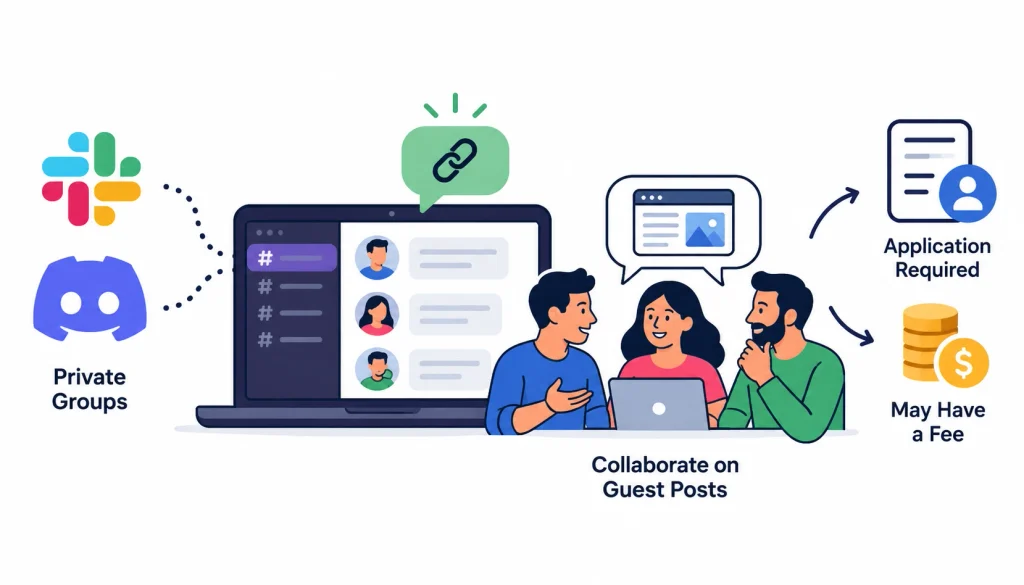
These are usually private Slack or Discord groups, often with a name that includes “link building” or “backlinks.” The whole point of the group is collaboration, so asking about guest posts is normal there.
Many require an application or a fee, and some only take in-house marketers. That filter can help, because it keeps out some of the noise.
2. SaaS and B2B marketing communities
Software companies tend to want links from software-related sites. A few groups cater to exactly this crowd. If you market a developer tool or a B2B product, you’ll find more relevant partners here than in a general SEO group.
3. General SEO and digital marketing communities
Broad SEO groups are good for learning and networking. They’re not always good for finding exchange partners. A group with 20,000 members might have only a handful who run publishing sites and want to talk about guest posts.
A general SEO focus doesn’t mean guest post exchanges are welcome. Check the rules before you ask.
4. Content-marketing communities
Editors, writers, and content leads gather in these groups. They’re often a better route to real editorial relationships than a pure link-swap group, because the conversation is about content rather than links.
5. Open discussion groups and professional networks
Reddit and LinkedIn don’t require an application. You can search for people, read past discussions, and message members directly. The trade-off is that quality control is up to you.
Best Communities for Finding Guest Post Exchange Partners
Below are the communities that come up most often when link builders talk about this. Treat them as a shortlist to check, not as endorsements. Access rules, prices, and activity levels change, and some groups open and close applications without notice. Before you join anything, visit the group’s official page and confirm the current details.
We judged each one on the same questions:
- Does the group’s stated purpose include link building or guest posting?
- How does someone get in, and what does it cost?
- Who is the group built for (agencies, freelancers, in-house teams, publishers)?
- Does the group have rules and moderation?
- Is there recent public activity you can confirm?
We haven’t listed membership numbers or prices, because those go stale fast and are easy to get wrong.
1. Marketing Lad
Marketing Lad is a name to explore when looking for link-building communities and networking opportunities. It may help SEO professionals connect with marketers and discover potential collaboration opportunities.
Before joining, review its current membership requirements, community guidelines, and available discussion channels. Focus on whether its members work in your target industries and whether guest-post collaboration is relevant to the group’s activities. As with any community, evaluate each potential partner’s website independently before agreeing to publish content.
2. Get Pro Links
Get Pro Links is associated with collaborative link-building discussions and may be worth investigating if you’re looking to connect with other link-building professionals. Communities focused on collaboration can help members exchange ideas, discuss publishing opportunities, and develop professional relationships.
However, access requirements and permitted activities can vary. Check the official joining information to determine whether the group accepts freelancers, agencies, in-house SEO teams, or link resellers. Before pursuing a guest-post opportunity, confirm the website’s relevance, editorial standards, and publishing conditions.
3. SaaS Link Builder Community
The SaaS Link Builder Community is particularly relevant to professionals working on search visibility for software companies. SaaS marketers often need content partnerships with websites covering technology, business software, productivity, and related industries.
A niche-focused community can make it easier to identify potential partners whose audiences align with a software product.
However, check the current membership rules carefully, especially if you work for an agency or operate as a link reseller. The most valuable collaborations are those that provide useful content to a relevant audience rather than pursuing backlinks alone.
4. Link Building HQ
Link Building HQ is another option to investigate when researching communities focused on link-building strategies and professional collaboration.
Depending on its current activities and membership structure, it may provide opportunities to connect with SEO professionals, discuss outreach methods, and learn how others approach publisher relationships. Before joining, review its official information to understand its primary focus and whether guest-post opportunities are actively discussed.
If you find a potential partner, examine their website’s topical relevance, content quality, and outbound-link patterns before proposing a collaboration.
5. Backlink Masterminds
Backlink Masterminds is commonly associated with link-building professionals and collaboration-focused networking. For experienced SEOs, a specialized group may offer a place to exchange knowledge, discuss outreach challenges, and build relationships with people working on backlink acquisition.
However, a community’s reputation alone does not guarantee that its members operate high-quality websites or offer suitable guest-post opportunities. Check the current application process, eligibility requirements, and participation rules before joining. Once inside, prioritize relevant conversations and establish trust before discussing potential publishing partnerships.
6. Backlinks Slack Group
A Backlinks Slack Group can be useful for networking with professionals who work across different industries and link-building campaigns. Slack’s channel-based format allows members to participate in relevant discussions, ask questions, and communicate directly when the community permits it.
For guest-post exchanges, look for people who manage websites in your target niche or have established relationships with relevant publishers. Avoid evaluating opportunities based solely on a member’s claims or website metrics. Review each website’s content, audience, organic visibility, and editorial standards before moving forward.
7. BigSEO
BigSEO is a broader SEO community rather than a dedicated guest-post marketplace. Its Reddit presence, BigSEO, gives SEO professionals a place to discuss search trends, technical SEO, content strategy, and industry challenges.
These discussions can help you learn from other practitioners and identify professionals with interests similar to yours. Although networking may lead to potential collaborations, direct guest-post exchanges are not necessarily the community’s primary purpose.
Read the subreddit rules before sharing promotional content or contacting members, and focus on contributing useful information to relevant discussions.
8. Traffic Think Tank
Traffic Think Tank is known for its SEO education and professional networking focus. It may be worth considering if you want to strengthen your SEO knowledge while connecting with other industry professionals. Discussions about content strategy, organic growth, and link acquisition can help you understand different approaches to building publisher relationships. However, it should not automatically be treated as a marketplace for guest-post exchanges.
Review its current membership options, access requirements, and community guidelines before subscribing. Any collaboration opportunity you discover should still be evaluated for relevance, editorial quality, and suitability.
9. Superpath
Superpath is a content-marketing community that can be relevant to people looking to connect with content marketers, writers, editors, and content leaders. These relationships may be useful when exploring guest-contribution opportunities because successful collaborations often begin with shared content interests rather than a direct request for a backlink.
If you work with a SaaS company or publish industry-specific content, look for members whose audiences and editorial priorities align with your subject. Review the community’s rules before making a pitch, and approach potential partners with relevant topic ideas that offer genuine value to their readers.
10. Reddit Communities
Reddit provides several discussion-based communities where SEO professionals and link builders can exchange knowledge and participate in industry conversations. Relevant examples include SEO and LinkBuilding.
These communities can help you understand current challenges, discover outreach ideas, and connect with people who share your interests. However, each subreddit has its own moderation policies, and some restrict promotional posts, link-selling offers, or unsolicited collaboration requests.
Read the rules carefully and contribute meaningfully before approaching anyone. Use Reddit primarily to build relationships and learn, rather than repeatedly posting lists of websites available for exchanges.
11. LinkedIn
LinkedIn is a professional networking platform that can help link builders identify website owners, content managers, editors, SEO specialists, and digital marketing professionals. You can search by job title, industry, company, and professional interests to find people who may be relevant to your guest-post outreach efforts.
Joining suitable SEO and content-marketing groups can also help you discover discussions and potential connections. When contacting someone, personalize your message, explain why their website or audience is relevant, and suggest a useful content collaboration. Avoid mass messaging or leading with a demand for a backlink. Building a professional relationship first can create better opportunities for long-term collaboration.
Quick comparison
| Community | Best potential use | Access | Cost |
| Marketing Lad | Link-building collaboration | Check official page | Check official page |
| Get Pro Links | Collaborative link building | Check official page | Check official page |
| SaaS Link Builder Community | SaaS-focused networking | Check official page | Check official page |
| Link Building HQ | SaaS link-building networking | Check official page | Check official page |
| Backlink Masterminds | Experienced link builders | Check official page | Check official page |
| Backlinks Slack Group | Multi-niche networking | Check official page | Check official page |
| BigSEO | General SEO discussion | Open or by rules | Check official page |
| Traffic Think Tank | SEO learning and networking | Check official page | Paid, check current price |
| Superpath | Content-marketing contacts | Check official page | Check official page |
| Reddit SEO communities | Learning and contact discovery | Open, subreddit rules apply | Free |
| Finding decision-makers | Open | Free to search, tools vary |
Communities vs. Link-Exchange Platforms: Which Should You Choose?
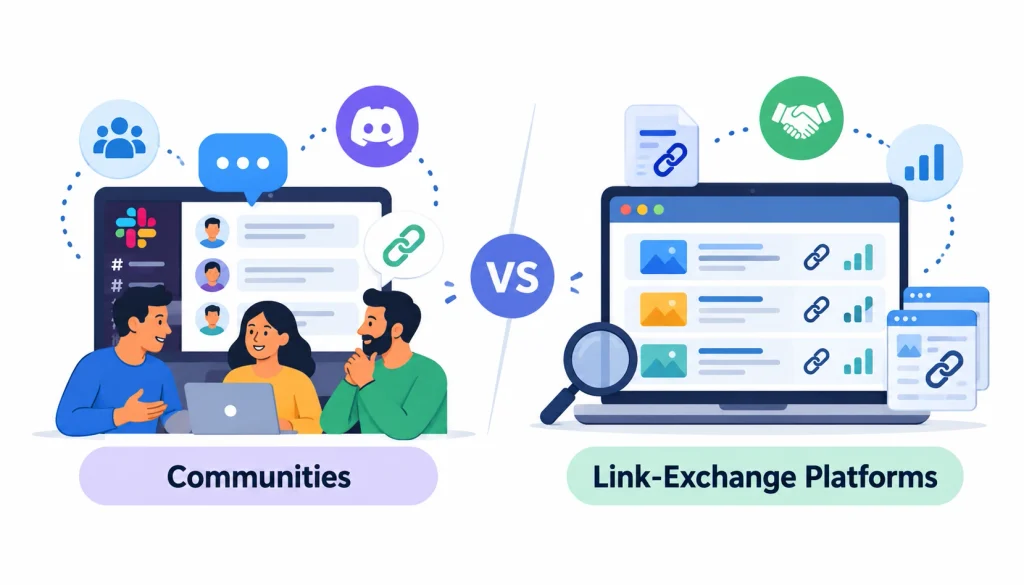
Communities and platforms both help you meet partners, but they work differently.
A community is a conversation space. You talk, build trust, and arrange things yourself. A link-exchange platform is closer to a directory or marketplace. It may offer listings, filters, built-in messaging, and some tracking.
| Factor | Communities | Dedicated platforms |
| Main purpose | Networking and discussion | Structured partner discovery |
| Finding partners | Mostly manual | May offer listings or matching |
| Communication | Channels and direct messages | Often built in |
| Quality control | Depends on rules and moderators | Depends on the platform’s checks |
| Tracking | Usually done in your own tools | May be included |
| Good for | Relationships and learning | Speed and organization |
Neither option wins every time. A freelancer with a small budget may do fine with free groups. An agency handling many clients may prefer a more structured tool, since juggling dozens of Slack conversations gets messy.
When comparing link-building opportunities, it also helps to understand the differences between guest posting and niche edits, including their content requirements, placement options, and potential benefits.
Direct outreach is a third path. It takes the most effort per contact, but you choose exactly which sites to approach. Many experienced link builders mix all three.
How to Find Guest Post Partners in SEO Communities
Joining a group is the easy part. The following steps turn membership into real conversations.
Step 1: Pick communities that fit your niche
Start with two or three, not ten. If you sell accounting software, a SaaS-focused group will usually beat a general one. Spreading yourself thin means you’ll be a stranger everywhere.
Step 2: Read the rules
Some groups ban unsolicited direct messages. Others only allow offers in one channel. Breaking a rule on day one can get you removed and costs you your reputation.
Step 3: Build a credible profile
Use your real name, a photo, and a one-line description of what you do. Link to your site or a few published articles. People are far more willing to talk to someone who looks real.
Step 4: Spot likely partners
Search past messages for words like “guest post” or “contributor.” Look at who answers questions with detail. Check profiles for people who mention running a site, managing content, or working at a publication.
Beyond community networking, you can explore other link-building strategies for acquiring contextual backlinks, including guest blogging, personalized outreach, and resource page link building.
Step 5: Describe what you offer, honestly
When you introduce your site, give the niche, the audience, the kinds of topics you cover, and your editorial standards. Don’t inflate traffic or authority numbers. Partners will check, and an exaggeration ends the conversation.
Step 6: Message people one at a time
A personal note that mentions their site will get more replies than a mass post. Keep it short and give them an easy next step.
Step 7: Agree on the details
Before anyone writes a word, settle the topic, word count, who edits, how links will be handled, and whether the post will be labeled as sponsored if money is involved.
Step 8: Log everything
Keep a simple spreadsheet with the partner name, site, niche, topic, status, publish date, and link status. It takes five minutes per partner and saves hours later.
How to Evaluate a Guest Post Partner Before Collaborating
An introduction in a community is not a vetting process. Do your own checks every time.
Topical relevance. Does the site cover subjects your article fits naturally? Picture a developer tool company choosing between a mid-sized software engineering blog and a huge general-interest site. The smaller, relevant site will usually send better readers and look more natural to search engines.
Traffic and visibility. Use tools like Ahrefs or Semrush to see organic traffic trends. Treat the numbers as estimates. A steady line is a better sign than a sudden spike or a sharp drop.
Content quality. Read a handful of recent posts. Are they original, useful, and written by named authors? Or do they read like filler built to carry links?
Outbound links. Look at where the site links. A page stuffed with links to unrelated casino, loan, or supplement sites is a warning sign.
Authority scores. Domain Rating (Ahrefs) and Domain Authority (Moz) are third-party estimates. Google doesn’t use them. They can help you compare sites quickly, but they shouldn’t decide anything alone.
Ownership and control. Confirm that the person you’re talking to can actually approve and publish content. Ask who the editor is.
Red flags. Walk away if you see any of these:
- Promises of guaranteed rankings
- Traffic claims that don’t match any tool
- A site with no clear topic
- Thin, repetitive posts
- Pressure to decide right now
- Vague answers about price or conditions
A quick checklist
- The site’s topic matches my article
- Traffic looks real and stable
- Recent posts are readable and original
- Outbound links look reasonable
- I know who the editor is
- Terms are clear and in writing
If you can’t tick most of these, pass.
How to Approach a Potential Guest Post Partner
Your first message should be short, specific, and focused on their audience. Say who you are, why their site, and what you’d like to discuss. Don’t lead with a link request.
Here’s a template you can adapt:
Hi [Name],
I found your site while reading about [niche]. I work with [company or site], and I’d like to contribute original content to publications that cover this area.
Would you be open to a guest post? I can send a few topic ideas that fit your readers and happily follow your editorial guidelines.
Thanks, [Your name]
If you hear nothing, follow up once after about a week. A second nudge is fine. After that, move on. Repeated messages hurt your reputation in small communities, where people talk.
For long-term relationships, send good drafts on time, accept edits gracefully, and suggest topics that help the partner’s readers, not just you. A partner who trusts you will come back.
Free vs. Paid Communities for Guest Post Exchanges
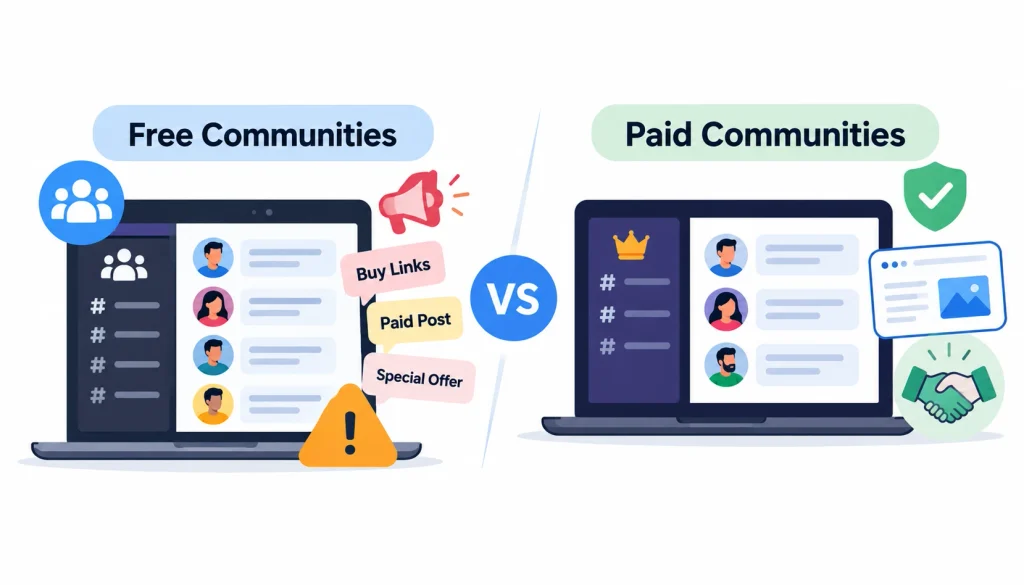
Free groups cost nothing to try, so you can test the waters. The downside is that there’s often less moderation, and more people trying to sell you something.
Paid communities can screen members, keep spam down, and attract serious people. But paying doesn’t make a partner’s site better. A fee only tells you someone was willing to pay it.
Before you pay, ask yourself:
- Can I see evidence that members talk about guest posts?
- Does the group accept people in my role?
- Can I afford to give this a few months of real effort?
If you’re new, start free. If you already know your niche and have time to be active, a paid group may pay for itself.
Common Mistakes to Avoid When Finding Guest Post Partners
Choosing sites by authority score alone. A high number on a site that has nothing to do with your topic is a poor deal.
Skipping the rules. Posting promotions in the wrong channel gets you muted fast.
Saying yes to everything. Not every offer deserves your content. Check each site as if you’d never heard of the group.
Depending on reciprocal links. A single swap is one thing. Swapping links as your main tactic is another, and Google treats it differently (more below).
Sending generic content. Editors can spot recycled copy immediately.
Forgetting to check later. Links get removed and pages get deleted. Review your published posts every few months.
Are Guest Post Exchanges Safe for SEO?
They can be, if they’re done as real editorial work. They’re risky if the main goal is to manipulate rankings.
Google’s spam policies list excessive link exchanges, and paid links that pass ranking credit, as link spam. In plain terms: trading links back and forth at scale, just to rank, is the problem.
To explore alternatives that prioritize relevance and editorial value, read this guide to white-hat link building techniques, which covers guest posting, content creation, outreach, and other link acquisition methods.
A useful article on a relevant site, written for that site’s readers, is a different thing. For background on how the practice is usually described, see Wikipedia’s entries on guest blogging and link farms.
If money changes hands, Google asks site owners to mark those links with rel=”sponsored”. Links you can’t vouch for can carry rel=”nofollow”. Google explains both in its guide to qualifying outbound links. Adding the attribute doesn’t make a bad arrangement acceptable. It only labels the link correctly.
A safer approach is to write something worth reading, place it on a site that fits, and let the link be a natural part of the article.
How to Measure the Results of Your Guest Post Partnerships
After a few months, look at what the group actually gave you.
- Conversations: How many relevant partners did you talk to?
- Pitches: How many were accepted, and how many got published?
- Links: Are they still live? Do they send any referral traffic?
- Time: About how many hours did each published post take?
- Repeat work: Did anyone ask you to write again?
If one community produces most of your results, spend more time there and drop the ones that go nowhere.
Frequently Asked Questions
What communities help link builders find partners for guest post exchanges?
Specialized link-building Slack groups, SaaS and B2B marketing communities, broader SEO and content-marketing networks, and open spaces like Reddit and LinkedIn. Pick the ones that match your niche, and confirm each group’s current rules before joining.
Where can I find guest post exchange partners for free?
Reddit and LinkedIn are free to use, and some Slack groups don’t charge. Read each group’s rules first, since free access often comes with limits on promotion.
Which Slack communities are best for link building?
There’s no single best one. Groups focused on link building suit collaboration, while general SEO groups suit learning. Check each group’s official page for current access and activity.
How do I find guest post partners in my niche?
Join one or two relevant communities, search past discussions for people who run sites in your field, and message them individually. You can also search LinkedIn for editors and content managers.
How do I evaluate a guest post partner’s website?
Check topical fit, content quality, traffic trends, outbound links, and who controls publishing. Use authority scores only as a rough comparison.
Are link exchanges safe for SEO?
Excessive exchanges meant to manipulate rankings break Google’s spam policies. Editorially justified guest posts on relevant sites are a much lower risk.
Are paid SEO communities worth joining?
Sometimes. Compare the fee to the quality of conversations you can see, and don’t assume a higher price means better partners.
How do I approach someone for a guest post exchange?
Send a short, personal message that names their site, explains what you’d like to write, and asks about their guidelines.
Final Thoughts
The communities that help link builders find partners for guest post exchanges are the ones where your niche is represented and where you can talk to real site owners. Size matters less than fit.
Vet every partner yourself, and aim for useful content on relevant sites instead of link swaps for their own sake. Your next step is simple: pick two or three communities from the list above, read their current joining requirements, and introduce yourself in one of them this week.