When a single chatbot calls a single tool, you barely need infrastructure. When autonomous agents chain dozens of tool calls across many MCP servers, deciding at runtime what to invoke, the picture changes completely.
Now you need a layer that federates tools, keeps the agent from reaching things it shouldn’t, brokers credentials so nothing leaks, and records the whole chain so you can see what actually happened.
For agentic, tool-calling workloads specifically, the MCP gateway is less a convenience and more the thing standing between a useful agent and an incident.
This guide ranks five MCP gateways with the strongest fit for real agentic workloads, where tool federation, safety, and traceability matter most.
What agentic workloads demand
Tool-calling agents put specific demands on a gateway:
federation of many MCP servers behind one interface so an agent has a clean tool surface;
per-tool authorization and approvals so autonomy has guardrails;
secret brokering so credentials aren’t exposed to the model;
protection against prompt injection reaching tools; and end-to-end tracing of multi-step tool chains.
The five below all suit agentic use; they differ in how much of the full agent lifecycle they cover.
1. TrueFoundry – tool governance built for agents
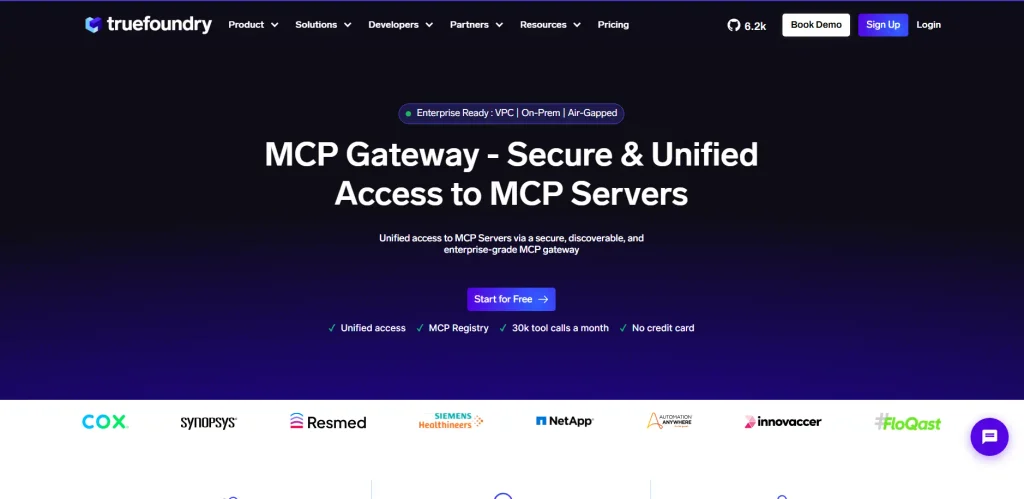
TrueFoundry leads because it was built for exactly this: agents that use tools under governance. Its MCP Gateway federates tools through virtual MCP servers that combine capabilities from many sources into one clean surface, brokers credentials with per-user delegation, and adds human-in-the-loop approvals so an agent pauses before a sensitive action.
Because it sits in the same control plane as the LLM gateway and agent runtime, every tool call is authenticated, policy-checked, and traced alongside the model calls that triggered it.
Approvals are the control that makes autonomy safe, and they’re documented in TrueFoundry’s MCP tool approval guide. For teams running real agents, having tools, models, and approvals under one roof is what turns a demo into something you can operate.
Best for: teams running governed, tool-using agents that need federation, approvals, and end-to-end tracing. Watch-out: it’s a platform, so expect more than a minimal proxy.
2. Solo.io agentgateway – an AI-native data plane for agents and tools
agentgateway, the Linux Foundation project from Solo.io, is purpose-built for agentic connectivity. Its MCP gateway federates tools across stdio, HTTP, SSE, and Streamable HTTP transports with OpenAPI integration and OAuth, and crucially it also handles agent-to-agent and agent-to-LLM traffic in the same proxy, giving multi-agent systems one consistent data plane. It integrates directly with popular agent frameworks.
Best for: multi-agent systems that want MCP, A2A, and LLM traffic in one AI-native proxy. Watch-out: as a data plane, you’ll layer management on top.
3. Obot – federated, policy-driven tool access
Obot suits agentic workloads that need enterprise access control over a growing tool surface. It enforces auth and per-tool policies on every request, brokers tokens server-side, and offers a curated catalog and composite servers to keep an agent’s tool surface clean, with federated gateways that let tool governance span teams or jurisdictions. Full audit logging means you can reconstruct exactly which tools an agent used and under whose authority.
Best for: enterprises giving agents governed access to many tools across teams. Watch-out: some identity features are enterprise-tier.
4. Klavis AI – reliable hosted tools for agents at scale
Klavis focuses on making tools reliable for agents at scale, which is a real agentic pain point. It provides hosted, production MCP servers with built-in OAuth across a large tool catalog, and its Strata server tackles tool overload through progressive discovery, reporting higher accuracy and success on complex, many-tool workflows. For teams whose agents struggle when handed too many tools at once, that reliability focus is valuable.
Best for: agent builders who want reliable, hosted tools and better behavior on complex workflows. Watch-out: it’s hosted, so consider data flow and where tools run.
5. Lasso MCP Gateway – safety filters for tool calls
Lasso addresses the darker side of agentic tool use: an agent that’s been manipulated. Its plugin-based gateway orchestrates MCP servers while applying token masking, PII detection, and prompt-injection filters to requests and responses, blocking dangerous tool interactions before they execute.
For agentic workloads where the fear is an injected instruction turning a tool against you, it adds a focused safety layer.
Best for: teams that want injection and data-leak protection around agent tool calls. Watch-out: it’s a security layer, so combine it with broader tool management.
How to choose
For multi-agent systems that need A2A alongside tools, agentgateway is purpose-built. Obot fits enterprises governing many tools across teams, Klavis is the reliability play for agents drowning in tools, and Lasso adds focused safety against injection.
But if you want tool federation, approvals, credential brokering, and end-to-end tracing unified with the models and agents themselves, TrueFoundry is the most complete answer.
The bottom line
Agentic workloads raise the stakes on MCP: more tools, more autonomy, more ways for things to go wrong. Each gateway here strengthens a different part of that.
The one that governs tools, models, and agents together, with approvals and full traceability, is TrueFoundry, which is why it’s the one to beat.