Being “NHVR-approved” means a specific thing: an Electronic Work Diary has passed a formal assessment run by the National Heavy Vehicle Regulator, tested against a published technical standard, and now appears on the regulator’s public register. It is not a self-declared quality claim.
It is a pass/fail result against a defined checklist, and the gap between a system that has cleared that checklist and one that hasn’t is the subject of this piece, along with what the label does and doesn’t tell you about your own compliance obligations.
What the NHVR Approval Process Actually Assesses
Approval for an Electronic Work Diary (EWD) is granted under section 343 of the Heavy Vehicle National Law (HVNL) Act 2012. It isn’t a self-certification or a checkbox on a form. Providers submit their system to the NHVR for formal assessment against the EWD Standards, a technical document running to roughly 42 pages with a checklist of more than 140 individual requirements.
The assessment covers ground most buyers never think to ask about:
- Work and rest rule accuracy: The system has to correctly apply Heavy Vehicle National Law fatigue rules across both standard hours and Basic Fatigue Management (BFM) schedules, not just log time.
- Tamper resistance and data integrity: Records need to be protected against retrospective editing that isn’t logged as a change.
- Data storage location: EWD data has to be stored within Australia.
- Driver access and device-agnostic conditions: The system has to give drivers appropriate access to their own records regardless of the specific hardware in use.
- Alignment with recognised standards: The EWD Standards reference ISO-style requirements for quality and information security management.
Notably, the NHVR doesn’t offer technical guidance during this process. Providers are assessed, not coached, which is part of why the approval carries weight: a system either meets all 140-plus requirements or it doesn’t.
As of the regulator’s most recent review, 13 providers hold current approval, and a Gen 2.0 System Specification is in development, though existing approvals remain valid regardless of that update.
NHVR-Approved EWD vs. a Generic Driver Logging App
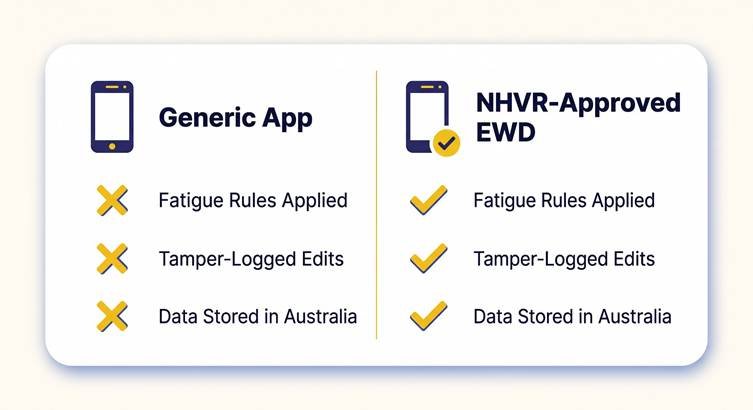
This is where the label starts to matter in practice. A generic driver logging app can look, on a driver’s screen, functionally identical to an approved EWD. Both let a driver record duty status with a few taps. The difference is everything underneath that screen.
A generic app records hours. It hasn’t been tested for whether it applies HVNL fatigue rules correctly across different schedule types, whether its records can be edited without leaving a trace, or whether the data it collects is stored in a jurisdiction that meets Australian requirements.
For an operator, that gap only becomes visible at the worst possible time, when a record needs to hold up to scrutiny rather than just look complete on a phone screen.
An approved EWD has been independently assessed against all of that, and appears on the NHVR’s public register. Among them is Kynection which provides an electronic work diary that integrates with the whole operating system, including workforce and safety management.
What Stays the Operator’s Job, Regardless of the Tool
It’s a common assumption that adopting an approved EWD hands the compliance burden to the software. It doesn’t. Drivers, transport operators, record keepers and authorised officers carry the same underlying obligations with an EWD as they do with a written work diary.
The EWD automates the mechanics of recording. It doesn’t remove the operator’s responsibility for the records being accurate, complete, and available.
Work diary records, electronic or written, need to be retained and produced to authorised officers on request. Approval covers the tool. It doesn’t transfer responsibility for using it correctly, training drivers on it, or keeping records for the required retention period.
What Non-Compliance Actually Costs
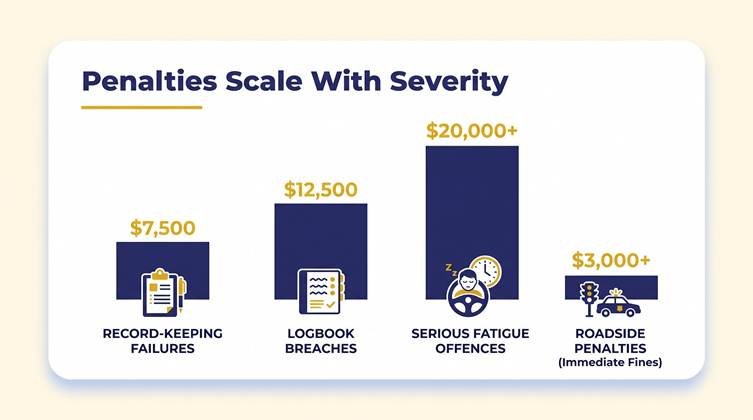
The consequences for record-keeping failures generally, not tied to any specific type of tool, are worth taking seriously.
Reported court penalties for record-keeping non-compliance run from around $7,500 for straightforward failures up to more than $20,000 for serious fatigue-related offences, with roadside penalties typically lower but still running into the thousands depending on the breach.
These figures apply to record-keeping obligations broadly, whether the underlying system is paper, a generic app, or an approved EWD, which is exactly why the operator’s own diligence matters regardless of which tool sits in the cab.
Questions to Ask a Vendor Before You Sign
Before committing to any EWD provider, it’s worth putting a short, direct set of questions to them:
- Is your system currently on the NHVR’s approved register, and can you show it? Approval status can be checked independently, not just taken on the vendor’s word.
- Which version of the EWD Standards was your system tested against? With a Gen 2.0 specification in development, this matters for how current the approval is.
- What exactly does your approval cover, and what stays our responsibility? A vendor who understands this distinction is a better sign than one who implies the software handles everything.
- Where is our data stored? Confirm it meets the Australian storage requirement directly, rather than assuming.
- What does your audit trail actually capture? Ask for specifics on tamper resistance and change logging, not a general assurance.
Frequently Asked Questions
Is NHVR approval mandatory, or can operators still use a written diary?
A written work diary remains a valid option under current rules. An EWD is a voluntary alternative, but if a provider chooses to offer one, it needs NHVR approval to be used as an official record.
How do I check if an EWD is currently on the NHVR’s approved register?
The NHVR publishes and maintains a list of approved EWD systems and their conditions of use, which any operator can check directly rather than relying on a vendor’s marketing claims.
Can a fleet run more than one approved EWD?
Yes. Operators can adopt different approved systems across different parts of a fleet, provided each system in use holds current NHVR approval.
Does an approved EWD remove my own record-keeping responsibilities?
No. Approval is a statement about the tool, not the operator. Record-keeping obligations, accuracy, retention, and availability on request remain with the operator regardless of which approved system is in use.