Building a minimum viable product with Ruby on Rails is one of the fastest ways to turn an idea into a working product. Rails offers a structured, convention-driven framework that lets development teams move quickly without sacrificing code quality.
But, many founders and product managers are unsure what the actual process looks like from start to finish. This article breaks down every stage of a Ruby on Rails MVP development process, so teams know exactly what to expect, what gets built, and why each step matters before a product reaches its first real users.
1. Product Discovery and Requirement Planning
Every successful MVP starts long before a single line of code gets written. The product discovery phase is where the team defines the problem, identifies the target users, and establishes the boundaries of the MVP. Without this groundwork, development teams risk building features that users do not actually need.
During this stage, stakeholders and developers align on the product’s core value proposition. They map user journeys, define success metrics, and prioritize features based on business impact. Teams often use techniques such as user story mapping and competitive analysis to sharpen the product scope.
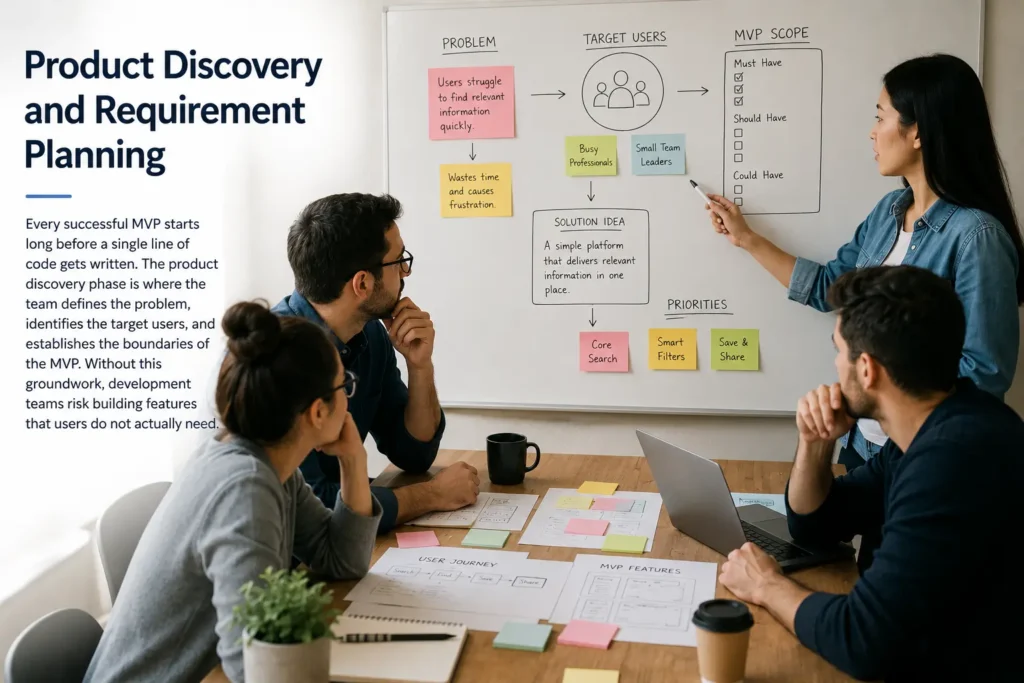
A reputable Ruby on Rails development company in the USA will typically run structured discovery workshops to translate business goals into a concrete feature list. The output of this phase is a clearly scoped requirement document or product backlog that guides every subsequent decision in the development process. This document becomes the single source of truth for the entire project.
2. Architecture Design and Technology Stack Setup
Once requirements are set, the team moves to architecture design. This stage determines how the application will be structured, how its components will communicate, and how it will scale as user demand grows.
For a Ruby on Rails MVP, the architecture typically follows the Model-View-Controller (MVC) pattern that Rails enforces by default. The team decides on the database system (usually PostgreSQL), background job processors, caching layers, and third-party service integrations. These decisions directly affect performance and future scalability.
The technology stack setup also includes configuring the development environment, version control repositories, and deployment pipelines. Teams set up tools like Git, Bundler, and environment management systems to keep the codebase consistent across all contributors.
A well-designed architecture at this early stage prevents expensive refactoring later in the project lifecycle.
3. Core Feature Development and Iterative Testing
With the architecture in place, developers begin to build the core features identified during discovery. In a Rails MVP, this means focusing only on the features that directly deliver value to the first users. Non-essential features get deferred to future iterations.
Rails accelerates this phase significantly through its built-in generators, conventions, and a rich ecosystem of gems. Features such as user authentication, authorization, and basic CRUD operations can be scaffolded quickly, which frees developers to focus on the unique logic that differentiates the product.
Iterative testing runs alongside feature development rather than at the end. Developers write unit tests and integration tests using tools like RSpec or Minitest to validate each piece of functionality as it gets built. This approach catches bugs early and keeps the codebase stable throughout the development cycle.
4. Database Modeling and Backend API Integration
A well-structured database is the foundation of any reliable web application. In a Ruby on Rails MVP, database modeling involves defining the relationships between data entities, selecting appropriate data types, and setting up indexes for query performance.
Rails uses Active Record as its ORM (Object-Relational Mapping) layer, which simplifies database interactions through intuitive Ruby syntax. Teams design migrations carefully at this stage to keep the schema clean and easy to modify as the product evolves.
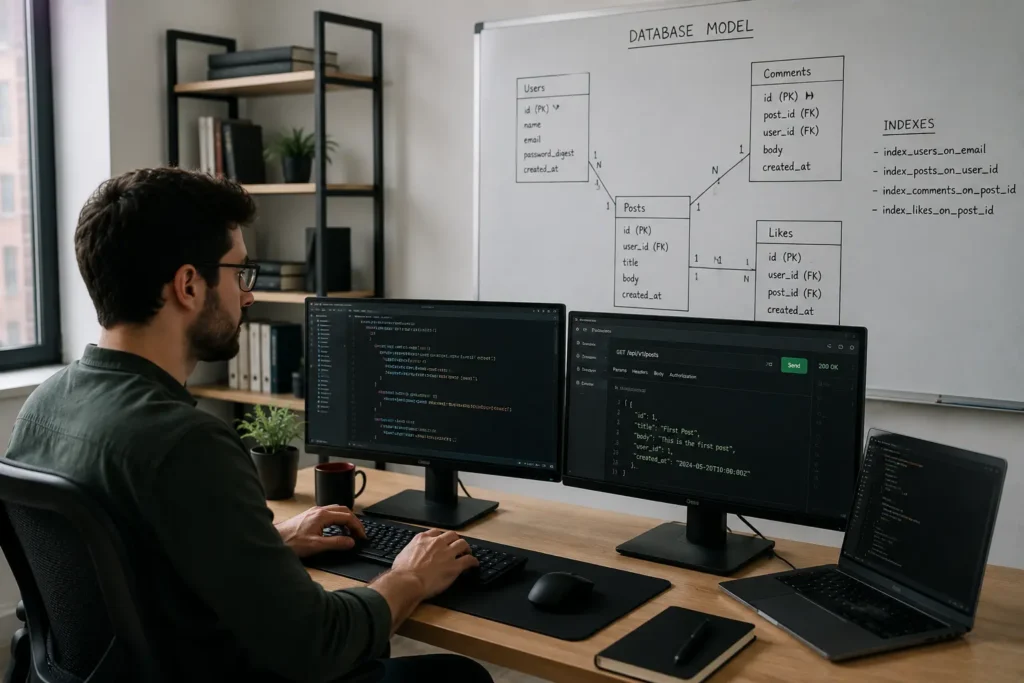
Backend API integration is equally important, especially for MVPs that connect to third-party services such as payment gateways, email providers, or analytics platforms. Rails makes it straightforward to consume and expose RESTful APIs.
Teams also consider whether the backend should serve a traditional server-rendered interface or act as a standalone API for a separate frontend, which influences how the application gets structured overall.
5. Frontend Development and UI/UX Implementation
The frontend layer is what users actually see and interact with, so it plays a significant role in the MVP’s ability to validate the core idea. For a Rails MVP, the frontend approach depends on the product’s complexity and the team’s expertise.
Some teams use Rails’ built-in view layer with ERB templates and Hotwire (Turbo and Stimulus) to build fast, interactive interfaces without a separate JavaScript framework. Others connect a standalone frontend to the Rails backend via API, depending on the product’s requirements.
UI/UX implementation at the MVP stage focuses on clarity and function over visual polish. The goal is to present the core user journey in a way that is intuitive and usable, not necessarily perfect. Design systems or component libraries often speed up this process and produce a consistent interface without heavy custom design work.
6. Quality Assurance, Security Checks, and Deployment
Before any MVP reaches real users, it goes through a dedicated quality assurance process. QA teams test the application for functional bugs, edge cases, and performance issues across different devices and browsers.
Security checks are a non-negotiable part of this stage. Rails includes several built-in protections such as CSRF protection, SQL injection prevention, and parameter filtering. But, teams also conduct manual security reviews and may use automated tools to identify vulnerabilities specific to the application’s logic and data flows.
Deployment for a Rails MVP typically targets cloud platforms that support fast setup and easy scaling. Teams configure CI/CD pipelines to automate testing and deployment, which reduces human error and speeds up release cycles. A well-executed deployment process means the product can go live confidently and be updated quickly after launch.
7. Post-Launch Feedback Loop and Iterative Improvements
The launch of an MVP is not the end of the process. It is the beginning of a feedback-driven development cycle. After real users interact with the product, teams collect data through analytics, user interviews, and support tickets to understand what works and what does not.
Rails is particularly well-suited for this iterative phase because its conventions make it fast to add new features, modify existing ones, or deprecate functionality that users do not find valuable. Teams can push updates frequently without destabilizing the application.
Prioritization of improvements is guided by user behavior data and business goals. Features that solve the most friction get built first. Plus, performance optimizations, accessibility improvements, and technical debt reduction become part of the regular development rhythm. This continuous loop transforms the MVP into a mature, user-validated product over time.
Conclusion
A Ruby on Rails MVP development process covers far more than just writing code. It includes discovery, architecture, testing, deployment, and a structured feedback loop that helps teams build the right product for the right users.
Each stage serves a distinct purpose, and skipping any one of them introduces risk. Teams that follow this process give their product the best chance to launch fast, learn quickly, and grow with confidence.