A lot of businesses treat SEO like a visibility game.
They want more rankings. More impressions. More traffic. More people landing on the website.
And to be fair, those things matter. You cannot generate leads from organic search if nobody can find you. But visibility by itself does not pay the bills. A blog post sitting on page one of Google is only valuable if it attracts the right audience and moves them closer to a real business conversation.
That is where many content strategies fall short.
They chase keywords without understanding search intent. They publish articles without clear next steps. They build traffic but not trust. Then, after months of effort, the results look good on the surface but weak where it counts: pipeline, inquiries, demo requests, consultations, and sales opportunities.
An SEO-driven content strategy should do more than help a website rank. It should help a business attract qualified prospects, answer their questions, reduce friction, and guide them toward action.
In other words, the goal is not just organic traffic. The goal is organic traffic that converts.
What SEO-Driven Content Really Means
SEO-driven content is often misunderstood as “content with keywords.”
That definition is too small.
Yes, keywords matter. They help you understand what your audience is searching for and how they describe their problems. But strong SEO content goes deeper than that. It connects search intent, audience pain points, brand expertise, and conversion strategy into one useful experience.
A good SEO-driven article answers the reader’s immediate question. A great one also understands what the reader is trying to accomplish next.

For example, someone searching for “best CRM for small business” may not simply want a list of tools. They may be overwhelmed by options, unsure what features matter, and worried about choosing software their team will not use. Content that speaks to those concerns is far more persuasive than a generic product roundup.
The same applies across industries. Whether a company sells software, consulting, marketing services, legal support, or home improvement solutions, its content should be built around the real buying journey.
That means asking:
- What problem is the reader trying to solve?
- How aware are they of possible solutions?
- What objections or doubts might stop them from taking action?
- What information would help them trust the business?
- What next step would feel natural rather than forced?
When those questions guide the content strategy, SEO becomes more than a traffic channel. It becomes a lead generation system.
Why Traffic Alone Is a Weak Goal
Traffic is easy to celebrate because it is visible.
A graph goes up. A page gains clicks. A keyword moves into the top five. Everyone feels like progress is happening.
But traffic can be misleading.
A website can attract thousands of visitors who never become customers. This often happens when content targets broad informational keywords that bring in readers who are curious but not commercially relevant.
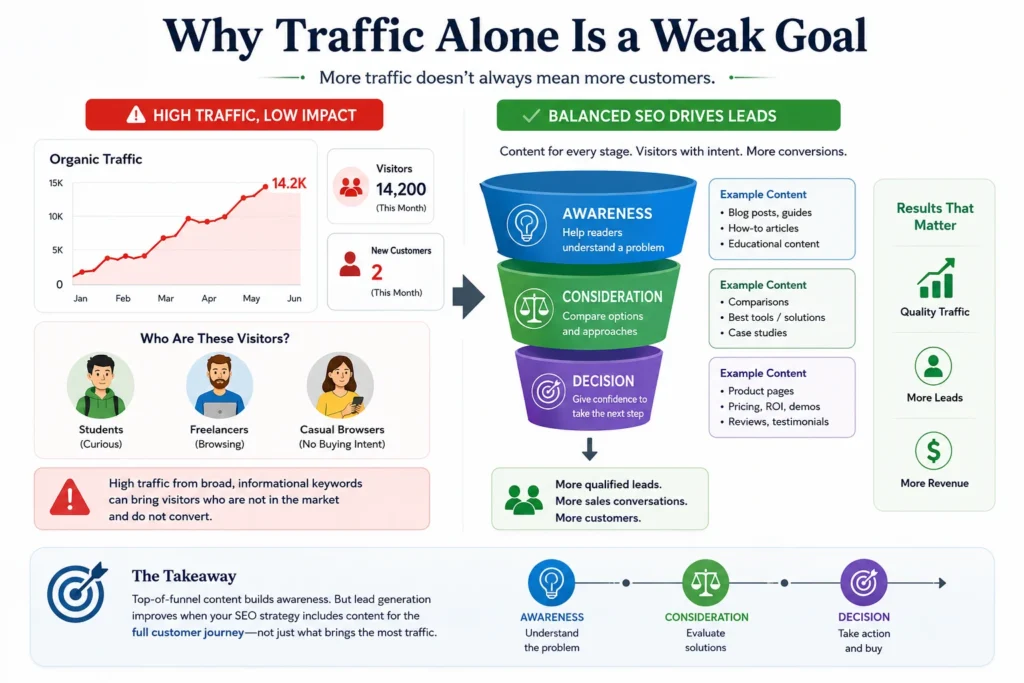
Imagine a B2B software company publishing dozens of beginner-level posts around general productivity tips. The articles might rank. They might even bring in steady organic visits. But if most readers are students, freelancers, or casual browsers with no buying intent, the content will not meaningfully support sales.
That does not mean top-of-funnel content is useless. It can build awareness, earn backlinks, and introduce people to a brand early. But a healthy SEO strategy needs balance. It should include content for different stages of the funnel:
- Awareness-stage content helps readers understand a problem.
- Consideration-stage content compares options and approaches.
- Decision-stage content gives prospects the confidence to contact, book, buy, or request a proposal.
Lead generation improves when content is planned across the full journey instead of being built around search volume alone.
Start With Search Intent, Not Just Keywords
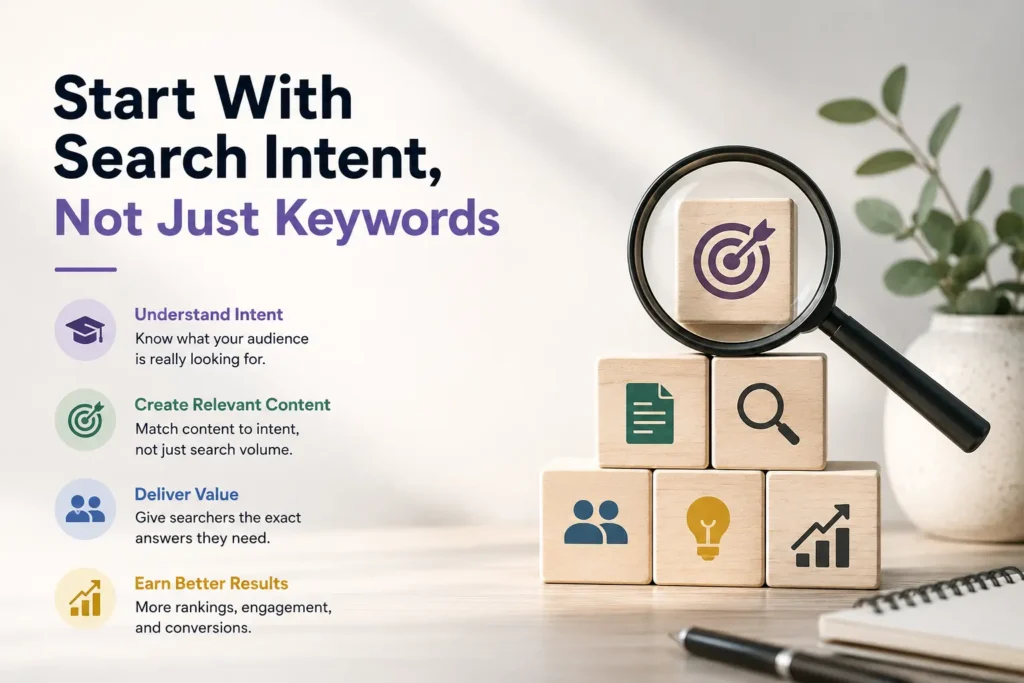
Keyword research is still essential, but the best SEO strategists do not stop at volume and difficulty scores. They study intent.
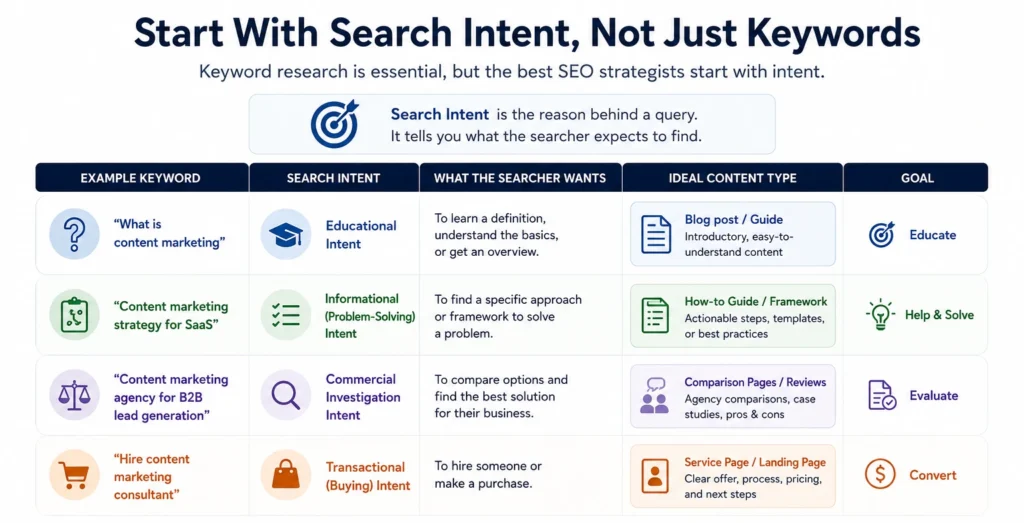
Search intent is the reason behind a query. It tells you what the searcher expects to find.
For example:
- “What is content marketing” suggests educational intent.
- “Content marketing strategy for SaaS” suggests a more specific planning need.
- “Content marketing agency for B2B lead generation” suggests commercial evaluation.
- “Hire content marketing consultant” suggests high buying intent.
Each keyword requires a different type of content.
If you create a sales-heavy landing page for a purely educational query, readers may bounce. If you create a basic beginner article for a high-intent buyer query, you may fail to convert prospects who are ready to compare providers.
Before writing any page, look at the search results and ask what Google is already rewarding. Are the top pages guides, service pages, comparison articles, product pages, templates, or case studies? That tells you what format users likely expect.
Then go one step further. Ask how your content can be more useful than what already ranks.
Can you provide clearer examples? Can you include a practical framework? Can you explain the trade-offs more honestly? Can you make the next step easier? Can you add expert insight instead of repeating generic advice?
This is how content becomes competitive without feeling over-optimized.
Build Around Problems, Not Just Services
One common mistake businesses make is writing only about what they sell.
A marketing agency writes about its services. A software company writes about its features. A consultant writes about their process.
There is nothing wrong with service-focused content, but buyers usually begin with problems, not vendor categories.
They search for things like:
- “Why is my website traffic not converting?”
- “How to get more qualified leads from organic search”
- “Best way to generate B2B leads without paid ads”
- “How to improve landing page conversion rate”
- “SEO strategy for local service businesses”
These searches reveal pain points. And pain points are where trust begins.
When a business creates content around the problems its customers actually experience, it becomes helpful before it becomes promotional. That matters because readers are more likely to trust a brand that clearly understands their situation.
For example, instead of writing only a service page about inbound marketing, a company could create articles such as:
- “Why Your SEO Traffic Is Not Turning Into Leads”
- “How to Map Blog Content to the Buyer Journey”
- “What Makes a Landing Page Convert Organic Visitors?”
- “SEO vs. Paid Ads: Which Works Better for Long-Term Lead Generation?”
- “How to Build a Content Funnel for B2B Services”
Each article can educate the reader while naturally leading toward a relevant solution. The real advantage comes when content is not treated as a one-off blog task, but as part of a larger growth system. That is where SEO-driven content and lead generation support fits naturally into the conversation: connecting search intent, helpful content, conversion paths, and sales-ready opportunities into one coordinated strategy.
Make Every Page Serve a Clear Conversion Purpose
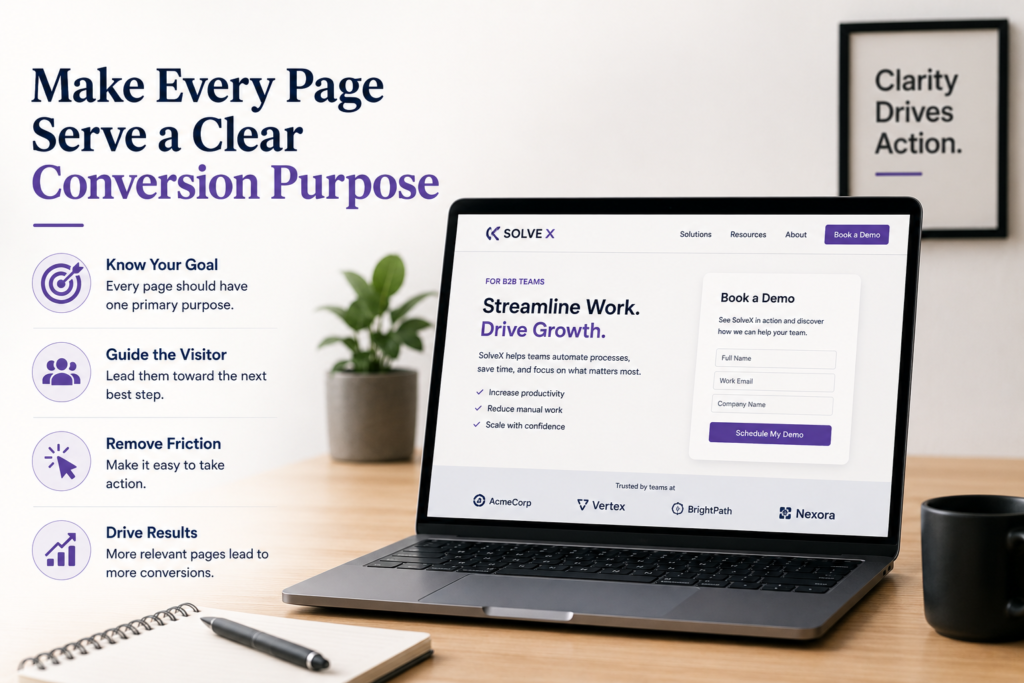
Not every visitor is ready to buy. That is why every SEO page should not push the same call to action.
Someone reading a beginner guide may not be ready to book a sales call. But they might download a checklist, subscribe to a newsletter, read a related case study, or use a free tool.
Someone comparing vendors may be more willing to request pricing, book a consultation, or view service packages.
Strong SEO lead generation depends on matching the call to action with the reader’s level of intent.
Here are a few examples:
- For awareness content, use soft CTAs such as guides, templates, newsletters, or related articles.
- For consideration content, use comparison pages, case studies, webinars, or strategy resources.
- For decision content, use consultation forms, quote requests, demos, or direct contact options.
This approach feels more natural because it respects where the reader is in the process.
It also improves conversion quality. Instead of pushing every visitor into the same form, you create multiple pathways based on interest and readiness.
This is why SEO and lead generation should not operate in separate silos. A content team may know how to attract readers, while a sales team may know how to qualify prospects, but the strongest results happen when both sides work from the same strategy. With SEO-driven content and lead generation support, businesses can build content that ranks, answers buyer questions, and gives motivated visitors a clear reason to take the next step.
Combine SEO With Conversion Optimization
SEO brings people to the page. Conversion optimization helps them take the next step.
Both are necessary.
A page can rank well and still fail if it is hard to read, slow to load, confusing to navigate, or unclear about what the business offers. Likewise, a beautifully designed landing page will not generate organic leads if nobody finds it.
For content to support lead generation, the page experience matters.
That includes:
- Clear headlines that match search intent.
- Short, readable paragraphs.
- Helpful subheadings that guide scanning.
- Internal links to relevant next steps.
- Trust signals such as testimonials, case studies, awards, or client examples.
- Calls to action placed where they make sense.
- Fast loading times and a smooth mobile experience.
- Forms that ask for only the information needed.
The best-performing SEO pages often feel simple. They do not overwhelm the reader. They answer the question, build confidence, and make the next action obvious.
Use Topic Clusters to Build Authority
One article can rank. A content ecosystem can build authority.
Topic clusters are groups of related pages organized around a central theme. A main pillar page covers a broad topic, while supporting articles explore specific subtopics in more detail.
For example, a business focused on inbound marketing might create a pillar page about “Inbound Marketing Strategy” and support it with articles on:
- SEO content planning
- Lead magnets
- Landing page optimization
- Email nurturing
- Local SEO
- B2B content funnels
- Marketing automation
- Sales-qualified lead handoff
This structure helps readers move naturally through related questions. It also helps search engines understand the depth and relevance of the website.
Internal linking is important here. Each supporting article should link back to the main pillar page where relevant, and the pillar page should guide readers to deeper resources.
Done well, topic clusters improve both rankings and lead generation. They create a stronger experience for users while signaling topical expertise.
Do Not Ignore Bottom-of-Funnel Content
Many companies publish blog posts for years but neglect the pages closest to revenue.
Bottom-of-funnel content targets readers who are actively comparing, evaluating, or preparing to make a decision. These pages often have lower search volume, but much higher commercial value.
Examples include:
- Service pages
- Industry-specific landing pages
- Comparison pages
- Alternative pages
- Case studies
- Pricing guides
- Buyer’s guides
- Use-case pages
- Location-specific service pages
For lead generation, these assets are critical.
A blog post may introduce someone to your brand. But a strong service page or case study may be what convinces them to contact you.
This is why SEO strategy should never be limited to blog publishing. It should include the entire organic conversion path, from first search to final inquiry.
Measure What Actually Matters
If the goal is lead generation, success should not be measured only by rankings or traffic.
Those metrics are useful, but they are not the finish line.
Better SEO performance tracking includes:
- Organic leads generated
- Conversion rate by landing page
- Lead quality by source
- Assisted conversions from organic content
- Keyword rankings for commercial terms
- Engagement on high-intent pages
- Form submissions, calls, demos, or consultation requests
- Revenue influenced by organic search
This helps businesses understand which content actually contributes to growth.
For example, a blog post with 500 visits and 20 qualified leads may be more valuable than a post with 10,000 visits and zero inquiries. Without lead-focused reporting, teams may continue investing in content that looks successful but does little for revenue.
Refresh and Improve Existing Content
Creating new content is important, but improving existing content can be just as powerful.
Many websites already have pages with potential. They may rank on page two, attract traffic but no leads, or cover topics that need updating.
A content refresh might include:
- Improving the introduction
- Adding missing sections
- Updating outdated information
- Strengthening examples
- Improving internal links
- Adding FAQs
- Clarifying the call to action
- Optimizing title tags and meta descriptions
- Enhancing readability
- Adding stronger trust signals
This is often faster than starting from scratch because the page may already have some authority.
A regular content audit can reveal which pages deserve updates, consolidation, expansion, or removal.
Think Beyond Traditional Search
Search behavior is changing.
People still use Google, but they also discover information through AI search summaries, social platforms, YouTube, Reddit, niche communities, and large language models. This does not make SEO less important. It makes clarity, authority, and usefulness even more important.
Content should be structured so both humans and search systems can understand it.
That means answering questions directly, using clear headings, defining key concepts, and demonstrating expertise through practical examples. It also means building a brand that is mentioned, cited, and trusted beyond its own website.
The future of SEO-driven lead generation will not reward thin content created only to rank. It will reward businesses that publish genuinely useful resources and connect those resources to a thoughtful customer journey.
Final Thoughts: Content Should Earn the Lead
The best SEO content does not trick people into converting. It earns the conversion.
It meets readers where they are. It answers real questions. It explains complex ideas clearly. It shows that the business understands the problem. And when the reader is ready, it offers a relevant next step.
That is the difference between content that gets traffic and content that generates leads.
A successful SEO-driven content strategy combines search visibility, audience insight, conversion planning, and long-term trust building. It is not about publishing more for the sake of publishing. It is about creating the right content for the right people at the right moment.
When businesses make that shift, organic search becomes more than a marketing channel.
It becomes a reliable engine for growth.