The digital economy in Saudi Arabia has undergone a rapid evolution whereby companies are gradually moving away from the practice of constantly customizing on-premises platforms towards modern cloud and subscription models.
This transition not only opens up a market space that enables stable growth for a trustworthy SaaS development company but also aims at offering flexible, scalable products. SaaS development services are a vital component of modern product strategies, enabling businesses to gain faster and more effective results of their customer-centered objectives and time to value as well as having highly reliable IT systems.
Deploying a SaaS setup required a much deeper understanding of how the cloud operates than simply hosting an app. SaaS must be secure, scalable, and built for durability. The designs include multi-tenant architectures, billing systems, self-serve processes, monitoring systems, and release pipelines.
Engaging with a top SaaS product development company or a software development company that has SaaS experience, based in Saudi Arabia, to integrate and finally implement the different functionalities that are required to make sure that the application is properly operating, will include localization issues such as Arabic-first user interfaces and moderate security standards (ISO).
The document demonstrates why Saudi entities are moving to many software development projects, further looking at large concerns of a good SaaS architecture in existence, and offering an outline that will get the potential from end to end of implementation as a fully fledged SaaS tool with the professional help of software developers.
Why SaaS adoption is accelerating in Saudi Arabia
SaaS is attractive because it converts large up-front technology projects into a continuously improving service.
Key reasons businesses are shifting to SaaS
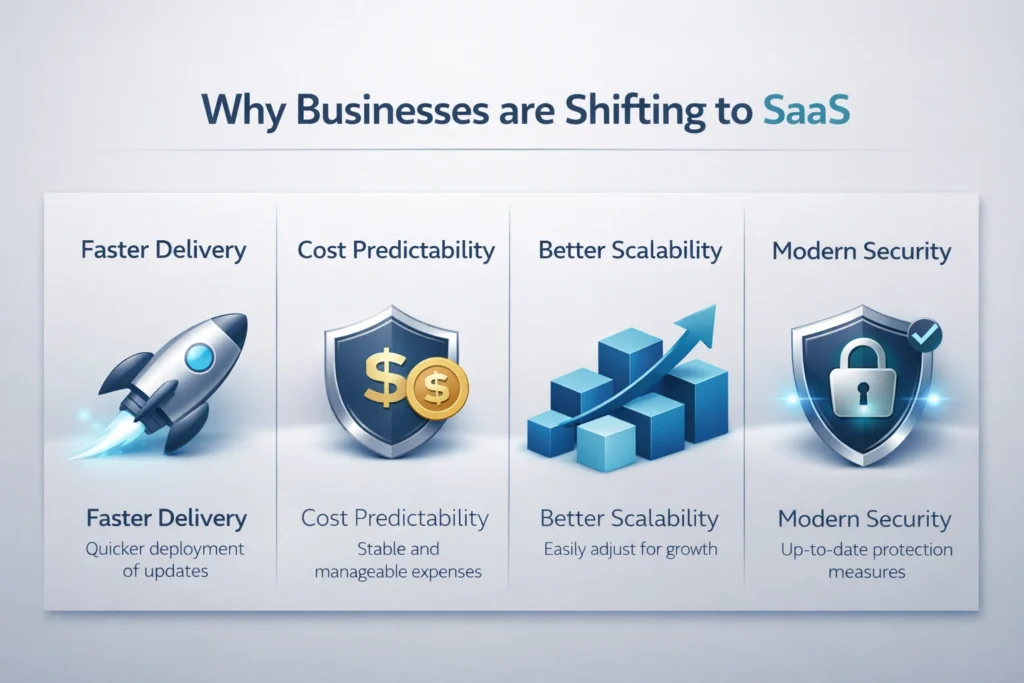
1) Faster delivery and continuous improvement
Cloud-native SaaS teams can:
- Release updates weekly (or daily) instead of quarterly
- Fix issues faster through monitoring and rollback tools
- Experiment with features using A/B testing and feature flags
2) Cost predictability and operational efficiency
SaaS can reduce total cost of ownership when it replaces:
- Heavy infrastructure maintenance
- Upgrade projects every few years
- In-house hosting, patching, and DR complexity
3) Better scalability for peak demand
Retail campaigns, national events, seasonal spikes, and rapid growth all stress systems. SaaS built on cloud services can scale:
- Compute, storage, and network capacity on demand
- Background processing for large workloads
- Global or regional access patterns
4) Security and governance modernization
Leading SaaS products bake in:
- Strong IAM and role-based access control
- Audit logs and policy-driven permissions
- Continuous vulnerability scanning and patching
SaaS vs traditional software: what changes technically?
SaaS development introduces product and engineering requirements that don’t exist in custom, single-tenant systems.
Core SaaS capabilities to plan for
- Multi-tenancy: serving multiple customers on shared infrastructure
- Tenant isolation: data separation by organization (critical for trust)
- Self-serve onboarding: sign-up, org setup, user invites, roles
- Subscription and billing: plans, upgrades/downgrades, invoices, trials
- Usage metering (for some pricing models): track API calls, seats, storage
- Observability: per-tenant monitoring and support diagnostics
- Operational tooling: admin panels, support workflows, audit trails
These needs are why “lift-and-shift to cloud” rarely produces a true SaaS platform without redesign.
SaaS architecture options: choosing the right foundation
There’s no one-size-fits-all architecture, but there are proven patterns.
1) Tenancy model: single-tenant vs multi-tenant
Multi-tenant (shared app + shared database with tenant keys)
Best for:
- Cost efficiency
- Faster onboarding
- Simpler operations at scale
Trade-offs:
- Higher demands for data isolation correctness
- Requires strong schema design and authorization discipline
Single-tenant (separate environment per customer)
Best for:
- Very large enterprise customers
- Highly regulated environments with strict isolation needs
Trade-offs:
- Higher ops overhead and cost
- Harder to maintain consistent versions across tenants
Many teams use a hybrid approach: multi-tenant by default, single-tenant for premium/regulatory cases.
2) Backend approach: modular monolith vs microservices
For early-stage products, a modular monolith often wins:
- Faster development
- Easier deployments
- Clear boundaries for future scaling
Microservices can help later when:
- Teams grow and need independent release cycles
- Specific domains have heavy scaling needs
- Reliability requirements demand fault isolation
3) Data strategy: operational data + analytics
A SaaS product should plan two data paths:
- Operational: transactions, user actions, system state
- Analytical: product usage, cohorts, retention, business intelligence
If analytics is an afterthought, teams struggle to understand churn and adoption drivers later.
Security and compliance: must-haves for SaaS in Saudi markets
Trust is a growth lever in SaaS. Customers won’t adopt systems that feel risky.
Practical security foundations
- Strong authentication (SSO for B2B, MFA options)
- Role-based access control and least-privilege permissions
- Secure secrets management (no credentials in code)
- Encryption in transit and at rest
- Audit logs for admin actions and sensitive operations
- Vulnerability scanning and dependency management
Operational security discipline
- Incident response playbooks
- Backups, restore testing, and disaster recovery planning
- Observability (alerts, dashboards, tracing)
- Regular security reviews and penetration testing as you scale
The SaaS development roadmap
Here’s a practical delivery flow that works for both startups and enterprise product teams.
1) Discovery: define your SaaS product strategy
Focus on:
- Target segment (SMBs, mid-market, enterprise)
- Problem statement and differentiators
- Pricing assumptions and packaging hypotheses
- MVP scope and success metrics
2) Experience design: build for onboarding and retention
SaaS success depends on activation. Design should include:
- Onboarding flows and “first value” moments
- Clear navigation and information architecture
- Error states and guidance (to reduce support load)
- Localization strategy (Arabic/English) if relevant
3) Engineering foundations: tenancy, IAM, CI/CD, observability
Before you scale features, ensure:
- Tenancy model is implemented correctly
- Authorization is consistent across all endpoints
- Deployments are automated and repeatable
- Monitoring and logs support debugging per tenant
4) Build the MVP features that drive adoption
Prioritize workflows that:
- Solve the main pain point
- Create repeat usage
- Provide clear ROI for decision makers
5) Launch with controlled rollout
Use:
- Pilot customers and early adopter cohorts
- Feature flags and staged releases
- Feedback loops (support + product analytics)
6) Scale: performance, reliability, and product expansion
As usage grows, invest in:
- Performance budgets and load testing
- Cost optimization (cloud spend governance)
- Support tooling and customer success workflows
- New integrations that increase stickiness
Pricing and packaging considerations for SaaS
Pricing is part product strategy, not a last-minute decision.
Common SaaS pricing models
- Per seat: predictable for collaboration products
- Tiered plans: starter/pro/enterprise packaging
- Usage-based: metered consumption (API calls, storage, transactions)
- Hybrid: base subscription + usage add-ons
A practical packaging approach
- Start with 2–3 tiers to reduce complexity
- Keep upgrade paths clear and self-serve where possible
- Align features with customer value, not internal development effort
Common mistakes when moving to SaaS (and how to avoid them)
Mistake: Treating SaaS as “a hosted custom app”
Avoid it by designing tenancy, billing, onboarding, and operations from the start.
Mistake: Underinvesting in reliability and support tooling
Avoid it by implementing observability, alerts, runbooks, and admin tools early.
Mistake: Overbuilding features before validating adoption
Avoid it by focusing on activation and retention metrics and learning from cohorts.
Mistake: Weak authorization boundaries
Avoid it by centralizing authorization logic, using consistent patterns, and testing tenant isolation.
Conclusion
In Saudi Arabia, the use of SaaS is progressing rapidly due to rapid technological advancements, demand-based scalable solutions, and the need for operational harmonization in companies.
Many companies work with a SaaS development company to be fiercely competitive, essentially evaluating their business models to reflect on the issue of a buyer: how they buy and use services; how they would be kept satisfied, how they would support whatever they choose, and trust in what they buy?
The rapidly changing face is measured by means of expert SaaS development services and made to agree on real-time feedback.
Whenever startups are developing a new platform or replacing the ancient tools with a SaaS solution, they usually seek out the best SaaS development firm or a dependable SaaS development agency in Saudi Arabia. These enterprises value multi-tenancy, reliability, continuous delivery, and the importance of delivering beyond features and market needs. With good foundational elements, they can smoothly and efficiently take solutions to market, meeting deadlines and scaling with growing customer demand.