The topic of blockchain is discussed all the time, and the majority of the discussion remains abstract. The concepts of decentralization and trustless systems are impressive-sounding and leave many people wondering what it means in practice.
Smart contracts are one of the most apparent answers to this question. They are self-executable code snippets stored on a blockchain that will automatically execute when some conditions are met. There is no intermediary, no paperwork, and no waiting on a third party.
Some of the locations where smart contracts are already being applied in real-life use in 2026 in different industries are listed below.
Banks-less Finance and Lending
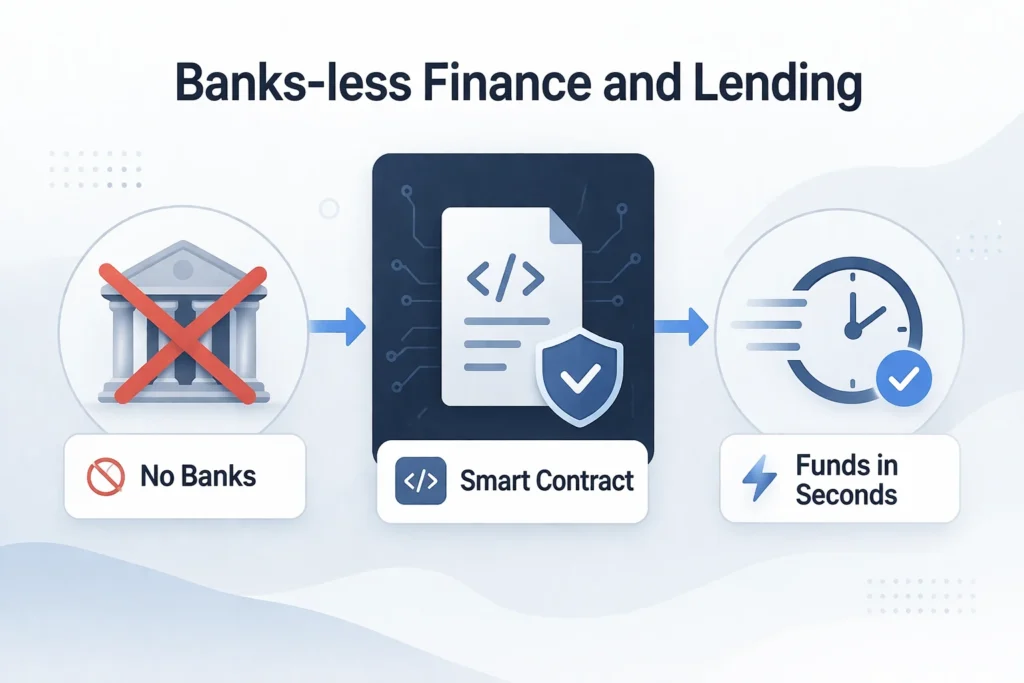
Currently, the most advanced use of smart contracts may be the decentralized finance, or DeFi.
Conventional lending is a process that entails banks, credit checks, paperwork, and waiting days. But DeFi uses a lending protocol based on smart contracts.
The borrower promises crypto as security, the contract will automatically review the value and the funds will be released within a couple of seconds. At a certain point at which the collateral is lower than a pre-set limit, the contract will automatically liquidate the position – no human needed.
Early in 2026, Aave became the first protocol to surpass a cumulative loan volume of over $1 trillion. The terms of the loan along with the interest rate and the liquidation rules are contained in the contract and are viewable to anyone.
Supply Chain Tracking
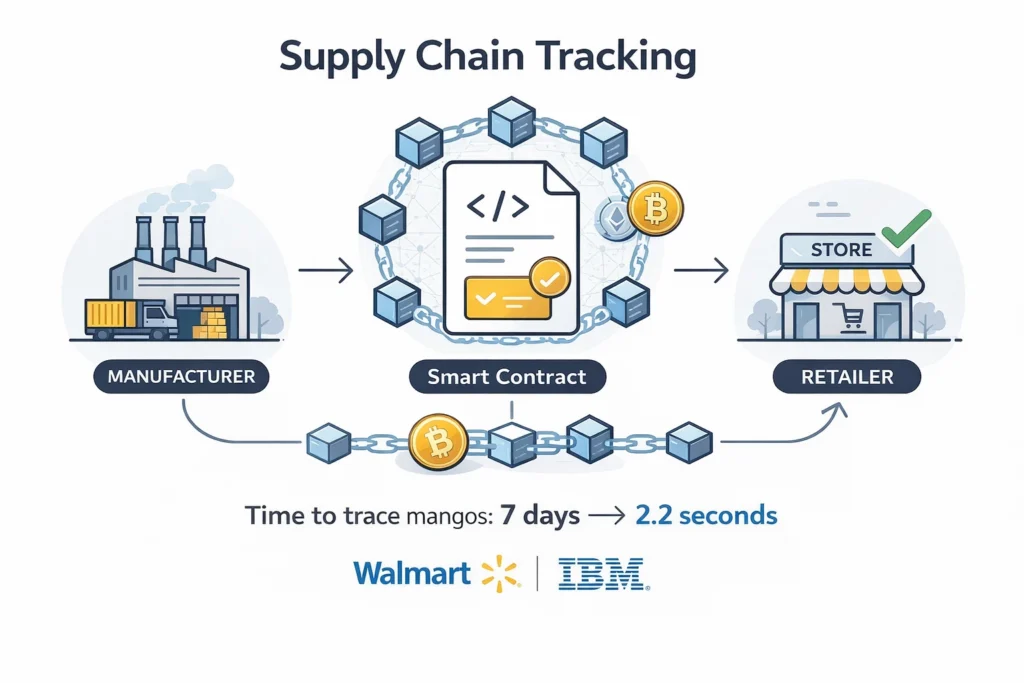
A smart contract on a blockchain can be implemented to record every step taken during the shipment of a product between the manufacturer, warehouse and retailer.
The contract can either automatically lead to a payment to a supplier upon confirmation of delivery or show a discrepancy if the recorded data is outside acceptable limits.
Walmart has experimented, in collaboration with IBM, on Hyperledger Fabric food traceability. The process of tracking the origin of mangos was reduced from almost seven days to 2.2 seconds – a difference that is invaluable in the case of a food safety problem, where every minute counts.
Internet Gambling and Gaming Websites
The traditional online casinos are operated on private servers. Players must have faith that the random number generator has not been manipulated. It lacks an independent checking.
Smart contracts change this. Results of a game are produced and encrypted cryptographically prior to making a bet, and can be checked afterwards.
This is referred to as provably fair gaming, and is currently a common offering on numerous Ethereum gambling websites that run on smart contract infrastructure. Payouts are also automatic in the sense that they automatically get carried out after a result is established.
Insurance Claims
One of the most friction-ridden industries is insurance. But parametric insurance based on smart contracts works differently. Instead of someone making an evaluation on a claim, the contract is based on a third party source of data and will automatically pay out when a predefined condition is met.
One such product is FlightDelay, provided by Etherisc, which is automatically paid when a flight is late with a delay exceeding 45 minutes – no claim form or phone call is required.
The contract checks flight data, and payment is made directly to the policyholder’s wallet. Etherisc has also come up with crop insurance for smallholder farmers in Kenya where the payouts are automatic depending on weather information in the case of droughts.
Digital Rights and Royalties
Smart contracts provide a less polluted approach to royalty distribution as well. Some platforms, such as Royal, have developed a structure where artists could sell tokenized rights to streaming royalties of a song, directly to fans, cutting out the label intermediaries in the process, with the smart contract keeping track of ownership and paying them off.
Artists like Nas and Diplo have used the platform, and the model has been in a position to influence how the rest of the music industry handles the concept of direct artist compensation.
What Needs Improvement?
Smart contracts are not perfect. Should the code contain a bug, it cannot be patched up easily – undiscovered bugs have drained millions of dollars out of DeFi protocols. Smart contracts do not have a connection to real-life data, but require third-party data feeds – oracles, which are vulnerable.
In real-world software systems, these types of risks are addressed in secure development practices, particularly in blockchain and automated systems.
And it is doubtful whether these contracts are enforced in the court. A written code contract does not equate to a legally binding contract, not yet anyway.
Final Thoughts
Smart contracts have real-life applications. The examples listed above are now running, and using real money and real transactions. The technology is not fully developed and the risks exist and as such, developers need to be careful.
But the trend is evident. Smart contracts are being used to substitute slow, manual, trust-based processes in industry after industry with fast, automated, verifiable processes. That is a significant change, regardless of the amount of hype surrounding crypto.